
- 50% reduction in procurement-related support tickets within the first year of use
- 1,000% week-over-week surge in user adoption in some organizations
- Supports 28 languages for plain-language queries
Experts view JAI as a transformative tool for corporate procurement, shifting from reactive support to proactive, AI-driven self-service that enhances efficiency and compliance.
JAGGAER's JAI Aims to Revolutionize Corporate Procurement with AI
RESEARCH TRIANGLE PARK, N.C. – May 05, 2026 – Global procurement software leader JAGGAER has officially launched JAI, an artificial intelligence assistant designed to fundamentally reshape how companies manage corporate spending. The new tool embeds AI directly into daily workflows, promising to make the often-complex process of buying goods and services faster, more intelligent, and significantly less frustrating for employees.
Early results from pilot customers are already painting a compelling picture of JAI's potential impact. The company reports an expected 50% reduction in procurement-related support tickets within the first year of use, coupled with measurable time savings across more than 40 distinct workflows. In some organizations, user adoption has reportedly surged by as much as 1,000% week-over-week, signaling that employees are rapidly discovering its utility and integrating it into their daily routines.
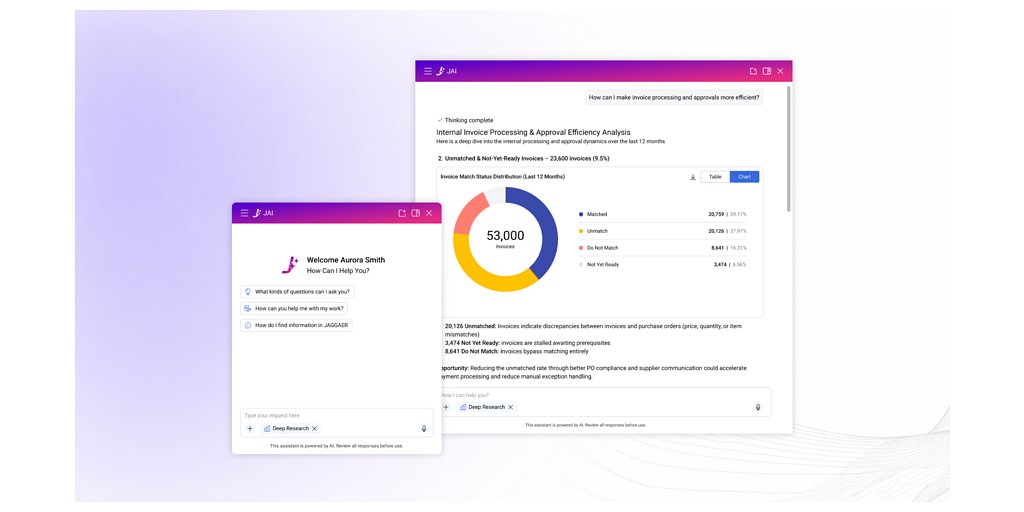
At its core, JAI functions as a knowledgeable colleague who is perpetually available. It is designed to understand a company's intricate purchasing rules, supplier agreements, and contract details, providing instant answers to common employee questions. This shift moves procurement support from a reactive, ticket-based model to a proactive, self-service paradigm.
The End of the Help Desk Ticket?
In most large organizations, the procurement process is fraught with simple but time-consuming questions. Employees frequently need to ask, "Do I need approval to buy this?" or "Who is our preferred supplier for office equipment?" Historically, finding these answers involved navigating dense internal portals, interrupting a colleague, or opening a help desk ticket and waiting for a response. This friction not only slows down operations but also leads to employee frustration and potential non-compliant spending.
JAI addresses this bottleneck directly. Employees can type questions in plain language—across any of 28 supported languages—and receive an accurate, policy-compliant answer in seconds. This eliminates the wait times and administrative overhead associated with traditional support channels.
A large financial institution participating in the early access program described the immediate benefits. “As a financial institution, we're beholden to very high standards from both a regulatory and a contractual standpoint,” a representative noted. “In practice, this means that Supply Chain teams need to reference and adhere to a complex set of principles. These are set out across different guides that range from risk standard handbooks to sourcing guides, often located in different places or outside the internal system, making the reference process difficult.”
The institution found that JAI created a unified, searchable view of these disparate standards. “By creating a unified view of all these standards, users can find the answers to their questions, rapidly and efficiently, without exiting the system,” the statement continued. “The time savings and accuracy of the detail we’re seeing in the Early Access phase is already a huge win.”
Beyond Q&A: Contextual AI and Data Security
JAGGAER emphasizes that JAI is not a general-purpose chatbot. Its power lies in its contextual awareness, which is achieved by grounding its knowledge exclusively on a company's own internal documents, data, and policies. Unlike AI models trained on the vast, uncontrolled expanse of the public internet, JAI's responses are tailored, relevant, and reliable because they are derived from the organization's single source of truth. This approach, often referred to as Retrieval-Augmented Generation (RAG), is critical for delivering trustworthy information in a high-stakes corporate environment.
This architecture also directly addresses one of the biggest enterprise concerns surrounding AI: data security. JAI is built to inherit and respect the same security protocols and access controls already established within the JAGGAER One platform. This ensures that employees can only see information and data they are authorized to view, preventing sensitive financial or contractual details from being exposed inappropriately.
Beyond answering questions, JAI's capabilities extend into proactive data analysis. The AI can dig deep into spending data to surface insights that once required hours of work from dedicated analysts. It can automatically identify areas where money is being spent outside of approved channels, flag suppliers that may pose a risk to the supply chain, and pinpoint opportunities for cost reduction and contract consolidation. This transforms the AI from a simple Q&A tool into a strategic analytical partner.
Navigating a Crowded AI Landscape
JAGGAER's launch of JAI comes as the enterprise software market is rapidly embracing artificial intelligence. Major competitors in the source-to-pay space, including SAP Ariba, Coupa, and Ivalua, have all been integrating AI into their platforms to automate tasks, analyze spend, and manage risk. The competitive differentiator, therefore, lies not in simply having AI, but in how it is implemented and the strategic vision it serves.
JAGGAER is positioning JAI as more than just another feature; it is an “intelligence layer” woven into the fabric of its entire platform. The company's vision for an “agentic AI” model suggests a system that can orchestrate multiple tools and processes to achieve broader business objectives, moving beyond single-task automation. This approach aims to provide a more holistic and integrated experience, where the AI acts as a central coordinator for complex procurement activities.
This strategy is evident in JAI's immediate availability and rapid deployment, which allows a company to have the system running on the same day it is purchased. This focus on ease of adoption is designed to lower the barrier for organizations looking to quickly leverage AI to solve pressing business challenges.
A Stepping Stone to 'Autonomous Commerce'
JAI is a cornerstone of JAGGAER's larger strategic vision for “Autonomous Commerce”—a future state where procurement and supply chain processes become an intelligent, self-governing system that learns and adapts over time. This vision seeks to elevate the role of human procurement professionals from transactional managers to strategic overseers.
“Procurement has always been about making smart decisions with limited time and information. JAI changes that equation entirely,” said Andrew Roszko, CEO of JAGGAER. “It is embedded into the core platform and actually earns trust - it knows your business, respects your rules, and gives you answers you can act on. This is just the beginning.”
The company has outlined a clear multi-stage roadmap for JAI's evolution. The current “JAI Assist” phase focuses on conversational guidance and task initiation. This will be followed in 2025 by “JAI Copilot,” which will offer more advanced contextual support and proactive suggestions across sourcing and supplier management. The final planned stage, “JAI Autopilot,” envisions a low-code agentic AI platform capable of autonomously managing entire complex workflows, from forecasting and spend management to contract handling, all orchestrated through a unified interface.
As JAI evolves, it is expected to take on increasingly sophisticated responsibilities, such as continuously monitoring contracts for risk, initiating renegotiations, and even scanning for external market signals like supply disruptions to trigger corrective actions. This progression marks a significant step toward a future where enterprise systems not only provide insights but also act on them, fundamentally changing the nature of strategic procurement.