
- $1.8 billion: Pre-money equity valuation of IQM's Nasdaq listing via SPAC merger.
- 23 quantum computers sold: IQM claims global leadership with 18 already delivered.
- $450 million: Capital infusion from SPAC deal, including PIPE financing.
Experts would likely conclude that IQM's Nasdaq listing represents a high-stakes bet on quantum computing's commercial viability, with strong institutional backing but significant risks inherent to the SPAC process and the nascent quantum sector.
IQM's Quantum Gamble: From Finnish Labs to a Nasdaq Listing
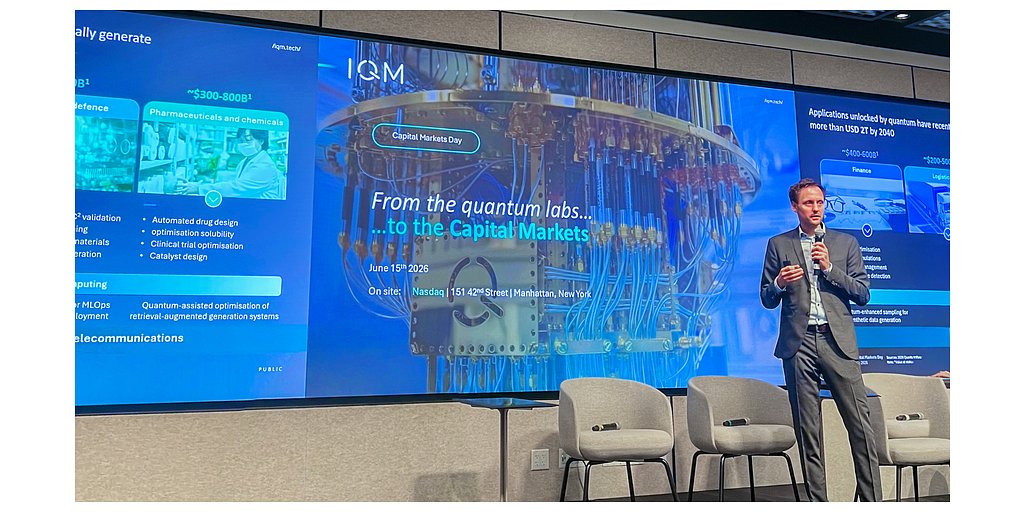
NEW YORK, NY – June 17, 2026 – In the heart of New York City, inside the Nasdaq MarketSite, the abstract world of quantum mechanics met the concrete reality of capital markets. IQM Quantum Computers, a Finnish-led pioneer, hosted its inaugural Capital Markets Day last week, laying its strategy bare for investors and analysts ahead of a pivotal public listing. The event marks a critical inflection point, not just for the company, but for the entire quantum computing sector as it navigates the treacherous path from laboratory theory to commercial viability.
IQM is on the brink of merging with Real Asset Acquisition Corp. (RAAQ), a special purpose acquisition company, in a deal that would take it public on the Nasdaq under the ticker 'IQMX'. This move could make IQM the first European quantum computing firm listed on a major U.S. exchange, a significant milestone that speaks volumes about the global race for technological supremacy. But as the company steps into the unforgiving spotlight of public markets, the central question is whether this quantum leap is a calculated strategic masterstroke or a high-stakes bet on a future that is not yet fully formed.
The Billion-Dollar SPAC Bet
The financial architecture of IQM's public debut is as complex as the technology it sells. The business combination with RAAQ values the company at a pre-money equity valuation of approximately $1.8 billion. The transaction is designed to inject over $450 million in liquidity, a war chest cobbled together from RAAQ's trust account, an upsized $146 million PIPE financing round, and IQM's own significant cash reserves. This capital is crucial for a company operating in a field where development costs are astronomical and profitability remains a distant horizon.
However, the SPAC route is fraught with peril. The quantum sector has seen other players like Rigetti and IonQ go public via SPACs with mixed results, often experiencing high volatility and sensitivity to investor sentiment. The ultimate cash infusion for IQM hinges on the RAAQ shareholder vote scheduled for June 25, specifically on the rate of share redemptions. A high redemption rate could significantly shrink the available capital, a common risk that has plagued many SPAC deals in recent years. Still, IQM's deal has garnered momentum, bolstered by the upsized PIPE—a sign of strong institutional confidence—and strategic board appointments aimed at navigating the rigors of being a public entity.
A Differentiated Strategy in a Crowded Field
What sets IQM apart in a field populated by giants like IBM and Google, and specialized players like Quantinuum and Rigetti? The company's core strategy revolves around a key differentiator: its on-premises deployment model. While many competitors focus on providing quantum access through the cloud, IQM physically sells and installs full-stack superconducting quantum computers directly at customer sites. This approach has proven highly attractive to its target market of research institutions, universities, and national laboratories, which prioritize data security, direct control, and hands-on integration with their existing high-performance computing infrastructure.
The company claims to have sold 23 quantum computers to date, with 18 already delivered and installed everywhere from European supercomputing centers to, most recently, the prestigious Oak Ridge National Laboratory in the United States. This metric, which IQM asserts makes it the global leader in quantum system sales, is a powerful validation of its business model. By building the hardware, designing the chips in-house, and assembling the full system, IQM's vertically integrated approach allows for a level of quality control and rapid innovation that is difficult to replicate. While superconducting technology requires extreme cooling and faces noise challenges, its scalability and fast gate speeds make it a leading contender for building the powerful quantum machines of the future.
From Lab to Market: Quantum's Commercial Dawn
The timing of IQM's public debut coincides with a broader shift in the quantum industry. The year 2026 is increasingly seen as the beginning of quantum's industrialization phase, where the technology begins to deliver tangible value beyond the research lab. Early applications are emerging in sectors like finance for portfolio optimization, logistics for route planning, and, most promisingly, in materials science and drug discovery, where quantum computers can simulate molecular interactions with an accuracy impossible for classical machines.
IQM has astutely positioned itself within this evolving ecosystem through strategic partnerships with giants like NVIDIA and Amazon Web Services (AWS), whose leaders shared the stage at its Capital Markets Day. These collaborations are essential for building the hybrid classical-quantum workflows that will dominate the near term, allowing quantum processors to tackle specific problems while integrated into larger, familiar computing frameworks. While widespread commercial viability for most enterprises is likely still a decade away, the groundwork is being laid now. The global quantum market is projected to grow at over 30% annually, creating a powerful tailwind for companies that can establish an early commercial foothold.
Europe's Quantum Champion Goes Global
IQM's journey to the Nasdaq is a story of more than just one company's ambition; it is a barometer for Europe's standing in the global technology race. For years, Europe has boasted world-class quantum research but has often struggled to translate that academic prowess into industrial leadership, frequently losing promising startups to the deeper capital pools of the United States. IQM's potential listing, coupled with a possible dual listing in Helsinki, represents a new model: a European champion leveraging U.S. markets to scale globally while retaining its continental roots.
This move comes as Brussels ramps up its own efforts through initiatives like the Quantum Technologies Flagship and a forthcoming EU Quantum Act, designed to build a sovereign and resilient quantum ecosystem. In a world where quantum capability is becoming a geopolitical imperative, IQM's success is intertwined with Europe's strategic autonomy. As the company prepares for its shareholder vote, its trajectory places it at the center of a grand convergence of speculative finance, deep technology, and the international contest for the future of computing.