
- First-ever robot-run CES booth: IntBot's Nylo will operate Booth #9377 entirely alone for the first day of CES 2026.
- 50+ languages: Nylo is capable of speaking over 50 languages, enabling broad accessibility in commercial settings.
- 2030 market projection: The social robotics market is expected to grow into a multi-billion dollar industry by 2030.
Experts would likely conclude that IntBot's experiment represents a significant milestone in the development of autonomous social AI, demonstrating its potential for real-world applications while highlighting the challenges of deploying such technology in unpredictable environments.
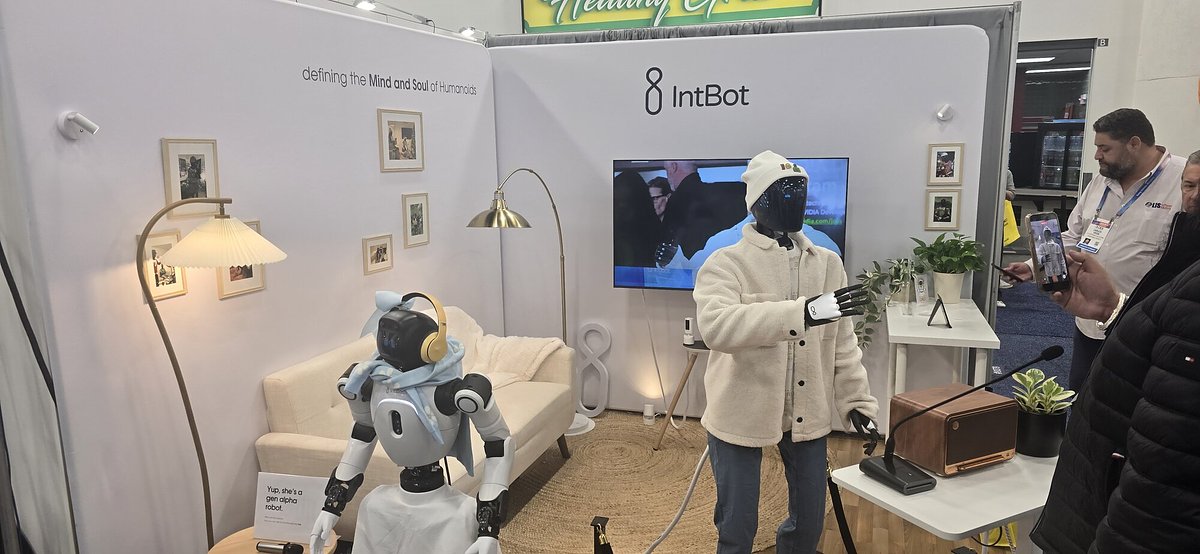
IntBot's Robot Runs a CES Booth Solo in a Bold Test of Social AI
LAS VEGAS, NV – January 05, 2026 – Amid the dazzling lights and cacophony of the Consumer Electronics Show (CES), one booth in the North Hall is preparing for an unprecedented experiment. Social robotics firm IntBot has announced that its flagship humanoid robot, Nylo, will operate its exhibit entirely alone for the first day of CES 2026, a bold demonstration intended to prove that autonomous social AI is ready for the real world.
For a full day, Nylo will be the sole exhibitor at Booth #9377. It will be tasked with greeting a torrent of attendees, proactively initiating conversations, answering complex questions, and navigating the unpredictable social dynamics of the world's largest technology trade show—all without a human operator in sight. The move is a high-stakes gamble, shifting robotics from carefully choreographed demonstrations to a live, unscripted public trial.
An Unprecedented Challenge
While CES is no stranger to robotic showcases, IntBot’s demonstration marks a significant departure from the norm. Many robotics companies, including AGIBOT and Hyundai's Boston Dynamics, are presenting advanced humanoids this year, but these often involve scripted routines or are part of larger, human-managed presentations. IntBot’s claim of a completely unmanned booth, run by a single autonomous agent for an entire day, appears to be a first for a major trade show.
The challenge is immense. A trade show floor is a chaotic environment rife with unpredictable crowds, ambient noise, and a wide spectrum of human behaviors. For Nylo to succeed, it must do more than just recite pre-programmed information. It will need to perceive social cues, manage multiple simultaneous interactions, and make independent decisions about who, when, and how to engage.
This live trial is the core of IntBot's message: social autonomy is no longer a laboratory concept. By placing its technology in one of the most demanding public settings imaginable, the company is making a definitive statement about the maturity of its platform and its readiness for commercial deployment in human-centric spaces.
The 'Physical Agent' Arrives
At the heart of this demonstration is IntBot's vision of a new technological paradigm. "We are moving from Digital AI to Physical Agents," said Lei Yang, CEO of IntBot, in the company's announcement. "Digital intelligence is powerful, but it has largely remained virtual. Nylo is the interface that allows AI to step into human spaces and interact with us on human terms."
This concept of a "Physical Agent" or "Embodied AI" represents the next frontier for artificial intelligence, moving it beyond screens and servers and into robots that can perceive, understand, and act within the physical world. Powering Nylo's capabilities is IntEngine, the company's proprietary social intelligence system. IntEngine is a multimodal AI that fuses data from vision, audio, and language models in real time. This integration allows the robot to coordinate its speech, facial expressions, and gestures to respond naturally and contextually.
Crucially, the system is designed not just to react, but to decide. Its multi-loop architecture reportedly enables Nylo to process the surrounding social context and autonomously initiate engagement, a key differentiator from purely responsive AI systems and a vital skill for operating in an open-floor environment like CES.
From Hotels to the Trade Show Floor
While the CES booth is Nylo’s most ambitious public test to date, it is not its first. The robot reportedly served as an AI information desk at NVIDIA’s GTC 2025 conference, interacting with thousands of attendees. That experience, along with IntBot's existing commercial deployments, forms the foundation for this week's experiment.
Founded in 2024, the early-stage startup has already deployed its robots in the hospitality industry. In these settings, the robots act as a "social-native" extension of hotel staff, welcoming guests, assisting with check-in, and answering routine questions about amenities and local attractions. Capable of speaking over 50 languages, they are designed to handle repetitive inquiries, freeing human employees to focus on more complex, high-touch guest services.
This strategy of testing and refining its technology in real-world commercial environments like hotels provides a crucial feedback loop. An administrative portal allows human operators to monitor interactions, review conversation logs, and update the robot's knowledge base, continuously improving its performance. This background in a live service industry lends credibility to IntBot's claim that Nylo is more than just a prototype; it's a commercial-grade agent being pushed to its limits.
A New Era of Human-Robot Interaction
IntBot's demonstration is part of a much larger industry trend. 2026 is widely seen as a pivotal year for embodied AI, as a wave of companies race to move their creations from research labs into practical, real-world applications. The social robotics market is projected to grow into a multi-billion dollar industry by 2030, fueled by advances in AI, falling hardware costs, and pressing demand in sectors facing labor shortages.
The field is becoming increasingly crowded and well-funded. Competitors like Figure AI, backed by major tech players including NVIDIA and Jeff Bezos, and 1X Technologies, supported by OpenAI, are developing humanoids for logistics and manufacturing. This broader industry push, focused on creating "universal robot brains" and foundational models for robotics, underscores the significance of IntBot’s focus on social intelligence.
As these highly autonomous physical agents begin to enter public squares, workplaces, and service environments, they raise profound questions about the future of work and society. Will they be colleagues or challengers? The integration of robots like Nylo prompts discussions around job displacement, the nature of human-robot trust, and the ethical responsibilities of their creators. Regulatory frameworks are also catching up, with measures like the EU AI Act set to govern the deployment of high-risk AI systems later this year.
IntBot's open invitation to CES attendees to interact with Nylo is more than just a product demo; it's an invitation to participate in a live social experiment. The results, successful or not, will provide invaluable data on the current capabilities and limitations of social AI and offer a compelling glimpse into a future where humans and intelligent machines coexist and collaborate in shared spaces.