
- Up to 125 GB/s throughput and 2.4 million IOPS with NVMe SSDs
- Up to 20 petabytes of scalable capacity with HDDs
- Over 50% cost reduction compared to all-flash deployments
Experts would likely conclude that Infortrend's hybrid storage solution offers a cost-effective and high-performance alternative for managing AI and HPC data, balancing speed and scalability to address the growing challenges of data management in modern enterprises.
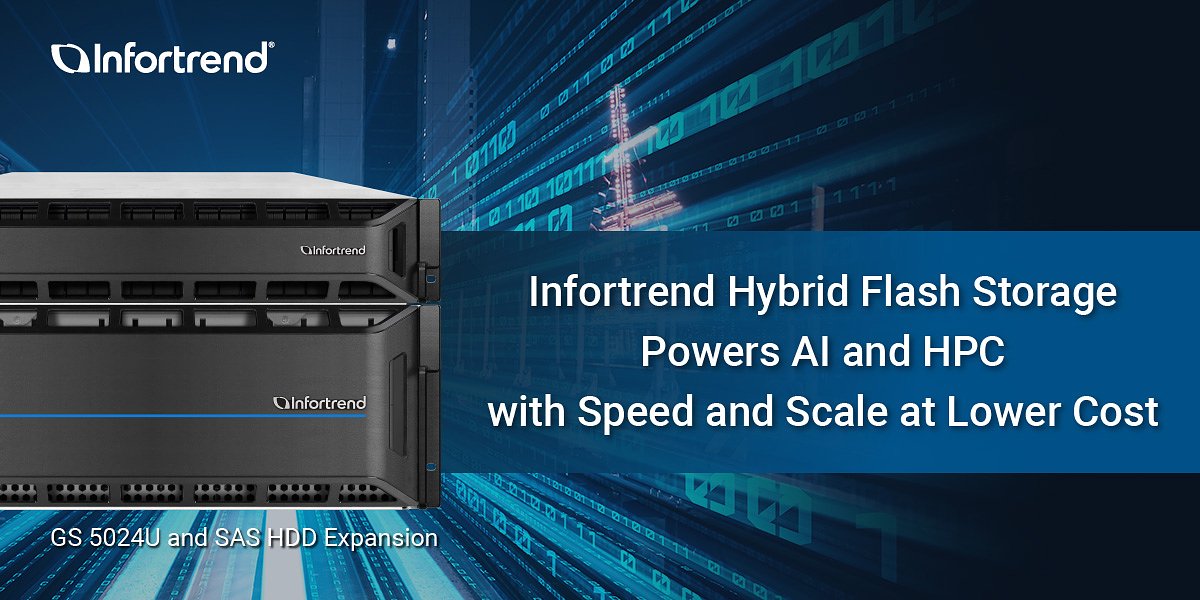
Infortrend's Hybrid Storage Aims to Tame AI Data Costs
TAIPEI, Taiwan – February 24, 2026 – As artificial intelligence, high-performance computing (HPC), and intelligent surveillance applications generate data at an unprecedented rate, organizations are increasingly caught in a costly tug-of-war between performance and capacity. Addressing this critical infrastructure challenge, enterprise storage provider Infortrend Technology has unveiled its flagship EonStor GS 5024U, a hybrid flash storage system designed to deliver extreme performance for active workloads while offering massive, cost-effective scalability for ever-growing data repositories.
The announcement positions the new system as a direct answer to the dilemma facing modern data centers: how to affordably manage petabytes of data without sacrificing the high-speed access required for cutting-edge computational tasks.
The High Cost of the Data Deluge
Enterprises at the forefront of innovation are grappling with a data explosion. AI training models ingest vast datasets, HPC simulations generate terabytes of output in minutes, and smart city surveillance networks capture continuous streams of high-resolution video. These applications demand the near-instantaneous response times of all-flash storage, particularly Non-Volatile Memory Express (NVMe) solid-state drives (SSDs), to avoid bottlenecks and keep expensive processors fully utilized.
However, building and scaling storage infrastructure entirely on high-performance flash media is a financially prohibitive strategy for the multi-petabyte capacities these fields now require. A full petabyte of enterprise-grade NVMe storage can represent a staggering capital investment, making a 20-petabyte all-flash solution an economic non-starter for all but the most well-funded organizations.
Conversely, relying on traditional hard disk drives (HDDs) alone, while cost-effective for bulk capacity, fails to provide the necessary throughput and low latency. This performance gap can leave multi-million dollar GPU clusters idle, waiting for data, effectively negating the investment in advanced computing hardware. This has created a significant market need for a middle ground—a solution that intelligently combines the best of both worlds.
A Hybrid Blueprint for Performance and Scale
Infortrend's EonStor GS 5024U is engineered to be that middle ground. At its core, the system is a unified storage platform built on a sophisticated hybrid architecture. It leverages the latest in high-speed interconnects and processor technology, featuring an Intel Xeon 6 processor, PCIe 5.0 support, and networking capabilities up to 200GbE with NVMe over Fabrics (NVMe-oF) for low-latency data access.
The system's performance tier is built around U.2 NVMe SSDs, delivering blistering speeds claimed to reach up to 125 GB/s in throughput and 2.4 million IOPS. This raw power is designed to house "hot" data—the active datasets currently being used for AI model training, real-time analytics, or HPC computations. The inclusion of NVIDIA's GPUDirect Storage technology further optimizes this process by allowing GPUs to directly access data on the NVMe drives, bypassing the CPU to reduce latency and maximize GPU efficiency.
Where the GS 5024U's strategy diverges from all-flash arrays is in its approach to capacity. Rather than forcing customers to pay a premium for flash to store their entire data lake, the system can scale up to 20 petabytes by adding expansion enclosures filled with cost-effective HDDs. An automated tiering engine intelligently and transparently moves data between the tiers. As data ages or becomes less frequently accessed—for example, a completed AI training run or archived surveillance footage—it is automatically migrated from the expensive NVMe tier to the high-capacity HDD tier, freeing up high-performance space for new, active workloads.
Deconstructing the Cost-Saving Equation
The company boldly claims this hybrid approach can reduce storage costs by over 50% compared to equivalent all-flash deployments. While specific pricing is deployment-dependent, the logic behind the claim is grounded in the vast price disparity between storage media. The strategy is to use the right tool for the right job: premium, high-cost flash for the small percentage of data that needs it, and low-cost bulk storage for the vast majority that does not.
Further enhancing this cost-efficiency is the system's support for Quad-Level Cell (QLC) SSDs. QLC technology offers higher storage density and a lower cost-per-gigabyte than the more common Triple-Level Cell (TLC) flash, but typically with lower write endurance. In the GS 5024U's tiered architecture, QLC drives can serve as a "warm" tier—a middle ground for data that is no longer hot but needs faster access than HDDs can provide. This allows organizations to keep more data on flash for quicker retrieval without paying the full price of high-endurance NVMe drives.
"GS 5024U combines high-speed access for active workloads with cost-efficient capacity for large datasets through a hybrid storage architecture," said Frank Lee, Senior Director of Product Planning at Infortrend Technology, in the company's press release. "The solution can deliver up to 100 GB/s throughput using HDDs only, further optimizing costs for large-scale projects." This statement highlights the system's ability to pull impressive performance even from its capacity tier, ensuring that even archived data remains highly accessible.
Meeting the Market Where It's Headed
Infortrend is entering a competitive field populated by storage giants like Dell EMC, NetApp, and Pure Storage, all of whom offer solutions for AI and HPC. However, by focusing intently on a high-performance hybrid model that aggressively targets the total cost of ownership (TCO), the company is carving out a distinct position. While all-flash solutions from competitors offer simplicity and raw performance, Infortrend is betting that for many organizations, budget realities will make a balanced, tiered approach the more pragmatic and sustainable choice.
The market trends support this strategy. As data volumes continue their exponential growth, the economic pressure to store that data intelligently will only intensify. Solutions that can deliver performance without demanding an all-or-nothing investment in the most expensive technology are well-positioned for success. By providing a flexible platform that allows organizations to scale performance and capacity independently while leveraging multiple tiers of storage media, Infortrend's EonStor GS 5024U presents a compelling argument that the future of large-scale data management is not just about speed, but about smart, cost-effective balance. The ability to harness the power of AI and HPC is increasingly tied to the ability to affordably manage the data that fuels them, making such hybrid systems a critical enabler of innovation.