
- 4-8%: Transaction costs for traditional international payments, often due to intermediary bank fees and poor exchange rates.
- 3-5 business days: Typical settlement time for traditional cross-border payments.
- 2025: Projected year when the number of FINTRAC-registered virtual currency providers in Canada could double.
Experts would likely conclude that Infini's Canadian MSB registration represents a strategic move to bridge traditional finance and cryptocurrency, addressing key pain points in cross-border payments while prioritizing compliance and security.
Infini's Canadian License Signals New Era for Enterprise Crypto Finance
HONG KONG – May 01, 2026 – Infini, an AI-powered financial technology firm, has secured a key regulatory registration in Canada, a move that highlights a critical shift in the digital asset landscape: the intense race to build compliant, enterprise-grade bridges between traditional finance and the world of cryptocurrency.
The company announced it has successfully registered as a Money Services Business (MSB) with the Financial Transactions and Reports Analysis Centre of Canada (FINTRAC). This registration authorizes Infini to provide foreign exchange, money transferring, and virtual currency services, marking a significant step in its ambition to create a global financial operating system for what it calls "next-generation enterprises."
While press releases announcing regulatory milestones are common, Infini's move into the tightly regulated Canadian market underscores a deeper industry trend. As businesses increasingly operate globally, they face persistent friction in cross-border payments—a system often bogged down by high costs, slow settlement times, and frustrating complexity. Simultaneously, the rise of digital assets presents both an opportunity and a challenge, with companies seeking to leverage their efficiency while navigating a minefield of compliance and fragmented infrastructure. Infini's strategy appears to be a direct response to this dual-sided problem, positioning regulatory adherence not as a burden, but as its core value proposition.
A Calculated Move into a Regulated Market
Securing an MSB registration from FINTRAC is more than a procedural step; it is a strategic entry into one of North America's key markets under a stringent regulatory framework. Canada has been actively refining its approach to digital assets, demanding strict adherence to Anti-Money Laundering (AML) and Combating the Financing of Terrorism (CFT) protocols. The country's enforcement actions, including a multi-million dollar penalty against crypto exchange Binance in 2024 for non-compliance, signal a low tolerance for ambiguity.
By obtaining this registration, Infini gains a crucial stamp of legitimacy. The Canadian MSB market for virtual currencies is expanding rapidly, with projections showing the number of providers could double by 2025. For global clients—from SaaS platforms to e-commerce marketplaces and Web3 startups—partnering with a FINTRAC-registered entity provides a layer of assurance that their funds are being handled within a supervised and compliant system.
"Successfully registering as an MSB with Canada’s FINTRAC is a major milestone in Infini’s development," said Christian, Founder and CEO of Infini, in a statement. "This achievement underscores our unwavering commitment to compliance and security as we build the premier financial operating system for the borderless economy."
Tackling the Pain Points of a Borderless Economy
The fundamental problem Infini aims to solve is one familiar to any business operating across borders. Traditional international payments are notoriously inefficient, with transaction costs often consuming 4-8% of the value through intermediary bank fees and poor exchange rates. Furthermore, settlement can take three to five business days, creating significant cash flow constraints and operational delays.
For modern digital businesses, this friction is a major impediment to growth. A SaaS company in Asia billing clients in Europe, or a community of freelance creators receiving payments from multiple platforms, currently juggles a fragmented array of services like PayPal, Stripe, and personal credit cards, often mixing them with cryptocurrency wallets for USDC payments. This creates a tangled web of financial data that is difficult to manage, reconcile, and report at tax time.
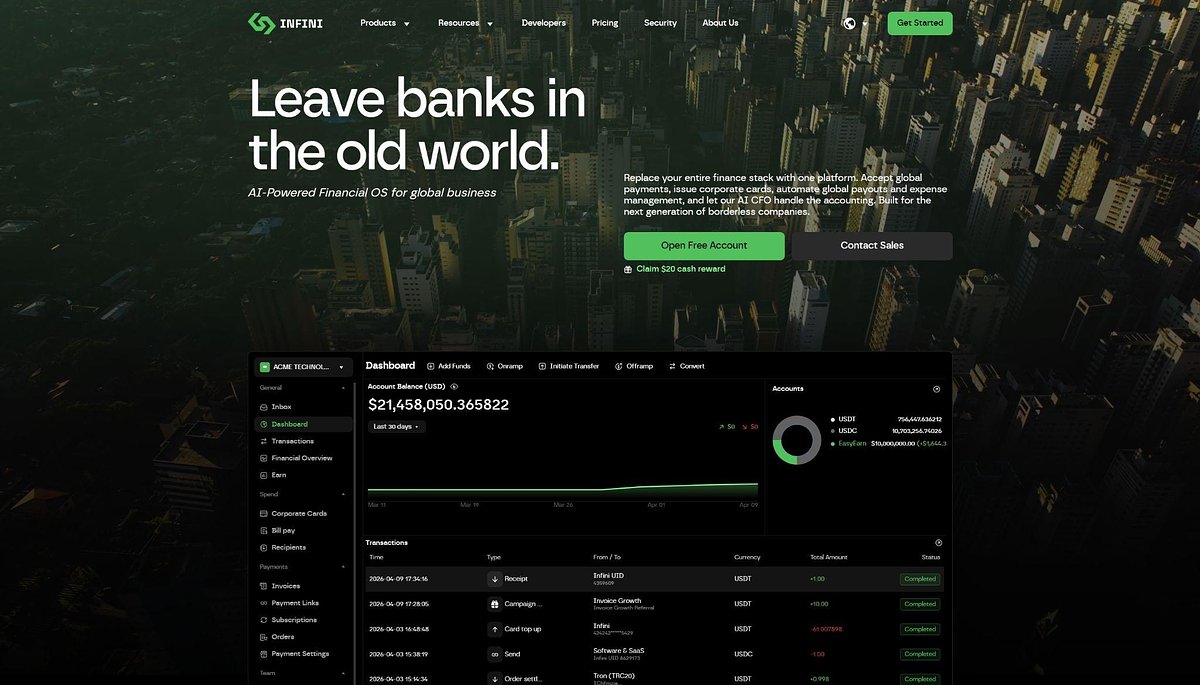
Infini's proposed solution is a unified platform built on a "dual-track 'Fiat + Stablecoin' architecture." The goal is to collapse what traditionally requires multiple banking relationships and fintech tools into a single, integrated system. Through its platform, the company claims enterprises can manage global multi-currency accounts, issue corporate virtual cards, route funds internationally, and manage expenses seamlessly. The integration of stablecoins is key to this model, offering the potential for near-instant settlement and reduced costs compared to legacy payment rails.
The 'AI CFO' and the Promise of Automation
Beyond simply blending fiat and crypto, Infini heavily promotes its use of artificial intelligence. The company markets its system not merely as a payment tool, but as a financial operating system complete with an "exclusive 'Digital Financial Employee.'" This "AI CFO" is designed to automate complex financial tasks, provide intelligent insights, and allow cross-border financial operations to run on autopilot.
This focus on AI-driven automation is a key differentiator in a crowded fintech market. The promise is to move beyond facilitating transactions to actively managing a company's financial health, from intelligent expense management to optimizing multi-currency fund routing. This vision is supported by a robust security framework that includes holding client fiat funds in bankruptcy-remote, segregated accounts at partner banks and securing crypto assets with enterprise-grade Multi-Party Computation (MPC) wallets.
By adhering to global standards for Know Your Customer/Business (KYC/KYB) and implementing real-time transaction monitoring, Infini is building a case that innovation and institutional-grade security can coexist. This comprehensive approach is designed to build the trust necessary for enterprises to commit their core financial operations to a new kind of platform.
Navigating a Global Regulatory Gauntlet
Infini's Canadian registration is not an isolated event but a reflection of a global regulatory convergence. Around the world, financial authorities are moving decisively to bring the digital asset industry within established regulatory perimeters. The European Union's Markets in Crypto-Assets (MiCA) regulation, which came into full effect in 2025, has created a comprehensive framework for the bloc. In the United States, legislation has aimed to provide federal clarity on stablecoins and licensing.
International bodies like the Financial Action Task Force (FATF) continue to push for global implementation of standards like the "Travel Rule," which requires the sharing of sender and receiver information for crypto transactions. This global push towards regulatory clarity, while challenging for some, is an enabling factor for companies like Infini that build compliance into their DNA from the outset.
For next-generation enterprises, the allure of blockchain's efficiency has often been tempered by regulatory risk. By proactively seeking and securing licenses in major jurisdictions, firms like Infini are betting that in the long run, the companies that win will be the ones that are trusted. This milestone in Canada is a clear signal that the future of enterprise finance will likely be built not in the unregulated shadows, but on a solid foundation of technology, security, and verifiable compliance.