
- 78% of Illinois voters oppose driverless heavy trucks (Teamsters poll, January 2026)
- 1,429 accidents involving Waymo vehicles (NHTSA, July 2021–November 2025)
- 4.4 million Americans employed in driving-dependent jobs at risk of displacement
Experts agree that while autonomous vehicle technology shows promise for safety and efficiency, significant public safety concerns, regulatory gaps, and potential job displacement warrant cautious, localized oversight before widespread deployment.
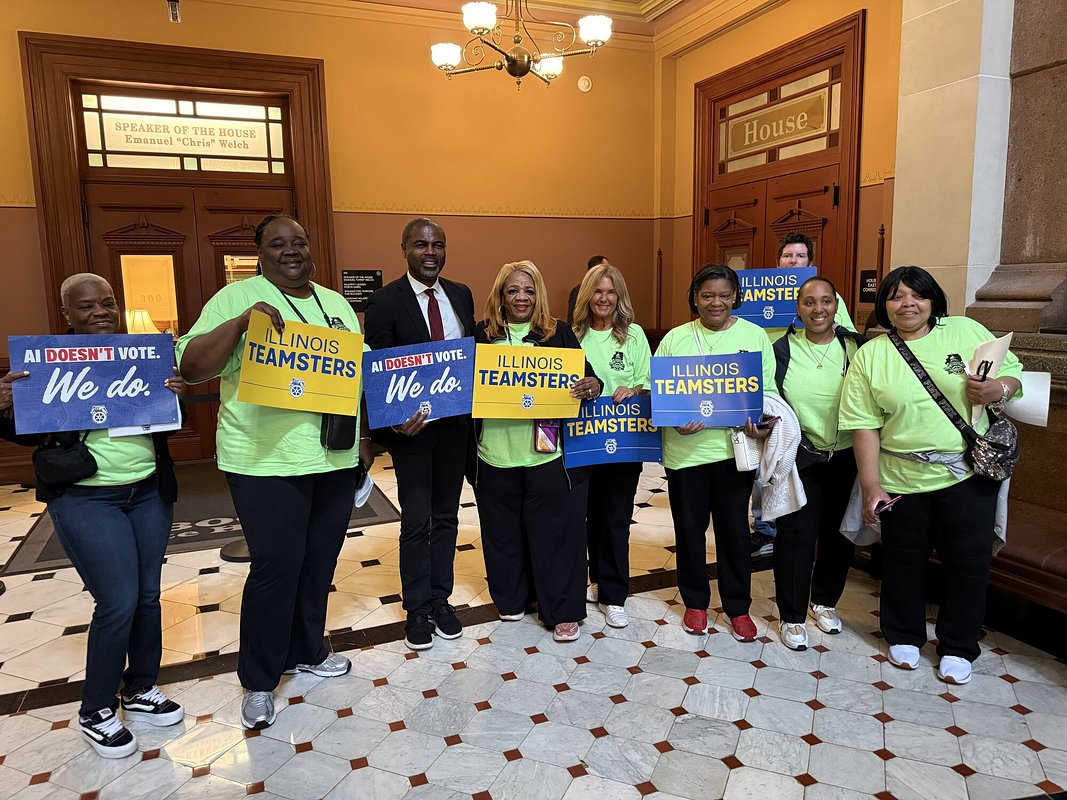
Illinois at a Crossroads: Unions Battle Waymo's Driverless Car Push
SPRINGFIELD, IL – April 14, 2026 – Chants of "People Over Robots" and "Driverless is Dangerous" echoed through the halls of the Illinois State Capitol on Tuesday as hundreds of union members gathered to oppose legislation they say threatens both public safety and middle-class livelihoods. The Teamsters and the newly formed Labor Alliance for Public Transportation (LAPT) held a press conference to denounce the Autonomous Vehicle Pilot Project Act, a bill backed by tech giants like Waymo that would clear the way for driverless cars and trucks on Illinois roads within three years.
At the heart of the protest is a fundamental conflict over the future of transportation in the state. On one side, organized labor warns of untested technology and mass job displacement. On the other, powerful tech companies argue their autonomous systems promise a future with fewer accidents and greater efficiency. The showdown in Springfield positions Illinois as a key battleground in the national debate over the rapid deployment of artificial intelligence on public roadways.
"This legislation is a handout to Big Tech that gambles with the safety of our communities and the stability of our families," Tom Stiede, President of Teamsters Joint Council 25, declared to the crowd. "We are not Luddites, but we demand safety before profits and people before robots. We will not stand by while our jobs are automated away by unproven technology."
The Legislative Battleground
The focus of the unions' ire is a pair of bills, HB4663 and SB3392, known as the Autonomous Vehicle Pilot Project Act. If passed, the legislation would authorize three-year pilot programs for fully autonomous vehicles in several key regions, including populous Cook County, the state capital of Sangamon County, and the Metro East area. Following the pilot period, the Illinois Department of Transportation (IDOT) would have the authority to permit statewide operation.
The bill grants IDOT exclusive state-level authority to regulate the technology, a provision that would limit the ability of local governments to impose their own restrictions. Proponents argue this creates a uniform regulatory framework necessary for innovation. However, opponents see it as a move to sideline local safety concerns. Currently, the legislation has stalled in the House Rules Committee, indicating a significant uphill battle for its supporters in the current session, but the threat remains a mobilizing force for labor groups.
This marks the second major initiative for the LAPT, a coalition that includes the Teamsters and the Amalgamated Transit Union (ATU). The group scored a significant victory last year in a campaign to secure funding for Illinois' public transit system, and they are now leveraging that momentum to confront the rise of automation.
A Clash of Visions: Safety and Jobs vs. Innovation
Labor leaders paint a stark picture of the potential economic fallout. With an estimated 4.4 million Americans employed in driving-dependent jobs, the stakes are immense. Studies project that full adoption of autonomous technology could eliminate hundreds of thousands of trucking jobs annually and displace the majority of the nation's 800,000 rideshare drivers. "We are talking about the decimation of a solid, middle-class profession," said Tim Drea, President of the Illinois AFL-CIO.
Beyond job losses, safety remains a paramount concern for the opposition. This sentiment is strongly reflected in recent polling. A January 2026 poll commissioned by the Teamsters found that nearly two-thirds of Illinois voters oppose allowing any driverless vehicles on state roads, with 78% specifically opposing driverless heavy trucks. The top concern cited by a majority of voters was public safety and the risk to human life.
In contrast, proponents like Waymo, an Alphabet Inc. subsidiary, present their technology as a solution to human fallibility on the road. The company, which has already begun testing with safety drivers in Chicago, publicly supports the bill and promotes its safety record from operations in cities like Phoenix and San Francisco. Waymo's data suggests its vehicles are involved in drastically fewer injury-causing crashes compared to human drivers. The company argues its technology doesn't get distracted, tired, or impaired, promising to make roads safer and more accessible for everyone.
National Precedent and Public Unease
The unions' cautious stance is bolstered by a growing trend of legislative skepticism in other states. The press conference highlighted recent decisions in New York, where the governor abandoned a push to legalize robotaxis, and Washington State, where a bill to authorize commercial AVs failed to pass earlier this year. This pattern suggests that Illinois lawmakers are not alone in weighing the risks of rapid AV deployment.
A separate February 2026 survey in Illinois, commissioned by the motorcycle rights group ABATE, found that only 38% of residents in the proposed pilot areas were favorable toward sharing the road with driverless taxis. That opposition intensified when respondents were informed that comprehensive safety regulations were not yet in place, with 72% supporting the right to remove hazardous AVs from the road.
These findings underscore a significant disconnect between the tech industry's vision and the public's current comfort level. While companies tout millions of miles driven, high-profile incidents across the country involving AVs—from obstructing emergency vehicles to collisions—have fueled public anxiety. Federal regulators at the National Highway Traffic Safety Administration (NHTSA) are also scrutinizing the technology. Between July 2021 and November 2025, NHTSA recorded 1,429 accidents involving Waymo vehicles, resulting in 117 injuries and two fatalities, though the data does not always assign fault. This complex safety record fuels the argument that the technology, while promising, may not yet be ready for widespread, unregulated deployment on public streets.