
- 75% of businesses identify security, compliance, and auditability as their most critical requirements for deploying AI agents (KPMG report).
- 97% of AI-related security incidents occur in environments lacking proper AI access controls (SailPoint research).
- 1 in 5 organizations has already experienced a security incident related to AI agents.
Experts agree that DNSid provides a critical, neutral identity standard for AI agents, addressing urgent governance and accountability gaps in the rapidly evolving AI-driven economy.
Identity Digital Unveils DNSid: A 'Birth Certificate' for AI Agents
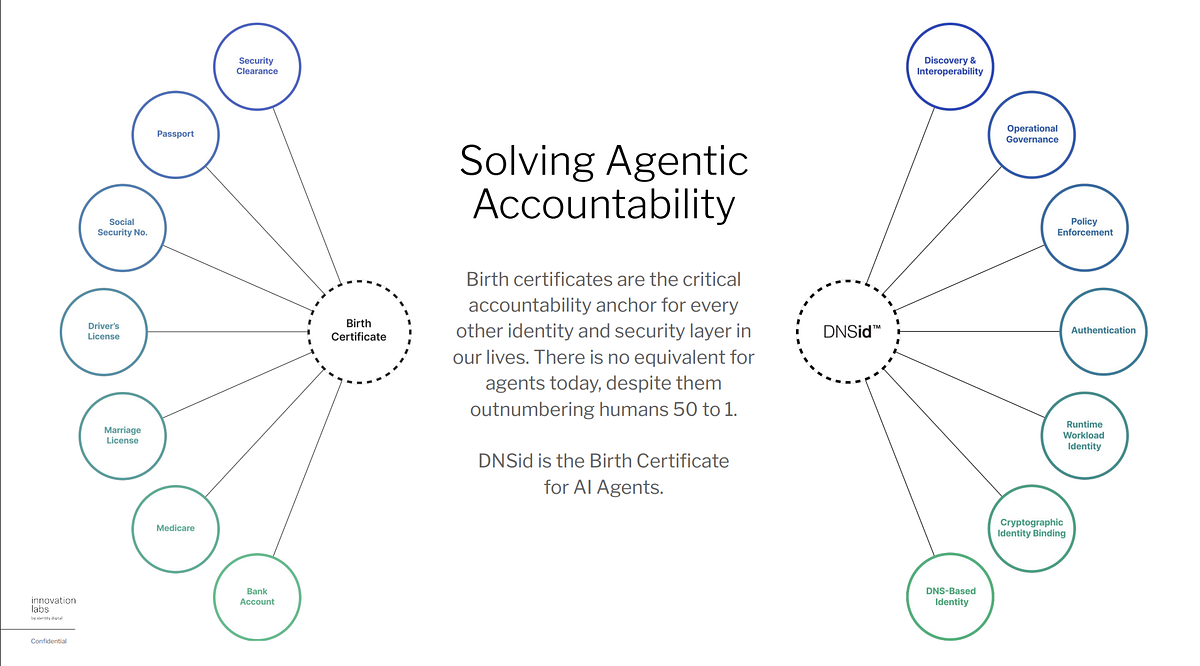
BELLEVUE, Wash. – April 27, 2026 – As artificial intelligence evolves from experimental tools into autonomous agents capable of executing complex tasks, a critical question has emerged: Who is accountable when they go wrong? Today, Identity Digital, a long-standing steward of the internet's domain name system (DNS), announced a potential answer with the launch of its new division, Innovation Labs, and its flagship solution, DNSid™. The company is positioning DNSid as a neutral, DNS-anchored identity standard—essentially a digital 'birth certificate' that binds every AI agent to verifiable ownership.
This initiative arrives as enterprises are rapidly moving AI agents from controlled sandboxes into mission-critical operations. These agents can now act autonomously, execute financial transactions, and interact across different software platforms, often at machine speed and beyond direct human supervision. The problem, however, is that each time an agent crosses a platform boundary, it often assumes a new identity, creating a fragmented and untraceable trail that makes governance nearly impossible.
“AI agents have moved from experimentation to production almost overnight. Enterprises across every sector aren’t just deploying them, they are scrambling to establish real security, governance and control,” said Akram Atallah, CEO of Identity Digital, in a statement. “The urgency is justified. Agents are already acting unpredictably, sometimes in error, sometimes in ways that create real risk. DNSid delivers the missing ownership and accountability layer that an AI-driven economy urgently requires.”
The Looming Threat of 'AI Chaos'
The rapid proliferation of AI agents has created what many experts describe as the fastest-growing, yet least-governed, class of digital actors within the enterprise. According to a recent KPMG report, 75% of businesses identify security, compliance, and auditability as their most critical requirements for deploying AI agents, a sentiment that underscores the deep-seated anxiety in executive boardrooms. This anxiety is not theoretical. Research from SailPoint reveals that one in five organizations has already experienced a security incident related to AI agents, with a staggering 97% of those incidents occurring in environments that lacked proper AI access controls.
Traditional Identity and Access Management (IAM) systems, built for predictable human workflows and static applications, are ill-equipped to handle the dynamic and autonomous nature of AI. An agent authorized to transfer a small sum of money could, through a simple error or a malicious compromise, initiate a transaction worth millions. Without a durable, verifiable ownership record, determining responsibility becomes a forensic nightmare, transforming a technical gap into a systemic financial and governance risk.
“AI agent chaos isn’t theoretical. It’s happening right now,” noted Lauren Goulston, general manager of Identity Digital Innovation Labs. “Autonomous agents are scaling faster than the standards needed to govern them. Without a universal approach, enterprises risk losing control as agents operate with bank accounts, software, and other sensitive information, all beyond human oversight.”
An Identity Built on the Internet's Bedrock
Rather than inventing a new protocol from scratch, DNSid's innovation lies in its strategic combination of three proven, globally adopted technologies: the Domain Name System (DNS), Public Key Infrastructure (PKI), and blockchain. This framework provides a persistent identity that works across platforms and over time.
Here’s how it works:
1. DNS as the Anchor: Each AI agent's identity is anchored to a domain name. Because DNS is the internet's universal coordination layer—relied upon by every enterprise and cloud provider—it provides a globally unique and resolvable foundation for ownership. Identity Digital, which operates one of the world's largest portfolios of top-level domains, brings decades of expertise in DNS governance to the table.
2. PKI for Security: Public Key Infrastructure provides the cryptographic backbone, enabling secure verification of an agent's identity and its associated ownership credentials.
3. Blockchain for Durability: A blockchain ledger maintains an immutable, authoritative record of the agent's identifier, its ownership history, transfers, and revocation status. This ensures that the agent's 'birth certificate' is durable and cannot be tampered with.
Crucially, DNSid is designed to be the foundational ownership layer, not a replacement for existing security systems. It does not authenticate agents in real-time or enforce run-time policies. Instead, it provides the permanent, globally resolvable ownership anchor on which other secure, accountable agent ecosystems can be built. This focus on verifiable ownership differentiates it from other solutions that tackle workload identity or session security, which often fail to answer the ultimate question of accountability.
The Race to Set the Standard
The launch of DNSid is not just a product release; it's a strategic move to establish a de facto industry standard for AI agent identity. A key part of this strategy is the involvement of the Linux Foundation's LF Decentralized Trust, an organization dedicated to fostering open, collaborative development for decentralized technologies. By aligning with the Linux Foundation, Identity Digital is signaling its commitment to an open, standards-based approach, which is critical for building trust and encouraging widespread adoption.
“The trust layer has taken on a new level of urgency as enterprises look to scale agentic AI,” commented Daniela Barbosa, General Manager of Decentralized Technologies at the Linux Foundation and Executive Director of LF Decentralized Trust. “Identity and authentication in the face of autonomous actors will challenge the industry in unprecedented ways and require new levels of openness and collaboration.”
An open standard for AI agent identity would prevent vendor lock-in and ensure interoperability, allowing agents from different developers and organizations to interact securely. This is vital for building a cohesive and scalable AI ecosystem. While other approaches like pure Decentralized Identifiers (DIDs) and Verifiable Credentials (VCs) are also emerging, DNSid's unique reliance on the internet's existing DNS infrastructure gives it a powerful advantage in terms of immediate global reach and familiarity.
From Boardroom Concerns to Regulatory Compliance
For CISOs and risk officers, a solution like DNSid offers a tangible way to address pressing governance challenges. By providing an immutable audit trail of ownership, it enables organizations to move AI agents from development into production with greater confidence, knowing that a clear line of accountability is in place.
This capability is becoming increasingly critical in the face of new regulations. The EU AI Act, for instance, imposes strict requirements for traceability, record-keeping, and human oversight for high-risk AI systems. Without a verifiable identity for each agent, proving compliance with such regulations becomes exceptionally difficult. Similarly, frameworks like the NIST AI Risk Management Framework (AI RMF) emphasize the need for attribution by connecting every agent's action back to a specific identity and the human who authorized it.
By providing a foundational layer for verifiable ownership, DNSid helps translate abstract ethical principles and regulatory demands into an operational reality. It offers a mechanism to ensure that as AI agents become more powerful and autonomous, they do not become untraceable, unaccountable actors in the digital economy. This new standard for identity may prove to be the essential guardrail needed to unlock the full potential of AI for responsible and scalable growth.