
- 30% code completion enhancement with CodeArts
- 80% code acceptance rate in enterprise projects using CodeArts
- 98% accuracy in AI-powered OCR for engineering drawing labels
Experts view Huawei Cloud's Agentic AI launch as a strategic move to position Thailand as a regional AI hub, aligning with national digital transformation goals while addressing challenges in security and governance.
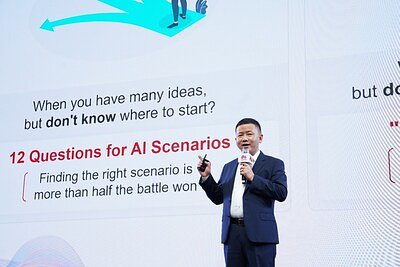
Huawei Cloud Unleashes Agentic AI to Power Thailand's Digital Future
BANGKOK, THAILAND – April 07, 2026 – Huawei Cloud has made a significant move to accelerate Thailand's digital ambitions, officially launching its Model as a Service (MaaS) platform and introducing a full-stack suite of Artificial Intelligence capabilities. The announcement, made at the Huawei Cloud Thailand AI Boost Day 2026, centers on a new paradigm called Agentic AI, which promises to transform AI from passive tools into proactive, intelligent agents capable of executing complex tasks.
This strategic push provides Thai enterprises with powerful new tools for innovation and aligns directly with the nation's goal of becoming a regional AI hub. The MaaS platform is designed to streamline the adoption of advanced AI for businesses by offering optimized, token-based access to leading industry models, including the powerful new open-source GLM-5 model, which excels at coding and agent-based tasks.
A New Paradigm: The Rise of Agentic AI
At the core of Huawei Cloud's announcement is the shift towards Agentic AI. This represents a fundamental evolution from current AI systems, which primarily react to user prompts, to autonomous systems that can understand goals, plan steps, and execute complex workflows with minimal human intervention. This shift introduces a new computing paradigm that places more dynamic demands on cloud infrastructure.
"Agentic AI is redefining how AI systems operate—from reactive tools to intelligent agents capable of autonomous decision-making and execution," stated James Tan, Head of AI for Huawei Cloud APAC, during the event. "This shift requires a new generation of cloud infrastructure that is more adaptive, scalable, and intelligent than ever before."
This move mirrors a broader global trend where AI is evolving into collaborative digital co-workers. Industry experts see agentic systems being applied to automate multi-step processes in finance, supply chain management, and customer service. However, this evolution also brings challenges, including the need for robust security, governance, and trust in autonomous systems.
To address these complexities, Huawei Cloud has built an integrated technology framework. Mr. Surasak Sanichwatphibun, CTO of Huawei Thailand Cloud Business, explained the company's approach: "To meet these evolving demands, Huawei Cloud has developed a comprehensive full-stack AI strategy, guided by the core requirements of Agentic AI. The company has established an integrated technology framework covering AI infrastructure, large models and toolchains, and intelligent agent platforms, providing strong foundational support for enterprises undergoing intelligent transformation."
Equipping Enterprises with a Full-Stack Arsenal
Huawei Cloud's strategy is not just theoretical; it is backed by a comprehensive suite of services designed to support enterprises at every stage of their AI journey. The newly launched MaaS platform serves as the gateway, providing access to powerful models on high-performance infrastructure.
The full-stack offering includes several key components:
- CloudMatrix AI Infra: This provides the foundational high-performance computing power, pooling resources to support the demanding training and inference tasks required by large AI models.
- ModelArts: An open, full-stack AI development platform that simplifies the entire AI lifecycle, from data engineering to model deployment, allowing developers to focus on innovation rather than infrastructure management.
- CodeArts: A sophisticated coding assistant that integrates directly into the development process. It enhances code completion by 30% and boasts an 80% code acceptance rate in enterprise projects, significantly boosting R&D efficiency.
- AgentArts: A one-stop platform for building and managing enterprise-grade AI agents. Using low-code and high-code methods, it allows businesses to reduce agent development time from days to mere hours, running on a serverless design for high reliability and scalability.
Both CodeArts and AgentArts are slated for launch in overseas markets in the second half of this year, signaling the company's global ambitions for its agent-level platforms. The support for the GLM-5 model within the MaaS offering is particularly notable, giving Thai developers access to a state-of-the-art open-source tool for building their own general-purpose AI agents.
Accelerating Thailand's National AI Vision
Huawei Cloud's launch is not happening in a vacuum. It directly supports the Thailand National AI Strategy and Action Plan (2022-2027), a comprehensive government initiative aimed at establishing an effective AI ecosystem to boost economic growth and improve quality of life. The plan's pillars—including developing robust infrastructure, increasing human capability, and promoting AI adoption—are all addressed by the new offerings.
The Ministry of Digital Economy and Society (MDES) has been clear about its goal to position Thailand as a regional AI hub by 2027, promoting investment in cloud systems and open-source platforms. Huawei Cloud's investment and open-ecosystem approach appear to be in lockstep with this vision.
This partnership is already bearing fruit. The company already supports the digital transformation of over 40 government agencies in Thailand. Furthermore, local enterprises are seeing tangible benefits. For instance, a national energy and petrochemical company is using Huawei Cloud's AI-powered Optical Character Recognition (OCR) to identify engineering drawing labels with over 98% accuracy. This real-world adoption demonstrates a clear path from AI exploration to production deployment for Thai businesses.
Navigating a Competitive Cloud Landscape
Huawei Cloud's ambitious strategy enters a fiercely competitive arena. The Southeast Asian cloud market is a key battleground for global giants like Amazon Web Services (AWS), Google Cloud, and Microsoft Azure, all of which offer extensive AI and MaaS-like services. However, Huawei is not a newcomer to be taken lightly. According to Gartner, the company was ranked second by revenue in Thailand's Infrastructure as a Service (IaaS) market in 2024, indicating a strong and growing presence.
The company's full-stack approach, combined with a deep understanding of local market needs and strong government relationships, serves as its primary differentiator. By offering a comprehensive ecosystem—from foundational infrastructure to agent-building platforms—it aims to become an indispensable partner for enterprises navigating their digital transformation.
Success stories from across the region bolster this value proposition. Asiasoft, a major online gaming company, used Huawei Cloud to slash its mobile game rollout time by 50% while cutting costs by 30%. Similarly, Singaporean app Nestia improved its application performance by 20% and achieved a 30% cost reduction. These proven results provide a compelling case for Thai businesses considering a deeper investment in AI. As enterprises across Thailand begin to evaluate these powerful new capabilities, the race to harness intelligent automation is set to intensify, reshaping the nation's economic landscape for years to come.
Topics & Related
Cloud & Infrastructure
AI & Machine Learning
Agentic AI
Generative AI
Related Company Pulse