
- $14.5 million: The amount Technology Investment Consortium (TIC) invested in October 2021 for a 49% stake in Position Mobile Ltd SEZC.
- 10-day trial: The duration of the complex legal battle in the fall of 2025.
- February 17, 2026: The date of the landmark ruling by the Grand Court of the Cayman Islands.
Experts emphasize the critical role of precise, defensible technical analysis in resolving complex technology disputes, highlighting the necessity of clear, reproducible evidence in corporate governance and legal proceedings.
How Tech Experts Won a High-Stakes Battle in a Cayman Courtroom
LOS ANGELES, CA – February 23, 2026 – In a landmark ruling that underscores the growing power of technical expertise in corporate law, the Grand Court of the Cayman Islands has ordered a buyout of shares in a contentious tech dispute, handing a significant victory to Technology Investment Consortium LLC ("TIC"). The decision, delivered on February 17, 2026, hinged not just on legal arguments but on the meticulous analysis of software experts who translated complex code and engineering decisions into decisive courtroom evidence.
The case pitted TIC, a minority shareholder, against the majority owners of Position Mobile Ltd SEZC, a mobile app company. At the heart of the victory was the work of Cyberonix Experts, LLC, a Los Angeles-based advisory firm whose specialists provided the technical firepower needed to navigate the intricate details of the software-centric business.
The Anatomy of a Tech Dispute
The legal battle arose from a breakdown of trust within a joint venture. Technology Investment Consortium, a co-founder and the largest single shareholder in Position Mobile, had invested US$14.5 million in October 2021 for a 49% stake. The remaining 51% was held by entities connected to Genimous Investment (Hong Kong) Co., Ltd and Genimous Holding (HK) Limited.
Position Mobile was established to develop and market mobile applications, a venture that depended on mutual confidence and transparent operations. However, according to court filings, that confidence eroded. In an amended winding-up petition, originally dated April 1, 2022, and redated March 20, 2025, TIC claimed it had "justifiably lost all trust and confidence" in how the company's affairs were being managed by the majority shareholders.
The petition alleged mismanagement and sought the ultimate remedy of winding up the company on "just and equitable" grounds. In the alternative, TIC asked the court to compel the majority shareholders to purchase its shares at a fair value. The dispute escalated to a complex 10-day trial in the fall of 2025, reflecting the high stakes and the dense evidentiary record that the court had to unravel.
The Decisive Role of the Technical Expert
In an era where business operations are embedded in software, legal disputes increasingly turn on questions that lawyers and judges cannot answer alone. This is where firms like Cyberonix come in, acting as interpreters between the worlds of code and law. Retained by Dentons, counsel for the petitioner, Cyberonix was tasked with providing independent technical expertise to dissect the evidence and support the case strategy.
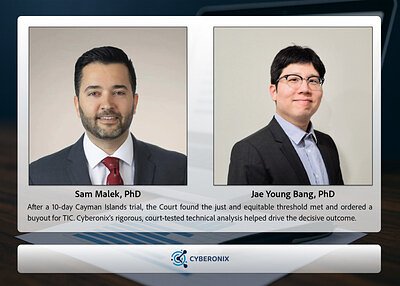
The testifying expert for Cyberonix was Prof. Sam Malek, a recognized authority in software architecture and distributed systems. His role was to perform a rigorous analysis of Position Mobile's technical operations and present his findings in a way that was clear, defensible, and could withstand intense cross-examination. He was supported by Dr. Jae Young Bang, CEO of Cyberonix, who provided strategic oversight.
"This ruling underscores the importance of precise, defensible technical analysis in complex technology disputes," said Dr. Bang in a statement following the ruling. "When software systems, engineering decisions, and technical records become central to litigation, expert opinions must be both technically rigorous and clearly articulated to withstand scrutiny."
This process involves more than just looking at lines of code. It requires understanding the architecture of the software, the decisions made during its development, and how those decisions impact the business. For the court, this expert testimony becomes a crucial lens through which to evaluate claims of mismanagement.
Prof. Malek added, "Effective expert testimony translates complex engineering realities into an objective and comprehensible technical record. Our focus is on methodological clarity, reproducibility, and careful alignment with the standards required in court." This methodical approach transforms abstract technical data into concrete evidence of operational conduct, allowing a court to make informed judgments on matters of corporate governance.
A Global Stage for Corporate Governance
The choice of the Grand Court of the Cayman Islands as the venue for this battle is itself significant. The jurisdiction is a major global hub for investment funds and holding companies, and its laws are specifically designed to handle complex international corporate disputes. The legal framework provides specific protections for minority shareholders, including the ability to petition for a "just and equitable" winding-up of a company.
In this case, referenced as FSD 79 of 2022 (DDJ), the Court found that "the threshold for a just and equitable winding up order has been crossed." This was a critical finding that validated TIC's fundamental complaints. However, rather than ordering the corporate death penalty of liquidation—a move that can destroy value for all stakeholders—the Court opted for the more nuanced remedy of a buyout. This forces the majority to purchase the minority's stake at a fair price, providing an exit for the aggrieved party while allowing the underlying business to continue.
This outcome highlights a key feature of Cayman Islands jurisprudence, which often favors practical solutions that preserve enterprise value. By ordering a buyout, the court acknowledged the irreparable breakdown in the relationship between the shareholders while stopping short of dissolving a potentially viable company. The ruling serves as a powerful reminder to majority shareholders in any jurisdiction that their actions can be scrutinized and that minority investors have powerful legal recourse.
A Cautionary Tale for the Tech Industry
Beyond the specific legal and technical details, the Position Mobile case serves as a cautionary tale for the fast-paced technology sector. Joint ventures and partnerships are common in the industry, enabling rapid growth and market entry. However, this case demonstrates the profound risks when trust, transparency, and governance are not carefully managed from the outset.
The dispute did not arise from a single catastrophic event but from a progressive loss of confidence, a scenario familiar to many business partnerships. The allegations of mismanagement and the subsequent need for a deep, technical investigation highlight the importance of maintaining clear records, open communication, and robust internal controls. When partners can no longer trust the information they receive about a company's operations, the foundation of the business is compromised.
The resolution, while a victory for TIC, came at a high cost, involving years of litigation and a lengthy, expensive trial. The case is a stark illustration that in the modern economy, shareholder disputes are increasingly intertwined with technological complexity. As more companies' core value is tied to intangible assets like software and data, the ability to legally and technically scrutinize those assets is becoming an indispensable tool for investor protection and corporate accountability.