
- 70% of new applications will be developed using no-code/low-code technologies by 2026 (Gartner).
- All backend services (databases, authentication, file storage, server-side logic) now integrated into Hostinger Horizons.
- No additional cost for the new backend features, included for all new users.
Experts view Hostinger Horizons' integrated backend as a significant step toward solving the no-code industry's long-standing bottleneck, potentially empowering a broader audience of citizen developers by simplifying complex application development.
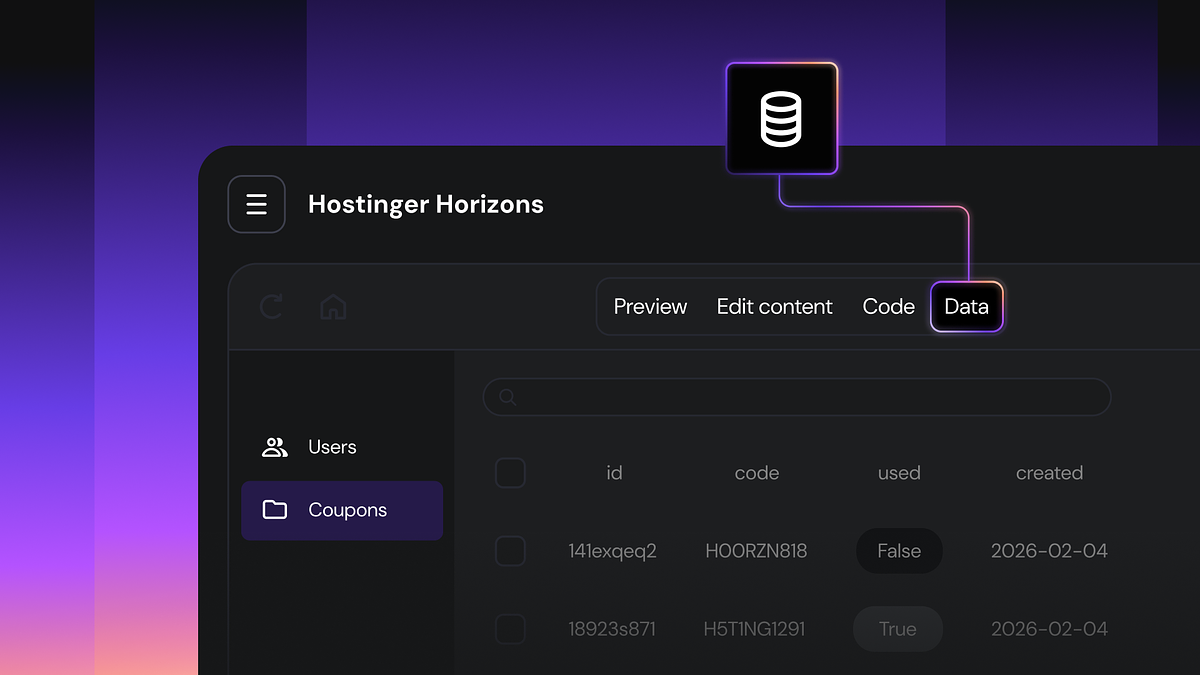
Hostinger Horizons Aims to End No-Code's Backend Bottleneck
VILNIUS, LITHUANIA – February 23, 2026 – Hostinger has announced a landmark update for its AI-powered no-code platform, Hostinger Horizons, introducing fully integrated backend services. The move is a direct challenge to a long-standing frustration in the no-code community, aiming to eliminate the so-called "backend bottleneck" that has often forced creators to stitch together multiple third-party services to build a single, functional application.
The update brings databases, user authentication, file storage, and server-side logic directly into the Horizons platform. This allows users to develop and deploy complete applications, from business websites and operational tools to complex AI-powered projects, all within a single, unified environment. The company states this removes the need for separate accounts and complex integrations, a significant point of friction that has historically hampered the no-code promise of seamless creation.
Solving a Persistent Industry Problem
For years, the no-code movement has excelled at democratizing frontend development—the visual, user-facing part of an application. Platforms like Webflow have empowered designers and entrepreneurs to build stunning websites without writing a line of code. However, when an application needs to do more than just display information—when it needs to store user data, manage accounts, or run custom logic—the process often grinds to a halt.
This is the backend bottleneck. To add these essential functions, creators have traditionally been forced to venture outside their no-code builder, navigating the complex world of Backend-as-a-Service (BaaS) providers like Xano or Backendless, or wrestling with API integrations. This not only introduces a steep learning curve but also creates dependencies on multiple vendors, increasing complexity, potential security risks, and costs.
While some full-stack platforms like Bubble have long offered integrated backend functionality, they are often perceived as having a significant learning curve, deterring users who seek simplicity and speed. Hostinger Horizons' new strategy appears designed to occupy a powerful middle ground: providing the comprehensive power of a full-stack platform with the simplicity and AI-driven workflow it is becoming known for. By automating the backend setup based on user descriptions, Horizons aims to keep the development process intuitive. A user simply describes the need for user accounts or data storage, and the platform provisions the necessary infrastructure behind the scenes.
A Unified Platform for a Growing Market
The no-code and low-code development market is experiencing explosive growth. Industry analysts at Gartner project that by 2026, 70% of new applications will be developed using these technologies, as businesses race to accelerate their digital transformation. Hostinger's move positions it to capture a significant portion of this expanding market, particularly among small to medium-sized businesses and entrepreneurs.
The new integrated backend includes a suite of essential features. User authentication is handled natively, supporting traditional email and password sign-ins, one-time passwords, and single sign-on (SSO) with major providers like Google, Apple, and Microsoft. The platform also includes built-in email sending capabilities for transactional messages such as sign-up confirmations, password resets, and custom event-triggered alerts, all without requiring an external email service.
A key feature highlighted in the announcement is the strict separation between testing and live environments. This allows developers and creators to experiment with new features and make changes in a safe "staging" area without any risk to the live, user-facing application. Updates are only pushed to the public when they are intentionally published, a professional-grade workflow that is often missing from more basic no-code tools and addresses a common source of user anxiety.
According to the company, all these new backend services run on Hostinger’s own infrastructure. This consolidation is a strategic advantage, allowing for tighter integration, potentially better performance, and a simplified security posture compared to solutions that rely on a patchwork of external providers.
Empowering a New Wave of Citizen Developers
Ultimately, the significance of this update may lie in its potential to empower a broader audience of "citizen developers"—individuals with great ideas but without formal coding skills. By abstracting away the most complex and intimidating part of app development, Hostinger Horizons lowers the barrier to entry for creating sophisticated, data-driven applications.
Entrepreneurs can now more realistically prototype and launch a minimum viable product (MVP) for a new software-as-a-service (SaaS) idea. Small businesses can build custom internal tools to streamline operations. Freelancers can create booking systems or client portals with secure logins. The promise is a dramatically accelerated path from concept to a fully functional, market-ready product.
This move is part of a larger trend where AI is not just a feature but a core component of the development process. By leveraging AI to interpret user intent and automate complex setup, platforms like Horizons are fundamentally changing what it means to build software. As the technology matures, the distinction between a simple website builder and a powerful application development platform continues to blur, opening up new possibilities for digital creation for millions around the world. The integrated backend feature is being included for all new users at no additional cost, signaling an aggressive push for market adoption.