
- ISO 37301 Certification: Hikvision achieved the ISO 37301 certification for its Compliance Management System, a rigorous international standard for ethical operations and global compliance. - Geopolitical Sanctions: The company faces bans and restrictions in the U.S., UK, Australia, Canada, and India due to national security concerns. - Industry Trend: Dahua Technology, Hikvision's rival, also received the ISO 37301 certification earlier this year, indicating a strategic shift in China's surveillance industry.
Experts view Hikvision's ISO 37301 certification as a significant but insufficient step to rebuild trust, emphasizing that sustained action and verifiable proof of ethical compliance will be necessary to overcome deep-seated skepticism and geopolitical barriers.
Hikvision's Compliance Gambit: A Bid for Global Redemption
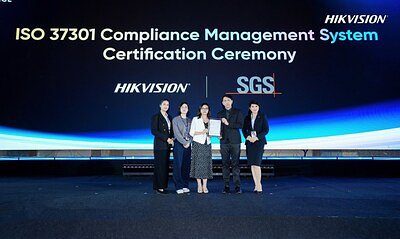
BANGKOK, THAILAND – December 03, 2025 – In a move radiating strategic intent, Chinese surveillance technology giant Hikvision announced it has achieved the prestigious ISO 37301 certification for its Compliance Management System. Unveiled at the company's Commercial Summit in Bangkok, the certification, awarded by the world-leading inspection firm SGS, is being presented as definitive proof of a commitment to ethical operations and global standards. But for a company mired in international controversy and facing a wall of sanctions, this certificate represents far more than a procedural milestone—it's a high-stakes play to rewrite its narrative and reclaim its place in the global market.
The Gold Standard of Governance
At its core, the ISO 37301 standard is the international benchmark for creating, implementing, and maintaining an effective Compliance Management System (CMS). Unlike its predecessor, which was merely a set of guidelines, this standard is certifiable. Achieving it requires a rigorous, multi-stage audit process that scrutinizes an organization's entire operational framework—from the board of directors down to daily processes. It demands a top-down commitment to a culture of integrity, a risk-based approach to identifying potential misconduct, and mechanisms for continuous improvement.
For Hikvision, the certification serves as a powerful external validation. The company’s press release highlighted the achievement as a testament to its "proactive measures" and "steadfast commitment to ethical business operations." During the ceremony, SGS Thailand's Sustainability Business Manager, Terachai Yaoprukchai, lent his firm's credibility to the effort, stating, "Hikvision has demonstrated industry-leading maturity and robustness in its compliance management system by deeply embedding compliance in its operations and strengthening globally adaptable risk controls."
The standard requires organizations to address a wide range of compliance obligations, and Hikvision states its efforts cover everything from cybersecurity and trade compliance to data protection and human rights. Theoretically, this certification suggests the company has built a resilient, transparent, and accountable system designed to prevent the very issues that have plagued its reputation.
A Strategy Forged in Controversy
To understand the significance of this move, one must look beyond the polished announcement and into the turbulent history that necessitates it. Hikvision, a partly state-owned enterprise with deep ties to the Chinese government, has become a focal point of geopolitical and ethical disputes over the last decade.
The company's technology has been linked to the mass surveillance and repression of Uyghur minorities in China's Xinjiang region, leading to widespread condemnation from human rights organizations. These allegations were a primary driver behind the U.S. government's decision in 2019 to place Hikvision on its "Entity List," severely restricting its ability to procure American technology.
The sanctions did not stop there. The U.S. Federal Communications Commission (FCC) has since banned the sale and import of new Hikvision equipment, deeming it an "unacceptable risk to U.S. national security." Similar bans and restrictions have been enacted or considered in the UK, Australia, Canada, and India, effectively locking the company out of significant government and enterprise contracts across the Western world. Concerns about potential cybersecurity vulnerabilities and data being funneled back to Beijing have made its products toxic in sensitive sectors. This ISO certification, therefore, is not a routine corporate achievement; it is a direct and calculated response to an existential business threat. It is an attempt to build a new foundation of trust where the old one has crumbled.
Beyond the Certificate: A Skeptical View
While the ISO 37301 certificate is a tangible asset, many industry observers and policy experts remain deeply skeptical. The critical question is whether a formal compliance framework, however robust on paper, can truly address the foundational ethical and security concerns surrounding the company.
"A certification provides a process, but it doesn't automatically confer virtue," noted one compliance consultant specializing in international trade, speaking on the condition of anonymity. "For a company with Hikvision's history, the market will be looking for irrefutable proof of change, not just a certificate. The burden of proof is exceptionally high."
Critics point out the potential for "compliance washing"—the practice of using certifications and corporate social responsibility initiatives to mask underlying problems. An audit, even one conducted by a reputable firm like SGS, has its limits. It can verify that processes and documentation are in place, but assessing the genuine culture and intent within a massive, partly state-influenced corporation operating in a non-transparent political system is another challenge entirely. Can an external auditor truly confirm that human rights protections are embedded "end-to-end" in a supply chain that touches Xinjiang? Can it definitively rule out the potential for state-directed security backdoors in its hardware and software?
The ISO 37301 standard itself is principles-based and flexible, which allows it to be adapted to any organization. However, this flexibility also means its effectiveness is entirely dependent on the sincerity and rigor of its implementation—something that remains difficult for outsiders to verify.
An Industry at a Compliance Crossroads
Hikvision's move is not happening in a vacuum. It reflects a broader trend within the security technology industry, which finds itself at a critical intersection of technology, ethics, and geopolitics. Tellingly, Dahua Technology, Hikvision's chief Chinese rival and a fellow target of U.S. sanctions, announced it had received the very same ISO 37301 certification earlier this year. This suggests a coordinated strategic pivot by China's leading surveillance firms to use internationally recognized standards as a shield against Western sanctions and scrutiny.
This approach contrasts sharply with that of their Western competitors. Sweden-based Axis Communications, for example, emphasizes compliance with specific, legally mandated standards crucial for market access in the West. These include compliance with the U.S. National Defense Authorization Act (NDAA), which bans certain Chinese-made components in federal systems, and achieving SOC 2 attestation for its cloud services, a key requirement for enterprise customers concerned with data security.
This divergence highlights two different worlds of compliance. One is a broad, principles-based framework (ISO 37301) aimed at demonstrating good global citizenship. The other is a tactical, rule-based approach focused on clearing specific, non-negotiable market barriers. For global companies, the question is no longer if they need a compliance strategy, but which strategy will prove most effective.
For Hikvision, the ISO certification is a bold declaration that it is ready to play by global rules. It is a tool designed to reassure partners, mollify regulators, and win back customers. Yet, in the court of global opinion and in the highly securitized marketplace it operates in, the verdict will ultimately depend not on the paper certificate, but on whether the company's actions can overcome years of deep-seated distrust.