
- 68% of Canada's police-reported human trafficking incidents occur in Ontario, despite the province having only 39% of the country's population.
- 91% of trafficking victims know their trafficker, often an intimate partner or acquaintance.
- Two-thirds of victims are under 25, with an average recruitment age of 13.
Experts agree that survivor-led awareness campaigns in high-traffic public spaces are critical in combating human trafficking, as they educate the public on recognizing subtle signs of exploitation and provide direct access to support resources.
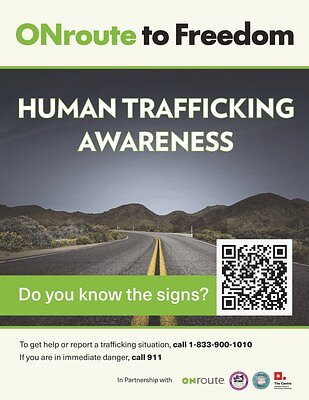
Highways to Hope: Survivor-Led Campaign Targets Ontario's Rest Stops
TORONTO, ON – April 22, 2026 – A powerful new campaign is transforming Ontario's bustling highway service centers into beacons of awareness in the fight against human trafficking. A partnership between ONroute and Timea's Cause, a survivor-led social enterprise, will place vital information directly in the path of millions of travelers, aiming to unmask a crime that thrives in the shadows of our transportation corridors.
The initiative, driven by survivor and advocate Timea Nagy, will see awareness posters installed at ten ONroute locations along Highways 401 and 400. The campaign officially launches on April 23 at the Barrie Northbound ONroute, marking a significant step in leveraging high-traffic public spaces to combat exploitation.
"Highways connect communities, but they can also be the loneliest place if you're a victim of human trafficking," said Nagy, founder of Timea's Cause. "That's why awareness in these spaces matters."
A Crisis Hidden in Plain Sight
While many Canadians believe human trafficking is a crime that happens elsewhere, statistics paint a grim picture closer to home. Ontario is the epicenter of this crisis in Canada, accounting for a staggering 68% of all police-reported incidents since 2009, despite having only 39% of the country's population. Between 2014 and 2024, the province's rate of reported trafficking incidents consistently outpaced the national average.
The Highway 401 corridor, one of North America's busiest highways, is a known route for traffickers who move victims between cities to isolate them from friends, family, and support networks. This constant movement is a key tactic of control, making public awareness along these routes a critical intervention point.
This new campaign directly confronts common misconceptions about the crime. "The signs of human trafficking are often subtle," Nagy explained. "People often think it involves kidnapping or confinement, but it often begins with manipulation, coercion, or someone taking advantage of your trust." Research confirms this reality; a staggering 91% of trafficking victims know their trafficker, who is frequently an intimate partner, friend, or acquaintance. The victims are overwhelmingly young women and girls, with two-thirds under the age of 25 and an average recruitment age of just 13.
A Survivor's Vision Meets Corporate Reach
At the heart of this initiative is Timea Nagy's journey from victim to internationally recognized advocate. After being trafficked to Canada from Hungary in 1998, she dedicated her life to supporting other survivors and educating the public. Her work, which has earned her the Prime Minister's Volunteer Award and a feature in the Canadian Museum for Human Rights, brings an unparalleled level of authenticity and urgency to the campaign.
Through her social enterprise, Timea's Market, she provides employment and skill development for other survivors by creating and selling natural bath and body products. This model of empowerment is central to her philosophy.
The partnership with ONroute provides a massive platform for this survivor-led message. With 22 locations serving over 40 million customers annually, ONroute plazas are a crossroads for a diverse cross-section of the public, including commuters, families, and professional drivers. This strategic placement ensures the campaign's message can reach an enormous and varied audience.
"As a high-traffic space, we have an opportunity to share information that can help people recognize the signs of human trafficking and know where to turn for support," said ONroute CEO, Andy Webb. "Working with a survivor-led organization helps ensure this campaign reflects real experiences and what people need to know."
The Transportation Sector as a Line of Defense
The campaign extends beyond the walls of the service centers and onto the highways themselves, thanks to a collaboration with the Women's Trucking Federation of Canada (WTFC). The federation will promote the campaign using truck wraps, turning commercial trailers into mobile billboards that carry the awareness message across the province.
This highlights the growing role of the transportation industry as a crucial ally. Organizations like Truckers Against Trafficking (TAT) have long recognized that professional drivers are the "eyes and ears of the nation's highways." Their constant presence at truck stops and along major routes puts them in a unique position to spot and report suspicious activity.
"The trucking industry is in a unique position to help raise awareness, simply because of how many communities we move through every day," said Shelley Walker, CEO of the WTFC. "When more people know the signs, it creates more opportunities for someone to get help."
The posters and associated materials are designed to do just that. They will educate the public on subtle red flags—such as a person who seems fearful, is not in control of their own ID or money, or shows signs of physical abuse—and provide clear, actionable steps. The campaign prominently features the Canadian Human Trafficking Hotline (1-833-900-1010), a confidential, 24/7 multilingual service that connects callers with support, and advises the public to call 911 in any emergency situation.
For Nagy, every poster is a potential lifeline. It's a message to those who feel isolated and invisible that they have not been forgotten. "That's why efforts like this are so important -- so victims and survivors know that there's help available," she stated.