
- $6M in total funding: The Skoll Foundation awarded $2M each to three organizations: ChildLife Foundation (Pakistan), SmartStart (South Africa), and Indus Action (India).
- 5.8M children treated: ChildLife Foundation has already treated over 5.8 million children in Pakistan.
- 160,000 children weekly: SmartStart’s programs currently reach 160,000 children in South Africa.
Experts agree that the Skoll Awards highlight the effectiveness of empowering local innovators with unrestricted funding to drive scalable, systemic social change through community-integrated and data-driven approaches.
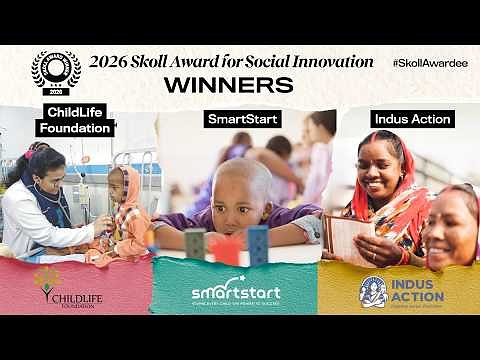
Local Innovators, Global Impact: Skoll Awards $6M to Tackle Systemic Crises
WASHINGTON, D.C. – April 07, 2026 – The Skoll Foundation today announced the recipients of its prestigious 2026 Skoll Award for Social Innovation, granting $2 million each to three organizations pioneering solutions to deeply entrenched global problems. ChildLife Foundation in Pakistan, SmartStart in South Africa, and Indus Action in India were recognized for their proven, scalable models that are transforming child health, early education, and access to public benefits for millions.
The unrestricted awards, which will be presented at the 23rd annual Skoll World Forum in Oxford, U.K., later this month, highlight a growing shift in philanthropy toward empowering local leaders who are rewriting the script on social change. By tackling systemic failures with community-integrated and data-driven approaches, these social enterprises are offering powerful blueprints for progress in some of the world's most challenging contexts.
From the Ground Up: Redefining Social Progress
The 2026 awardees stand out for their ability to create profound impact by addressing the root causes of inequality and suffering within their communities. Each has developed a unique, context-specific model that is now poised for exponential growth.
In Pakistan, a nation where nearly 1,000 children die each day from treatable conditions, the ChildLife Foundation is revolutionizing pediatric emergency care. Rather than building a parallel system, ChildLife partners with the government to overhaul and manage emergency rooms within existing public hospitals. By introducing modern equipment, efficient protocols, and rigorous staff training, the organization has achieved a tenfold reduction in mortality rates in the ERs it manages. Its impact extends far beyond major cities through a 24/7 telemedicine network that connects over 300 district hospitals to pediatric specialists, covering 90 percent of the country's population. Having already treated over 5.8 million children, ChildLife aims to scale its model to 40 modernized ERs and over 400 telemedicine sites, with the goal of providing life-saving care to 20 million children annually.
Meanwhile, in South Africa, where over a million children aged three to five are locked out of early learning opportunities, SmartStart is building an educational ecosystem from within communities. Its innovative social franchise model empowers local individuals, primarily women, to establish licensed early learning micro-enterprises in their homes and community spaces. This approach simultaneously tackles two critical issues: it provides affordable, high-quality early childhood education that is proven to narrow the achievement gap, and it creates dignified livelihoods for thousands of underemployed community members. With 15,000 programs currently reaching 160,000 children weekly, SmartStart has become the nation's leading early learning network. Independent evaluations show its model is working, with the proportion of children "on track" for developmental milestones jumping from 45% to 65% in just eight months.
In India, Indus Action confronts a paradox: a government that spends $150 billion annually on over 5,000 social protection programs, yet whose benefits fail to reach an estimated 800 million eligible citizens due to bureaucratic complexity. Indus Action acts as a crucial bridge, using technology and community engagement to help vulnerable families navigate the system and claim their legislated rights. By building open-source, citizen-centric tools and partnering directly with state governments to improve delivery systems, the organization has already helped hundreds of thousands of families access vital education, health, and financial programs. Their work under the Right to Education Act alone has enabled over 239,000 children from disadvantaged backgrounds to enroll in private schools, demonstrating a highly cost-effective pathway out of poverty. The organization's ambitious goal is to seamlessly connect 30 million citizens to their entitled benefits by 2030.
The Strategic Power of Unrestricted Funding
The Skoll Foundation's decision to provide $2 million in unrestricted funds to each winner is a deliberate and strategic choice that reflects a broader evolution in philanthropy. This approach moves beyond traditional, project-based grants, placing trust in proven leaders and empowering them with the flexibility to invest in what they need most, whether it's scaling operations, investing in technology, or adapting to unforeseen challenges.
"This year's winners of the Skoll Award for Social Innovation prove that when bold, creative leaders set their sights on a problem, their resolve and commitment lead to global systems change," said Marla Blow, CEO & President of the Skoll Foundation, in the announcement. "Even in the face of profound shocks to the social impact space, these organizations are not simply maintaining their impact; they are increasing it exponentially."
This philosophy of flexible, trust-based philanthropy is gaining traction as the limitations of restrictive funding become more apparent. Experts argue that unrestricted support is essential for fostering long-term, systemic change. It allows organizations to build robust internal capacity, retain top talent, and pivot their strategies based on real-time data and community feedback. This model treats grantees as partners and experts, not just project implementers. As the non-profit sector faces increasing demand amid declining government funding in many regions, such strategic, empowering investments are more critical than ever.
Lessons from the Front Lines: A Blueprint for Scalable Impact
While operating in vastly different sectors and countries, the work of ChildLife, SmartStart, and Indus Action reveals a set of common principles that offer a powerful blueprint for effective and scalable social change. Their success provides crucial lessons for policymakers, philanthropists, and development professionals worldwide.
A core theme is the power of public-private partnership. None of these organizations operate in a vacuum; they integrate deeply with existing government structures. ChildLife enhances public hospitals, Indus Action helps the Indian government fulfill its own policy promises, and SmartStart collaborates with South African officials to shape national early learning standards. This symbiotic approach ensures greater sustainability and allows for impact at a scale that would be impossible to achieve alone.
Equally important is their community-centric design. These are not top-down solutions imposed by outsiders. SmartStart’s model is built on the entrepreneurial drive of local women. Indus Action relies on a network of empowered citizens to help their peers. This deep community integration fosters local ownership, ensures cultural relevance, and builds resilient social infrastructure that continues to deliver value long after the initial intervention.
Finally, these innovators demonstrate a sophisticated use of technology and data. From ChildLife’s expansive telemedicine network to Indus Action’s citizen-facing digital tools, technology is leveraged not as an end in itself, but as a powerful enabler to overcome geographic barriers and bureaucratic inefficiencies. This is coupled with a rigorous, evidence-based approach, using data from constant monitoring and independent evaluations to refine their models and prove their impact, creating a virtuous cycle of improvement and growth.
As the leaders of these three organizations prepare to accept their awards in Oxford, their work serves as a powerful testament to the potential of social entrepreneurship. They demonstrate that with ingenuity, deep community partnership, and strategic support, it is possible to build more equitable and prosperous systems for all. Their models provide not just inspiration, but actionable roadmaps for tackling some of the most complex challenges of our time.
Topics & Related
Telehealth
Software & SaaS
Financial Services
AI & Machine Learning
Data & Analytics
Digital Transformation
Artificial Intelligence
Generative AI
Sustainability & Climate
Regulation & Compliance
Revenue
Net Income
Partnership
Related Company Pulse