
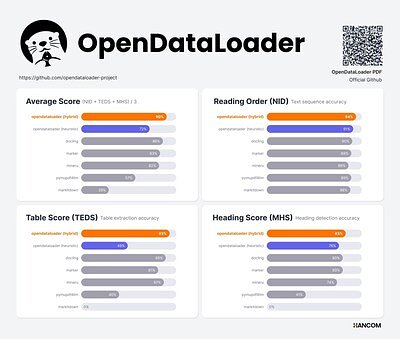
- Performance Benchmarks: OpenDataLoader PDF v2.0 outperforms competing open-source tools in reading order recognition, table extraction, and heading inference.
- License Change: Transition from Mozilla Public License (MPL 2.0) to Apache License 2.0 to foster commercial adoption.
- AI Add-ons: Four free AI add-ons included: OCR module, Table AI model, Formula Extraction tool, and Chart Analysis feature.
Experts would likely conclude that Hancom's OpenDataLoader PDF v2.0 represents a significant advancement in open-source document AI, combining superior performance, enhanced security, and strategic licensing to drive global adoption and innovation.
Hancom's New PDF Tool Aims to Reshape Open-Source Document AI
SEOUL, South Korea – March 13, 2026 – South Korean software giant Hancom has launched OpenDataLoader PDF v2.0, a significant update to its open-source document intelligence tool that is poised to challenge the established landscape of PDF data extraction. The release is built on bold claims of superior performance, a novel hybrid AI engine that prioritizes local data security, and a strategic shift in licensing designed to accelerate global adoption and commercial innovation.
In a field crowded with both open-source projects and proprietary enterprise solutions, Hancom is making a definitive statement. The company, best known for its Hangul word processor, released internal benchmarks showing OpenDataLoader PDF v2.0 outperforming competing open-source tools in critical areas like reading order recognition, table extraction, and heading inference. To foster transparency and community validation, Hancom has published the complete benchmark dataset and reproducible code on its official GitHub repository, inviting developers to scrutinize the results.
A Strategic Shift to Openness and Commercial Use
Perhaps the most significant move for the developer and enterprise community is the project's transition from the Mozilla Public License (MPL 2.0) to the far more permissive Apache License 2.0. This is not merely a legal footnote; it represents a fundamental strategic pivot designed to eliminate barriers to commercial use.
MPL 2.0, with its file-level copyleft provisions, can create complexities for businesses wanting to integrate and modify code within their proprietary products. In contrast, the Apache 2.0 license allows users to freely use, modify, and distribute the software for any purpose, including in commercial, closed-source applications, with minimal restrictions. This change directly addresses license compatibility headaches that often deter corporate adoption of open-source tools.
By embracing Apache 2.0, Hancom is effectively rolling out the red carpet for enterprises and startups to build on top of OpenDataLoader PDF. The company explicitly stated it expects this move to spur the creation of downstream business models, including new WebApp and SaaS applications, fostering a vibrant ecosystem around its core technology.
Solving Enterprise Pain Points: Security and Accessibility
At the heart of OpenDataLoader PDF v2.0 is a hybrid extraction engine that intelligently combines AI-based parsing with traditional direct extraction methods. The practical benefit is twofold: high accuracy on complex documents and an unwavering commitment to data security. The entire engine is designed to run entirely on-premise, meaning no sensitive data ever needs to be sent to a cloud server for processing. For organizations in sectors like finance, law, and healthcare, where data residency and confidentiality are non-negotiable, this local-first approach is a critical differentiator.
The new version comes bundled with four powerful AI add-ons at no cost: an OCR module for scanned documents, a lightweight Table AI model for complex tables with merged cells, a Formula Extraction tool for scientific notation, and a Chart Analysis feature that converts visuals into natural language descriptions. Crucially, these are designed for compatibility with third-party models, allowing developers to integrate the tool into existing AI pipelines without a complete overhaul.
Beyond data extraction, Hancom is tackling another major enterprise challenge: digital accessibility. With regulations like the European Accessibility Act (EAA) now in force and global standards like PDF/UA (Universal Accessibility) becoming mandatory, the operational burden of making documents accessible is immense. Hancom has announced a forward-looking roadmap to make OpenDataLoader PDF the first open-source tool to feature AI-generated accessibility tagging. This feature aims to automate the painstaking process of adding a logical structure tree and semantic tags to PDFs, a foundational step for compliance and ensuring documents are usable by people with disabilities who rely on assistive technologies like screen readers.
More Than a Parser: Infrastructure for the AI Revolution
Hancom's ambitions for OpenDataLoader PDF extend far beyond being a simple parsing tool. The company is strategically positioning it as a foundational piece of infrastructure for the burgeoning era of autonomous AI agents. The integration roadmap reveals a clear strategy to embed the tool deeply within the modern AI development stack.
Integration with LangChain, a leading framework for building LLM-powered applications, was completed in 2025. For 2026, Hancom is targeting integrations with Langflow, LlamaIndex, and the Gemini CLI. This ecosystem approach is vital. By connecting with tools like LlamaIndex, OpenDataLoader PDF becomes a powerful data ingestion layer for Retrieval-Augmented Generation (RAG) systems, which enhance large language models with private or domain-specific data. This allows AI applications to accurately answer questions and perform tasks based on the content of an organization's own document library.
Furthermore, the planned support for the Model Context Protocol (MCP) signals a focus on enabling more advanced agentic AI workflows, where autonomous agents can independently use the tool to read, understand, and act upon information contained in PDF documents. This positions OpenDataLoader PDF not just as a tool for developers, but as a utility for the AI agents they are building.
"OpenDataLoader PDF v2.0 has evolved into an open PDF data platform that anyone can freely use and build upon, through its AI hybrid engine and transition to Apache 2.0," said Jihwan Jeong, CTO of Hancom. "With upcoming commercial AI add-ons and accessibility solutions, we aim to lead the global ecosystem — making PDF documents not only AI-ready, but accessible to everyone."
OpenDataLoader PDF v2.0 is available now. Source code, benchmark datasets, and documentation are published at the project's official GitHub repository.