
- 10 MWe capacity: The Halo Micro-Modular Reactor (MMR) is designed to deliver 10 megawatts of electric power.
- Integral design: Combines reactor core, steam generator, and pressurizer in a single factory-sealed vessel, simplifying manufacturing and transport.
- Multi-year refueling cycle: Uses Low-Enriched Uranium Plus (LEU+) fuel to minimize operational complexity.
Experts would likely conclude that Hadron Energy's patented integral design leverages proven pressurized-water reactor technology to streamline manufacturing, enhance safety, and accelerate regulatory approval, positioning it as a pragmatic contender in the advanced nuclear power sector.
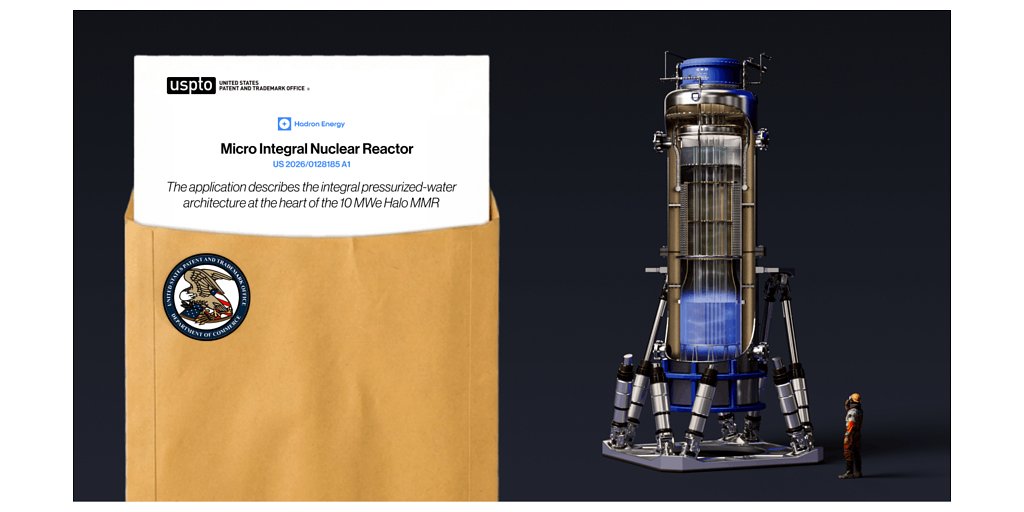
Hadron Energy's Patent: A Blueprint for Deployable Nuclear Power?
REDWOOD CITY, CA – June 16, 2026 – In the high-stakes race to build the next generation of nuclear reactors, innovation often gets tangled with exotic materials and unproven designs. Hadron Energy, however, is charting a different course. The company recently announced the publication of its first U.S. patent application, a move that pulls back the curtain on the engineering behind its Halo Micro-Modular Reactor (MMR). More than just a technical milestone, the document reveals a deliberate strategy: betting on proven technology, simplified design, and manufacturability to outmaneuver competitors in the complex journey to commercialization.
The patent, titled “Micro Integral Nuclear Reactor,” is the foundational intellectual property for the company’s 10-megawatt electric (MWe) power plant. While the forward-looking statements in any corporate announcement warrant caution, this publication puts hard engineering details into the public domain, offering a clear view of Hadron’s plan to deliver clean, transportable, and continuous power to a world hungry for it.
An Integral Design for a Modular Future
At the heart of the patent is an “integral pressurized-water architecture.” In simple terms, Hadron has taken the primary components of a traditional nuclear power plant—the reactor core, steam generator, and pressurizer—and housed them within a single, factory-sealed pressure vessel. This is a significant departure from the sprawling, complex plumbing of conventional plants, which require extensive on-site construction.
By eliminating the large-bore external piping that connects these components, the design achieves two critical goals. First, it dramatically simplifies manufacturing and transport. The Halo reactor is designed to be built in a factory, tested, and shipped by road or air to its destination. This plug-and-play approach could slash construction timelines and costs, two of the biggest hurdles for traditional nuclear projects. Second, it enhances safety. As described in the patent, the integral design removes the possibility of a large-break loss-of-coolant accident, a severe failure scenario that has long influenced reactor design and safety protocols. The reactor is further protected by passive cooling systems that can function without external AC power, a key lesson from past nuclear incidents.
“This first publication puts the engineering foundation of the Halo MMR on the public record and opens what we intend to be a deep intellectual property portfolio,” said Samuel Gibson, Founder and Chief Executive Officer of Hadron. “It reflects the work of an exceptional team and reinforces the momentum behind our development and licensing strategy.”
This approach stands in stark contrast to many other advanced reactor concepts that rely on novel coolants like molten salt or liquid sodium. While promising, those technologies face a longer, more arduous path through regulatory validation and require building entirely new supply chains. Hadron is instead leveraging the decades of operational data and regulatory familiarity associated with pressurized-water reactors (PWRs), the workhorse technology that powers the vast majority of the world's nuclear fleet.
Navigating the Regulatory Gauntlet
For any advanced nuclear company, the most formidable challenge isn’t just engineering—it’s navigating the rigorous and lengthy process of the U.S. Nuclear Regulatory Commission (NRC). Here, Hadron’s pragmatic choice of technology may prove to be its greatest asset. The company is not asking regulators to approve a fundamentally new type of nuclear fission; it is asking them to approve a novel, miniaturized application of a well-understood one.
Recent progress suggests the strategy is paying off. The patent publication follows two other key regulatory milestones for the company. The NRC recently accepted Hadron's Quality Assurance Program Description (QAPD), a foundational document that is a prerequisite for any serious licensing effort. Shortly after, the company submitted its Principal Design Criteria (PDC) white paper, which outlines the safety and design principles of the Halo reactor for NRC review. According to former regulatory officials, these pre-application engagements are crucial for de-risking the formal review process and building confidence with the agency.
Further signaling its move from design to execution, Hadron recently contracted a vendor to build a full-scope training simulator for the Halo reactor. This is a long-lead item essential for training the NRC-licensed operators who will one day run the plants. It’s a tangible investment that shows the company is planning for operational reality, not just theoretical design.
Powering the New Economy
The ultimate test for the Halo MMR will be its ability to solve real-world energy problems. Hadron is targeting a convergence of market needs where traditional power grids are falling short. The most prominent is the explosive growth of data centers, driven by the insatiable energy demands of artificial intelligence. These facilities require massive amounts of reliable, 24/7 baseload power, something that intermittent renewables like wind and solar cannot provide alone.
A 10 MWe micro-reactor, capable of being deployed directly on-site, offers a compelling solution, providing emission-free power without straining public grids. The same logic applies to heavy industry, remote mining operations, and isolated communities that currently depend on expensive and polluting diesel fuel. The Halo’s multi-year refueling cycle—enabled by a fuel called Low-Enriched Uranium Plus (LEU+)—minimizes on-site operational complexity, a major advantage for off-grid locations.
By focusing on the micro-reactor scale (2 to 20 MWe, as described in the patent), Hadron avoids direct competition with larger Small Modular Reactors (SMRs) being developed by companies like NuScale or GE Hitachi. Instead, it targets a niche for distributed, high-reliability power where its transportable, factory-built model provides a distinct advantage. With this patent, Hadron has not just protected its design; it has defined its place in the emerging energy landscape. With its technical blueprint now on public record, the company's race shifts from the patent office to the factory floor and the rigorous scrutiny of federal regulators.