
- 3-Horizon Roadmap: Graitec's AI strategy focuses on accountability, with phased integration (assistance, automation, generation).
- Open Ecosystem: Committed to integrating with existing platforms like Autodesk.
- Labor Shortage Mitigation: AI aims to enable smaller teams to accomplish more by automating mundane tasks.
Experts would likely conclude that Graitec's focus on AI accountability and trust aligns with the high-stakes, precision-driven needs of the AECO industry, offering a pragmatic alternative to speed-focused AI solutions.
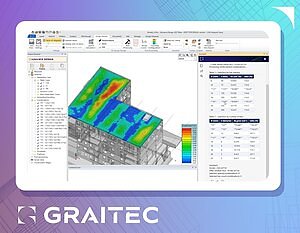
Graitec's AI Gambit: Why Responsibility is the New Speed in Construction Tech
PARIS, France – June 18, 2026
In the relentless gold rush for artificial intelligence, most companies are selling a pickaxe in the form of speed. Faster outputs, faster iterations, faster everything. But in the world of architecture, engineering, and construction (AECO)—where a misplaced decimal can have catastrophic consequences—one company is making a contrarian bet. Today, software developer Graitec unveiled an AI strategy that pointedly declares, "AI is not a speed problem. It is a responsibility problem."
This isn't just a clever marketing tagline; it's a strategic realignment that challenges the prevailing narrative. While others layer on generative chatbots as a flashy accessory, Graitec is arguing for something far more fundamental: AI that is so deeply embedded, auditable, and accountable that a professional would be willing to sign their name to its work. The company’s three-horizon roadmap isn’t about building a faster horse; it's about re-engineering the engine of creation for an industry built on precision and trust.
For the AECO sector, grappling with everything from labor shortages to staggering complexity, this focus on accountability might be the real killer app. It reframes the conversation from what AI can generate to what professionals can actually trust, build, and stand behind.
The Accountability Mandate
The core of Graitec’s position resonates deeply with the foundational principles of the AECO industry. Every blueprint is a promise of safety. Every structural calculation carries a legal and ethical weight. As professional bodies like the American Society of Civil Engineers (ASCE) consistently emphasize, AI is a tool, not a surrogate for professional judgment. The engineer remains the ultimate authority, responsible for every decision, regardless of its origin.
This is the crux of the "responsibility problem." An AI that generates a thousand beautiful but unbuildable or non-compliant designs is not a productivity tool; it's a liability engine. Graitec's strategy directly confronts this by proposing AI that operates within the guardrails of the real world.
"In AECO, AI can generate, but generating without accountability is not enough," said Emmanuel Leroy, Graitec's Chief Product & Strategy Officer, in the company's announcement. "The real challenge is ensuring what gets generated can be trusted, audited, and signed off on real projects. That's the bar we are building to."
To clear that bar, the company is focusing on three pillars. First, grounding the AI in engineering standards, structural codes, and fabrication norms. Second, driving outputs with deterministic engines—proven calculation and detailing software that produces verifiable results, with AI assisting in the preparation and interpretation. And third, ensuring every critical decision is ultimately validated by a human professional. It’s a philosophy that treats AI not as a magical black box, but as a powerful, yet governable, new layer in the professional's toolkit.
A Roadmap Beyond the Hype
To translate this philosophy into practice, Graitec has laid out a pragmatic, three-horizon roadmap, with all three horizons being developed in parallel. This isn't a distant, futuristic vision; it's a phased integration designed to build trust and deliver value incrementally.
Horizon 1: AI that Assists. This is the ground floor, and it’s already being built. By embedding AI directly into existing tools, Graitec is providing contextual guidance and task acceleration. For a structural engineer, this could mean instant access to relevant building codes within their design environment. For a BIM manager, it could mean AI-powered suggestions for resolving model clashes. These are not headline-grabbing generative feats, but they deliver immediate, tangible productivity gains and build user confidence in the technology.
Horizon 2: AI that Automates. The next step moves from assistance to delegation. This horizon targets the high-volume, low-creativity tasks that consume countless hours on any project. Think of AI handling repetitive coordination workflows, automating the flow of data between design and fabrication, or generating standardized documentation. The goal is to reduce manual effort and improve consistency, freeing up skilled professionals to focus on complex problem-solving.
Horizon 3: AI that Generates. This is the most ambitious frontier, where AI moves from optimizing tasks to generating holistic solutions. The vision is for a professional to provide design intent and constraints, and for the AI to generate optimized, code-compliant, and fabrication-ready designs in minutes. Crucially, even at this stage, Graitec insists that architects, engineers, and project teams will remain fully accountable, using the generated options as a powerful starting point for their final, validated design.
The Ecosystem Imperative: Playing Well with Others
Perhaps the most commercially astute element of Graitec's strategy is its commitment to an open ecosystem. The AECO technology landscape is notoriously fragmented, with professionals relying on a complex tapestry of software from different vendors. A closed, proprietary AI solution is a non-starter for most firms.
Graitec's plan to build its AI to integrate with the platforms customers already use—explicitly naming Autodesk—is a critical recognition of this reality. As an Autodesk Platinum Partner, Graitec is already deeply embedded in that world. Its recent acquisition of Ideate Software, a specialist in BIM plugins for Autodesk Revit, further solidifies this commitment, giving the company deeper access to the data and workflows that power a significant portion of the industry.
This open approach contrasts with a walled-garden mentality and aligns with the direction of major players like Autodesk, which is pursuing its own "Next Wave AI" of context-aware agents interacting across APIs. By positioning itself as a key, trusted partner within this emerging ecosystem, Graitec is betting on collaboration over domination.
This is further reinforced by its "shift-left" approach: bringing intelligence as early as possible into the project lifecycle. By using AI to generate, simulate, and validate options upstream, before decisions become expensive to change, Graitec is targeting one of the biggest sources of waste and inefficiency in construction: rework. Fewer fabrication errors and no surprises on site are benefits that resonate directly with a project manager's bottom line.
Redefining Roles, Not Replacing Them
The long-term implication of this strategy, particularly the automation and generation horizons, is a profound shift in the roles of AECO professionals. The fear of AI-driven job displacement is pervasive, but the reality in this sector is likely to be one of role evolution, driven by necessity.
The construction industry faces a severe labor shortage. AI is increasingly seen not as a threat, but as a force multiplier that can enable smaller teams to accomplish more. By automating the mundane, AI can free engineers and architects from the drudgery of documentation and repetitive calculations, allowing them to focus on the creative, strategic, and client-facing aspects of their work where human expertise is irreplaceable.
The professional of tomorrow may spend less time drawing and more time defining parameters, evaluating AI-generated options, and using their experience to make the final, critical judgments. Skills in data analysis, AI literacy, and systems thinking will become as important as knowledge of material science or structural dynamics. For junior professionals, this presents both a challenge and an opportunity. While automation may remove some traditional entry-level tasks, AI tools could also lower the barrier to entry for learning complex processes, accelerating skill development.
"We have 40 years of domain expertise embedded in our software," Leroy stated. "AI doesn't replace that; it unlocks it." In that single statement lies the entire strategy: a bet that in high-stakes industries, the future belongs not to the flashiest AI, but to the one that most successfully earns the trust of the professionals who must ultimately answer for its results.