
- 8K Resolution: GoPro MAX2 offers 'True 8K' 360-degree video, with up to 21% more resolution than some competitors.
- 37% Revenue Decline: GoPro's Q3 2025 revenue dropped 37% year-over-year, with a net loss of $21 million.
- 20% CAGR: The global 360-degree camera market is projected to grow at a compound annual growth rate (CAGR) of over 20% in the next five years.
Experts view the GoPro MAX2 as a strategic move to secure GoPro's position in the immersive content market, combining technological innovation with user-friendly design to address both creator needs and financial challenges.
GoPro's MAX2: A Strategic Victory in the Immersive Content Arms Race
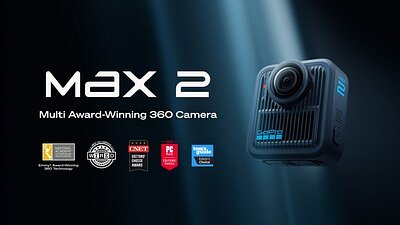
SAN MATEO, CA – December 03, 2025 – In a powerful statement to the consumer electronics market, GoPro has reasserted its innovative prowess. The company’s new MAX2 360 camera is sweeping the industry, collecting a string of top honors from technology authorities including WIRED, CNET, Tom's Guide, and PCMag. Capping this run is the company's third Technology & Engineering Emmy® Award, a prestigious nod to its foundational contributions to 360-degree video technology. While the accolades celebrate a single product, they signify a much larger strategic play in the rapidly expanding universe of immersive content.
GoPro's press release circuit has been alight with praise, with CEO Nicholas Woodman stating, "MAX2 is incredibly powerful, fun and easy to use, and is redefining how epic content comes to life." But beyond the polished corporate statements, the MAX2 represents a calculated response to a fiercely competitive market and a critical piece of the company's plan for a financial turnaround. This isn't just about a better camera; it's about securing a future in the next generation of digital media.
A New Benchmark in 360 Capture
The praise lavished upon the MAX2 is rooted in tangible technological advancements that address both creator ambitions and practical frustrations. The headline feature is its "True 8K" 360-degree video capability. In a market where resolution figures are often marketing buzzwords, GoPro's claim holds technical weight. The camera utilizes two sensors that each capture video at a resolution greater than 4K. When stitched together, this process retains more pixel data, resulting in a final 8K image that reviewers note is remarkably crisp and detailed, offering up to 21% more resolution than some competing 8K cameras.
This high-resolution capture at 30 frames per second (fps) is complemented by options for 5.6K at 60fps and 4K at 100fps, giving creators the flexibility to prioritize either maximum detail or silky-smooth slow-motion effects. Perhaps more significant for the camera's target audience—action sports enthusiasts and on-the-go creators—is the introduction of innovative twist-and-go replaceable lenses. The bulbous, exposed lenses of 360 cameras are notoriously vulnerable to scratches. By making them easily replaceable without tools, GoPro has provided a practical, real-world solution that significantly enhances the device's durability and long-term value.
This focus on user-centric design is paired with GoPro's legendary HyperSmooth stabilization technology and a six-microphone array that delivers impressive spatial and directional audio. It’s a package designed not just to capture a scene, but to immerse the viewer within it.
The Battle for the 360 Crown
The MAX2 does not enter a vacuum. The 360-camera market is a hotly contested arena, with Insta360 and DJI emerging as formidable rivals. Insta360's X-series cameras, particularly the recent X5, have set high bars for image quality and feature-rich software. CNET, while awarding the MAX2 an 'Editors' Choice' for its simplicity, still names the Insta360 X5 its 'best 360 camera overall' for 2025, praising its superior low-light performance thanks to larger sensors.
This highlights the strategic trade-offs at play. Where the MAX2 excels is in its streamlined user experience. Its simple two-button control and intuitive interface are designed for speed and ease of use, allowing creators to capture high-quality footage with minimal fuss. This approach contrasts with Insta360's app, which, while more powerful and feature-dense, can present a steeper learning curve. The MAX2, waterproof to 16 feet without a case and built with GoPro's signature ruggedness, doubles down on the brand's core identity.
However, it's not without its weak spots. Independent reviews consistently point to low-light video as an area where the MAX2 falls short of its primary competitors. Furthermore, its battery life, while adequate at just over an hour of 8K recording, is not class-leading, and it lacks the fast-charging capabilities found in some rival devices. This positions the MAX2 as the champion of daylight action and simplicity, while competitors may appeal more to users who prioritize nighttime shooting or maximum software versatility.
AI and the Democratization of Content Creation
A key pillar of the MAX2's appeal is what GoPro calls 'AI editing simplicity.' The challenge of 360-degree video has never been capture; it has been the complex, time-consuming process of 'reframing'—choosing a traditional flat, 16:9 or 9:16 frame from the spherical footage. GoPro's updated Quik app aims to solve this by using AI to automatically generate compelling edits, complete with pans, zooms, and cuts.
This feature is central to the company's strategy of democratizing advanced content creation. It lowers the barrier to entry for casual users, travel bloggers, and families who want to create dynamic, professional-looking videos without spending hours in editing software. While some professional reviewers have called the automatic edits 'hit or miss,' the value proposition for the mass market is undeniable. It transforms the 360 camera from a niche professional tool into an accessible device for everyday storytelling.
For advanced users, the workflow remains robust, if slightly less integrated than some would like. Footage can be exported via the GoPro Player desktop app for use in professional suites like Adobe Premiere Pro. This hybrid approach—simple for the novice, capable for the pro—is a calculated effort to capture the widest possible audience.
A Strategic Pivot Amidst Market Headwinds
The wave of awards and positive press for the MAX2 arrives at a critical juncture for GoPro. The company's Q3 2025 financial report painted a challenging picture, with revenue down 37% year-over-year and a net loss that widened to $21 million. Subscriber counts and direct-to-consumer sales also saw declines, reflecting intense market pressure and shifting consumer habits.
Against this backdrop, the MAX2 is not merely a new product; it is a cornerstone of a crucial turnaround strategy. Alongside other new hardware like the LIT HERO camera and the Fluid Pro AI gimbal, it represents an effort to diversify and expand GoPro's total addressable market. The accolades serve as powerful, third-party validation that can reignite consumer interest and drive sales during the vital holiday quarter. The Emmy® win, in particular, elevates the brand beyond a simple camera maker to an accredited technology innovator, a narrative that resonates strongly with both consumers and investors.
The initial promotional pricing of $399.99—a $100 discount—further underscores the aggressive push to regain market share. By positioning a technologically superior product at a competitive price point, GoPro is making a direct challenge to its rivals and a compelling offer to customers on the fence.
The Expanding Universe of Immersive Media
The success of the MAX2 is amplified by explosive growth in the very market it serves. The global 360-degree camera market is projected to grow at a compound annual growth rate (CAGR) of over 20%, potentially becoming a multi-billion-dollar industry within the next five years. This growth is fueled by the surging demand for immersive content across social media, the rise of VR and AR applications, and increasing adoption in commercial sectors like real estate, tourism, and education.
GoPro's Emmy® for '360-degree Consumer and Professional Camera Technology' is significant because it recognizes the company's long-term investment in the software and algorithms that make immersive video seamless and accessible. As AI continues to automate and simplify complex editing tasks, the creation of 360-degree content will become increasingly mainstream. The innovations packed into devices like the MAX2 are not just capturing our world in new ways; they are providing the tools to build the next iteration of digital interaction and entertainment.