
- $105 million in seed funding secured by Genesis AI
- 95% of physical labor remains unautomated due to lack of dexterity and adaptability in current robots
- Proprietary simulation engine generates synthetic data 430,000 times faster than real-world time
Experts would likely conclude that Genesis AI's hiring of Vivian Sun marks a critical step toward commercializing general-purpose robotics, leveraging her proven track record in bringing complex AI technologies to market.
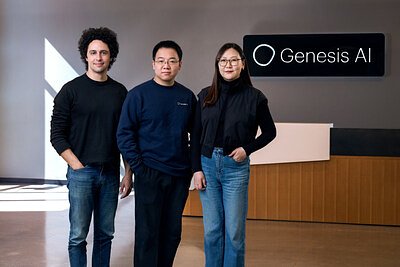
Genesis AI Hires Amazon Vet to Commercialize General-Purpose Robots
PARIS and SAN CARLOS, Calif. – March 11, 2026 – Genesis AI, a well-funded robotics company aiming to create general-purpose physical intelligence, has hired former Amazon leader Vivian Sun as its Vice President of Commercial and Strategy. The move signals a critical pivot for the company, shifting its focus from pioneering research and development to the aggressive commercialization of its advanced robotics platform.
Sun, a veteran startup builder with deep expertise in autonomous driving and AI from her time at Amazon, Waabi, and TuSimple, will lead Genesis AI's global go-to-market strategy, commercialization, and strategic partnerships. Her appointment is a clear declaration that the company, which has operated largely in stealth while securing $105 million in seed funding, is ready to transition its ambitious vision for "physical AI" from the lab into the real world.
A Strategic Pivot to Commercialization
Vivian Sun's career has been defined by her ability to translate complex, frontier technologies into viable commercial products. Her track record is precisely what a deep-tech company like Genesis AI needs as it enters its next phase. Most recently, Sun was the Head of Automated Driving at Amazon, where she gained firsthand experience integrating cutting-edge technology into one of the world's most complex logistical operations.
"Vivian has built playbooks for bringing breakthrough technologies from research in emerging industries into real-world deployment," said Zhou Xian, Co-Founder and CEO of Genesis AI. "Her expertise will help our customers transition into the era of physical AI, serving as a trusted partner to accelerate adoption and deliver long-term value to unlock the productivity potential of general-purpose robotics."
Before her tenure at Amazon, Sun served as Chief Commercial Officer at Waabi, a company developing autonomous driving technology. However, it was her role as an early executive at autonomous trucking firm TuSimple that cemented her reputation as a commercialization powerhouse. There, she was instrumental in shaping the company's business model and go-to-market strategy, forging a first-of-its-kind OEM partnership model and securing thousands of autonomous truck reservations. Her contributions were a key factor in TuSimple's successful $8 billion IPO.
Sun's appointment underscores a crucial trend in the AI industry: technological prowess alone is insufficient for success. The ability to build a business, forge partnerships, and navigate market entry is just as vital.
"General-purpose robotics represents one of the most exciting frontiers in technology today, with the potential to unlock unprecedented productivity across the globe," Sun stated. "Genesis AI is entering a pivotal moment as we transition from pioneering our technology to driving commercial adoption across industries."
Beyond Specialized Bots: The Promise of 'Physical AI'
Genesis AI is tackling one of the biggest challenges in automation. While specialized robots have become common in structured environments like automotive assembly lines, they represent a tiny fraction of automation's potential. An estimated 95% of physical labor, contributing upwards of $30 trillion to the global economy, remains unautomated because most tasks require a level of dexterity, real-world reasoning, and adaptability that current robots lack.
The company's solution is a "universal robotics foundation model" (RFM), a sophisticated AI brain designed to power a wide variety of general-purpose robots. Instead of building brittle, single-task software, Genesis AI is creating a horizontal platform that can learn and adapt, enabling different types of robots to perform a vast range of physical tasks.
Underpinning this ambitious goal is a full-stack, data-centric approach. Genesis AI has developed a proprietary, high-fidelity physics simulation engine capable of generating rich synthetic data at speeds reportedly up to 430,000 times faster than real-world time. This simulation data is integrated with large-scale data collected from real-world robots, creating a continuous, closed-loop system that gives the company a unique data advantage in training its models. This approach aims to solve the data bottleneck that has historically plagued robotics development, where collecting sufficient real-world training information is slow, costly, and often impractical.
A Crowded Field with Heavyweight Backing
The quest to build general-purpose robotics is becoming a high-stakes race, and Genesis AI is not alone. It joins a growing cohort of startups, including highly valued players like Skild AI and Physical Intelligence, all competing to define the future of physical work.
What sets Genesis AI apart is its formidable financial and intellectual backing. The company emerged from stealth with a massive $105 million seed round co-led by Eclipse Ventures and Khosla Ventures. The list of backers also includes Bpifrance, HSG, and a roster of tech luminaries such as former Google CEO Eric Schmidt, French telecommunications mogul Xavier Niel, and renowned AI pioneers Daniela Rus and Vladlen Koltun.
This level of investment reflects a profound belief in both the team and their technological strategy. Investors are betting on the company's full-stack approach and its unique method of combining simulation and real-world data to crack the code of generalizable AI for physical systems. The founding team itself comprises experts from top-tier institutions and companies like Mistral AI, Nvidia, and Google, with deep expertise spanning physics, graphics, robotics, and large-scale AI.
From Lab to Factory Floor: The Go-to-Market Challenge
With its technology foundation and funding secured, Genesis AI's greatest challenge now lies in execution—turning its universal model into tangible solutions for industries like manufacturing, logistics, healthcare, and agriculture. This is precisely where Vivian Sun's role becomes critical.
Her experience in the autonomous vehicle sector provides a direct parallel. Commercializing self-driving trucks required navigating complex regulatory landscapes, building trust with massive enterprise customers, and creating an ecosystem of partners—all challenges she will likely face again in the robotics sphere. Her background in logistics at Amazon and TuSimple makes her uniquely qualified to target the warehousing and supply chain sectors, which are grappling with persistent labor shortages and are ripe for advanced automation.
As part of its strategy, Genesis AI plans to open-source components of its data engine and foundation model. This move is designed to empower researchers and developers, accelerate progress across the field, and build a community around its platform. By fostering an open ecosystem, the company hopes to drive faster adoption and validation of its technology across new domains. With Sun now leading the charge on commercial strategy, the industry will be watching closely to see if Genesis AI can successfully bridge the gap between its ambitious vision for physical AI and the complex, unstructured reality of the global economy.