
- 2.2 pounds (0.99 kg): Weight of the GeekBook X14 Pro, claimed as the world's lightest Windows laptop in its class.
- 150% revenue growth: GEEKOM's revenue surge in the previous quarter, fueling its expansion into the ultralight notebook segment.
- 16-hour battery life: Promised battery duration for the GeekBook X14 Pro, addressing the demand for all-day power.
Experts would likely conclude that GEEKOM's entry into the ultralight laptop market with the GeekBook X14 Pro is a bold and strategic move, leveraging its mini PC expertise to challenge established brands, but success will depend on execution in marketing, pricing, and customer support.
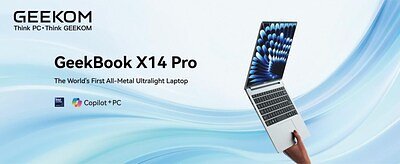
GEEKOM's Gambit: The 2.2-Pound Challenge to the Laptop Elite
TAIPEI, TAIWAN – December 01, 2025 – The fiercely competitive personal computing landscape is about to receive a new contender. GEEKOM, a company that carved out a dominant position in the premium mini PC market, has officially thrown down the gauntlet, announcing its expansion into the ultralight notebook segment with the GeekBook X series. Spearheading this ambitious charge is the GeekBook X14 Pro, a device positioned not just as a new product, but as a statement of intent, embodying the company's new vision: "Think PC, Think GEEKOM."
This move represents a classic case of a niche champion stepping into a global arena. Riding a wave of success that includes a staggering 150% revenue growth in the previous quarter, GEEKOM is leveraging its expertise in compact, high-performance engineering to challenge the likes of Dell, HP, Lenovo, and Apple. The central question for industry observers and consumers alike is whether this mini PC powerhouse has the strategy, innovation, and brand muscle to disrupt the established order of the laptop world.
The Weight of a Claim in a Crowded Market
GEEKOM's primary marketing salvo for the GeekBook X14 Pro is a bold one: it's billed as the "world's lightest Windows laptop in its class," weighing in at a mere 2.2 pounds (0.99 kg). In an era where portability is paramount for mobile professionals and hybrid workers, this figure is designed to grab attention. The laptop achieves this featherlight status through a precision-engineered magnesium alloy chassis, a material favored in the premium tier for its blend of strength and low weight.
However, in the cutthroat ultralight category, such claims are often a matter of fine print and careful classification. While 2.2 pounds is undeniably impressive for a 14-inch machine, GEEKOM enters a field populated by giants who have been perfecting this formula for years. Competitors like the ASUS Zenbook A14 and Lenovo's prestigious ThinkPad X1 Carbon Gen 13 Aura Edition also boast sub-1kg weights, with some configurations dipping even lower. Models from Dell's Latitude line and HP's OmniBook series similarly hover around this benchmark.
This context doesn't necessarily invalidate GEEKOM's engineering achievement. Rather, it highlights the ferocity of the competition and the aggressive positioning required to make an impact. The X14 Pro's weight firmly places it within the elite club of ultra-portables. The claim, whether definitively true or a masterpiece of marketing semantics, successfully signals that GEEKOM is not entering the market to compete on price alone, but to challenge on the core tenets of premium design and innovation.
Assembling a Premium Contender
Beyond its weight, the GeekBook X14 Pro’s specifications sheet reads like a checklist for a 2025 flagship ultrabook. The company has clearly studied the market and is aiming to match or exceed the features that define the premium experience. The centerpiece is a vibrant 14-inch 2.8K OLED display with a fluid 120Hz refresh rate—a combination that has become the gold standard for content creators and media consumers who demand crisp details and buttery-smooth motion.
Under the hood, the choice of Intel's top-tier Core Ultra 9 185H processor is significant. This chip is part of Intel’s "Meteor Lake" family, which is central to the "AI PC" revolution. It features a sophisticated architecture that combines high-performance cores for demanding tasks, efficiency cores for background processes, and a dedicated Neural Processing Unit (NPU). This NPU is critical, offloading AI-driven features—like real-time background blur in video calls or intelligent performance optimization—from the main processor, resulting in better performance and improved battery efficiency. With a promised battery life of up to 16 hours, GEEKOM is directly addressing the non-negotiable demand for all-day power.
These components show that GEEKOM understands the current battlefield. The ultralight market is no longer just about being thin and light; it's about delivering uncompromised performance, stunning visuals, and intelligent, AI-enhanced experiences. By integrating a high-refresh OLED panel and a powerful, AI-ready processor into its lightweight chassis, GEEKOM is ensuring its debut product can compete feature-for-feature with established flagships from brands like the Dell XPS, HP Spectre, and LG Gram.
A Strategic Leap from Niche to Mainstream
The launch of the GeekBook X series is far more than a product line extension; it's the cornerstone of a fundamental shift in GEEKOM's corporate strategy. Having cultivated a loyal following and impressive financial growth in the mini PC segment—where its products often outperform rivals from major brands in European markets—the company is now making a calculated bid to become a "full-spectrum PC brand."
This diversification is a logical, albeit challenging, next step. The laptop market is exponentially larger than the mini PC market, offering a far greater ceiling for growth. However, it also demands a different level of operational scale, brand marketing, and customer support. Building a brand that resonates with mainstream laptop buyers, who have long-standing relationships with established names, will require a substantial investment in marketing and building trust.
Furthermore, competing with global giants means navigating complex supply chains, managing global distribution, and, crucially, providing the robust after-sales service and warranty support that premium customers expect. While GEEKOM's success with online distribution channels like Amazon and Newegg provides a solid foundation, expanding its reach and support infrastructure to match its new ambitions will be a critical test. The company's ability to execute on this broader strategy will ultimately determine whether the GeekBook is a successful new chapter or a cautionary tale of overreach.
The mid-December launch will be the first real test of this new strategy. Pricing will be a key factor; to lure customers away from trusted brands, GEEKOM will need to offer a compelling value proposition that balances its premium specifications with an attractive price point. If it can successfully navigate these challenges, GEEKOM's entry could inject a fresh dose of competition into the premium laptop market, providing consumers with a powerful new option and forcing established players to keep innovating.