
- Efficiency: GPC 3.0 modules achieve efficiencies between 23.27% and 24.05%.
- Warranty: 30-year linear power warranty with a 0.35% annual degradation rate.
- Sustainability: FBR silicon process reduces energy use by 70%+ and carbon footprint by up to 42%.
Experts would likely conclude that GCL SI's back-contact technology represents a strategic shift toward higher efficiency, aesthetic integration, and sustainability in solar panels, positioning the company as a leader in the premium market.
GCL SI's Back-Contact Bet: Redefining Solar Value Beyond Watts
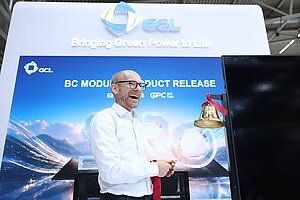
MUNICH, Germany – June 24, 2026 – Amid the hum of innovation at Intersolar Europe 2026, one of the solar industry's most influential gatherings, GCL System Integration Technology (GCL SI) made a declaration that was both a product launch and a profound statement of strategy. The company announced it is establishing back-contact (BC) cell technology as the core pillar of its future, unveiling the GPC 3.0 full-screen all-black module as the first emissary of this new era. This move is more than a technical upgrade; it's a calculated response to a market that increasingly demands a synthesis of peak performance, aesthetic elegance, and verifiable sustainability—a trifecta that could redefine lasting value in the 2026 energy landscape.
The Strategic Pivot to Back-Contact
For years, the solar industry's efficiency race has been dominated by technologies like TOPCon and HJT. GCL SI's pivot represents a confident stride in a new direction. The company is betting that BC technology offers a path to greater gains, framing it as the next logical step in solar's evolution. "BC is the ultimate architecture for crystalline silicon cells," stated GengWeng Huang, Executive Dean of GCL SI's Cell Research Division. "We've already explored TOPCon and HJT extensively, but both are reaching their physical limits. BC is opening a broader window for future efficiency gains."
This isn't mere marketing rhetoric. Back-contact architecture fundamentally redesigns the solar cell by moving all electrical contacts to the rear. This eliminates the metallic grid lines on the front that obstruct sunlight and create visual clutter, immediately boosting both light absorption and aesthetics. The result is a cleaner look and, more importantly, a higher ceiling for performance.
GCL SI is backing this claim with impressive numbers. Its mass-produced GPC cells have achieved an average conversion efficiency of 28.38%, a figure that pushes toward the theoretical limits of crystalline silicon. This translates into the new GPC 3.0 modules boasting efficiencies between 23.27% and 24.05%. While highly competitive, GCL SI enters a fiercely contested arena. Competitors like LONGi and Aiko Solar also showcased advanced back-contact modules at Intersolar with efficiencies touching the 25% mark, signaling that the battle for the premium market will be fought at the cutting edge of material science and manufacturing prowess.
Capturing the European Rooftop
The GPC 3.0 module is engineered with a specific customer in mind: the European home or business owner. In the dense, space-constrained markets of Europe, maximizing energy production from a limited rooftop area is paramount. With a power output of 475-500 watts per panel, GCL SI's new offering delivers the high energy density required.
But performance alone is no longer enough. The module's "full-screen all-black" design speaks to a sophisticated understanding of the market. As solar becomes a standard feature of the built environment, its visual integration is critical. These panels are designed not just to generate power, but to complement modern architecture, transforming a utilitarian object into a design element. This focus on aesthetics is a direct answer to how technological change can improve daily life, making the adoption of clean energy a more seamless and attractive proposition for consumers.
To underscore its commitment to lasting value, GCL SI is offering a 30-year linear power warranty with an impressively low annual degradation rate of just 0.35%, alongside a 30-year product warranty. This assures customers of sustained performance and a reliable return on investment over decades. In a powerful signal of its market-ready strategy, the company confirmed that the first containers of GPC 3.0 modules are already on their way to Europe, aiming to rapidly convert technological potential into market presence.
Beyond Efficiency: The Sustainability Edge
Perhaps the most strategic and forward-looking aspect of GCL SI's announcement lies in the material composition of its new modules. The company leverages its in-house FBR (Fluidized Bed Reactor) granular silicon, a technology that offers a substantial advantage in the growing economy of sustainability.
Unlike the energy-intensive Siemens method traditionally used to produce polysilicon, the FBR process consumes over 70% less energy and generates a carbon footprint up to 42% lower. This isn't an unverified claim; GCL's FBR silicon has received low-carbon certifications from respected bodies like the French Environment and Energy Management Agency (ADEME) and the China Quality Certification Center (CQC). For a market like Europe, where regulations like the Carbon Border Adjustment Mechanism and corporate ESG (Environmental, Social, and Governance) mandates are becoming powerful economic drivers, a verifiably lower carbon footprint is a formidable competitive advantage.
By controlling its supply chain from the raw silicon up, GCL SI can deliver a product that is not only high-performing but also aligns with the global imperative for decarbonization. This vertical integration allows the company to build sustainability into the very DNA of its products, offering a level of supply chain transparency and environmental accountability that is increasingly demanded by policymakers, investors, and end-users.
A New Benchmark for Value
With the launch of GPC 3.0, GCL SI is making a compelling argument that the definition of value in the solar industry is expanding. The conversation is shifting from a narrow focus on cost-per-watt to a more holistic assessment that includes lifetime energy yield, design aesthetics, and the environmental impact of manufacturing. The company's strategy is a cohesive narrative that weaves together advanced passivation techniques, innovative metallization to reduce silver consumption, and the foundational advantage of low-carbon FBR silicon.
This integrated approach demonstrates a nuanced understanding of where the global energy transition is headed. As the world looks toward 2026 and beyond, the companies that thrive will be those that can deliver not just a product, but a comprehensive solution that addresses the technical, economic, and ethical dimensions of our energy future. GCL SI's bet on back-contact technology is a clear signal of its intent to be one of those leaders, pushing the industry to build a cleaner and more resilient world, one elegant, efficient, and sustainable rooftop at a time.