
- Star Legend's social media following: 280 million combined for its celebrity-driven IP
- Star Legend's stock surge: 165.6% in a single session after Jay Chou's Douyin launch
- Unitree Technology's valuation: Over $1.7 billion
Experts view Galaxy Corporation's Nasdaq discussions and AI-powered entertainment strategy as a transformative shift in the industry, blending intellectual property, artificial intelligence, and robotics to create scalable, interactive content ecosystems.
Galaxy's Nasdaq Nod Signals New Era for AI-Powered Entertainment
SEOUL, South Korea – March 06, 2026 – A high-level meeting in Seoul is sending ripples through the global technology and entertainment sectors, signaling a potential new frontier where celebrity, artificial intelligence, and capital markets converge. The March 4 visit by Nasdaq Vice Chairman Bob McCooey to the headquarters of Galaxy Corporation was far more than a courtesy call; it was a significant exploration of the Korean “enter-tech” firm’s potential pathway to the U.S. stock market, underscoring growing investor appetite for companies that blend intellectual property (IP) with next-generation technology.
The meeting throws a spotlight on Galaxy's ambitious global strategy and its crucial alliance with Star Legend (6683.HK), a Hong Kong-listed IP powerhouse that has become the engine for its expansion into China and across Asia. As Galaxy positions itself not just as a content creator but as a unified ecosystem of IP, AI, and robotics, its journey from Seoul toward Wall Street could set a new precedent for the future of entertainment.
The 'Enter-Tech' Vision
Unlike traditional media conglomerates focused on film and music production, Galaxy Corporation has aggressively branded itself as an “entertainment technology” company. This model seeks to build a sustainable and scalable business by reducing reliance on individual hit shows or movies. Instead, the focus is on creating a durable ecosystem where intellectual property is amplified and monetized through cutting-edge technology.
During his visit, McCooey reportedly showed keen interest in some of Galaxy's most forward-looking projects, including an AI-based K-pop robot initiative and a virtual IP strategy. This aligns with the company's vision of a future where technology extends the life and reach of entertainment content. Galaxy's CEO has publicly forecasted the rise of “robot idols” within five years, coexisting with human performers, and has discussed projects aimed at creating AI-powered digital twins of artists, allowing them to release content and interact with fans posthumously.
This technology-first approach is precisely what piques the interest of global capital markets like Nasdaq, which prioritize scalable growth models. By integrating AI and robotics, Galaxy aims to create new, interactive entertainment formats that can be replicated and customized, offering a potentially more predictable revenue stream than the volatile, project-based economics of traditional Hollywood.
Star Legend: The Powerhouse Partner
Central to Galaxy’s global ambitions is its strategic partner and shareholder, Star Legend. The Hong Kong-listed firm has rapidly emerged as a dominant force in the creation and operation of celebrity-driven IP, providing Galaxy with critical access and expertise in the lucrative Chinese market.
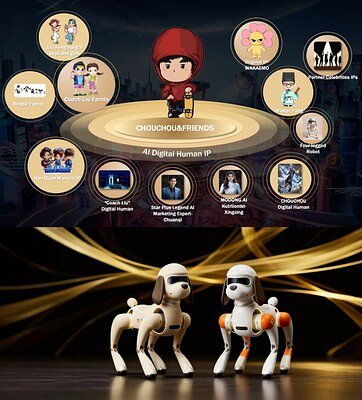
Star Legend has honed an end-to-end model that covers IP development, content operations, and commercial monetization. It boasts partnerships with some of Asia’s biggest stars, including Mandopop icon Jay Chou and fitness entrepreneur Will Liu. The company has skillfully transformed their personal brands into scalable IP assets, such as the “Chou Chou IP,” building a portfolio that commands a staggering combined social media following of around 280 million.
This influence has translated into significant market impact. On July 9, 2025, when Jay Chou launched his Douyin account under the Star Legend-developed IP, the company’s share price skyrocketed by as much as 165.6% in a single session. The market has consistently reacted with enthusiasm to its strategic moves, with its stock also jumping over 14% on the news that it would subscribe for up to 7% of Galaxy's share capital, solidifying the partnership. Financially, Star Legend reported revenues of HKD 736.30 million over the last year, with its IP creation and operation segment being the primary driver.
Beyond celebrity management, Star Legend is making strategic infrastructural plays. In September 2025, it became the sole private-sector shareholder in the operator of Beijing's iconic National Stadium, the “Bird’s Nest.” This move provides a world-class physical venue to anchor its IP, with plans to develop themed merchandise and events, further blurring the lines between digital content and real-world experiences.
A Blueprint for Global Expansion
With Star Legend securing its foothold in Asia, Galaxy Corporation is looking westward. The discussions with Nasdaq are the clearest signal yet of its intent to tap into the deep pools of capital in the U.S. to fund its ambitious expansion. The strategy appears to be a multi-pronged global assault, leveraging regional strengths: Korean software and content creation, Chinese market access and IP monetization, and U.S. financial backing.
China remains a pivotal, if complex, piece of the puzzle. Galaxy has been clear about its plans to establish “Galaxy China” and increase strategic investment, citing the market’s “virtually unlimited development potential.” The company sees a powerful synergy between South Korea's advanced software capabilities and China’s formidable hardware manufacturing prowess.
However, navigating China's heavily regulated entertainment landscape is a formidable challenge. Foreign companies have historically faced significant restrictions, often requiring joint ventures and navigating stringent content reviews. While recent regulatory shifts have slightly eased rules for establishing entertainment venues, the market still favors domestic content and requires careful, localized strategies. Here again, Star Legend’s role is indispensable, providing the local knowledge, partnerships, and cultural fluency necessary to succeed where many foreign firms have struggled.
Building the Future: IP, AI, and Robotics Converge
The most futuristic element of this emerging entertainment empire is the tangible integration of robotics. The vision of an “IP + AI + Robotics” model moved from a concept to a concrete business plan on November 12, 2025, when Star Legend announced a joint venture with the prominent Chinese robotics developer Unitree Technology.
The 50/50 joint venture, named Yuxing Entertainment Technology, aims to create and sell consumer-grade IP robots. The partnership clearly delineates roles: Star Legend will provide the celebrity IP, content design, and marketing muscle, while Unitree will handle the core robotics R&D, design, and production. Unitree, a Hangzhou-based firm valued at over $1.7 billion, is a leader in developing cost-effective and high-performance quadruped and humanoid robots, famous for its viral “Go1” robotic dog.
This collaboration is designed to create a new product category: personable, versatile consumer robots infused with the identity and character of beloved celebrities. The applications range from home entertainment to live musical performances, transforming a piece of hardware into a dynamic platform for content and interaction. As artificial intelligence and robotics continue to advance, the partnership between Star Legend and Unitree, backed by the broader vision of Galaxy Corporation, is laying the groundwork for what could be the next major evolution in interactive entertainment.