
- 180 zettabytes: Projected global data growth by 2025, straining traditional storage solutions.
- 215 petabytes per gram: Theoretical data storage capacity of DNA, surpassing conventional hard drives.
- 60% CAGR: Projected annual growth rate for the DNA data storage market through 2033.
Experts view this partnership as a critical step toward commercializing DNA data storage, leveraging semiconductor advancements to overcome cost and scalability barriers for long-term archival solutions.
Silicon Meets DNA: A New Partnership to Solve the AI Data Crisis
LEUVEN, Belgium and SOUTH SAN FRANCISCO, Calif. – March 05, 2026 – In a move that signals a major acceleration in the quest for next-generation data storage, nanoelectronics leader imec and DNA storage pioneer Atlas Data Storage have announced a strategic partnership. The collaboration, which includes a direct investment from imec into Atlas, aims to scale the production of synthetic DNA for storing the digital universe, tackling the explosive data growth of the artificial intelligence era head-on.
This alliance marries Atlas's specialized ASIC design and DNA synthesis technology with imec's world-renowned expertise in advanced semiconductor fabrication. The goal is to create a commercially viable, permanent data storage solution that leverages the blueprint of life itself to archive humanity's ever-expanding digital legacy.
The Dawn of a Biological Hard Drive
As AI models and data-intensive applications generate information at an exponential rate—projected to reach 180 zettabytes by 2025—traditional storage media like magnetic tape and hard disk drives are approaching their physical limits. These technologies face mounting challenges in density, long-term reliability, and sustainability, with enterprises already facing potential storage shortfalls.
DNA data storage presents a radical alternative. Nature's own information medium is incredibly dense; a single gram of DNA can theoretically hold 215 petabytes of data, equivalent to hundreds of thousands of conventional hard drives. It is also exceptionally durable. While magnetic tapes require energy-intensive, climate-controlled environments and must be migrated to new media every decade or two, properly encapsulated DNA can preserve information for thousands of years with minimal energy. This "write once, read forever" capability eliminates the costly and risky cycle of data migration.
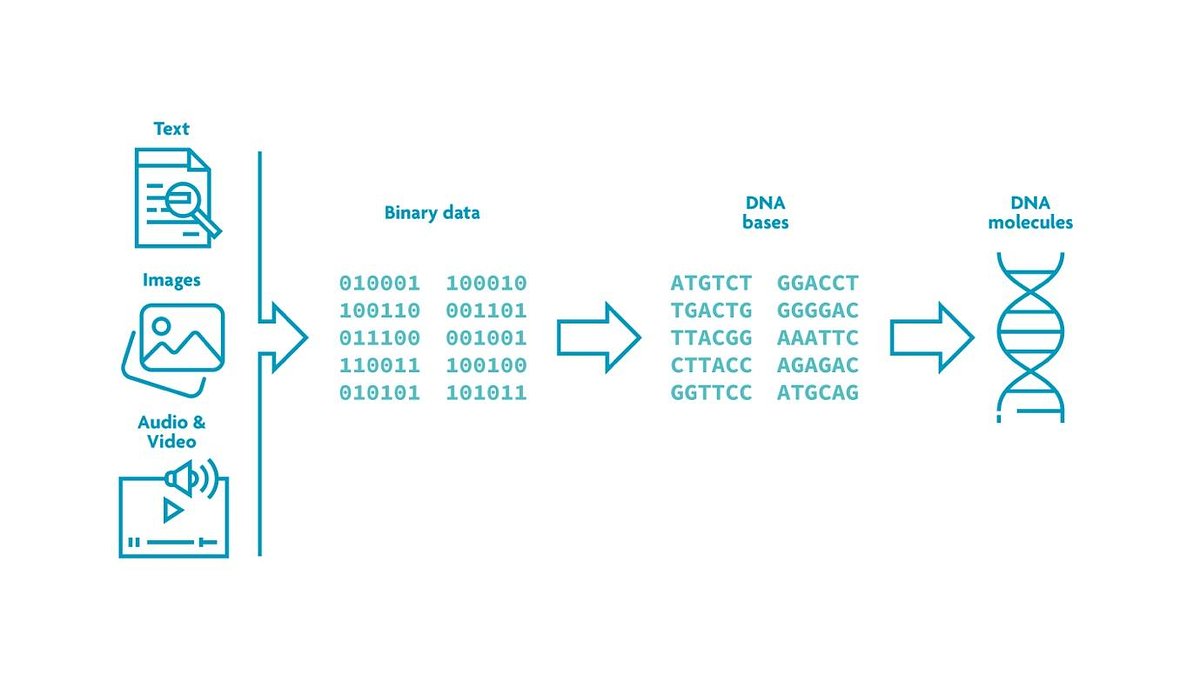
The partnership's core innovation lies in bridging the worlds of silicon and biology. To overcome the primary hurdle of slow and expensive DNA synthesis, the two companies have co-developed a custom chip that integrates a dense nano-scale array of electrochemical cells directly onto a CMOS ASIC designed by Atlas. This integrated chip acts as an orchestrator, controlling millions of individual sites where synthetic DNA is built, letter by letter, to encode digital 0s and 1s.
"To make DNA-based digital data storage viable, the synthesis throughput needs to scale by several orders of magnitude over today's approach," explained Siraj Nour ElAhmadi, Atlas Chief Operating Officer. "To meet this challenge, we anchored our solution on silicon, leveraging the very large-scale integration benefits afforded by CMOS technology. Our collaboration with imec was crucial to build the nano device layer on top of our CMOS ASIC."
The technical feat was not without its difficulties. "One of the challenges was etching the platinum devices at very small dimensions," said Simone Severi, imec Vice President of R&D. "Another critical design challenge was minimizing leakage currents between neighbouring devices at these extremely small dimensions." Imec’s R&D team developed a custom process to ensure the array's stability and reliability, a critical enabler for scaling up the technology.
A Strategic Bet on the Future of Data
Imec's involvement extends beyond technical collaboration. By taking a direct financial stake in Atlas Data Storage, the Belgian research hub is making a significant bet on the future of the data storage market. This move is consistent with imec's broader venturing strategy, which includes its imec.xpand venture capital fund, designed to nurture deep-tech startups where its semiconductor expertise can be a key differentiator.
"With this approach, imec becomes a direct investor in Atlas Data Storage," observed Olivier Rousseaux, imec director of venture development. "As with other imec venture portfolio companies, Atlas will benefit from cutting-edge R&D and nano fabrication processing capabilities, as well as hands-on business support."
This investment comes at a pivotal moment. The DNA data storage market, while still in its infancy, is projected to experience explosive growth. Market analysts forecast a compound annual growth rate (CAGR) of over 60%, potentially expanding from under $100 million in 2024 to more than $5.5 billion by 2033. Atlas, which spun out of Twist Bioscience in 2025, joins a competitive field of innovators including Illumina and Microsoft, all racing to commercialize the technology. The partnership with a manufacturing powerhouse like imec, with its state-of-the-art 300mm silicon platform, provides Atlas with a crucial advantage in scaling production and driving down costs.
Solving the Data Center's Carbon Problem
The insatiable demand for data has created a significant environmental challenge. Data centers currently account for 1-2% of global electricity consumption, a figure that is rising steadily. The energy required for powering servers and, critically, for cooling them, contributes a substantial carbon footprint.
DNA storage offers a path toward a more sustainable digital infrastructure. Once data is written to DNA and stored, it requires virtually no energy, a concept known as "ultra-low energy at rest." This dramatically reduces the operational costs and environmental impact associated with long-term archival. By compressing vast datasets into tiny physical volumes, it also promises to shrink the physical footprint of archival facilities from sprawling warehouses to a small room. This convergence of life science and semiconductor technology unlocks a radically greener way to manage the world's information.
The Road to Widespread Adoption
Despite its immense potential, DNA data storage faces significant hurdles before it can become a mainstream solution. The primary obstacles remain cost and speed. Currently, writing data to DNA can be astronomically expensive compared to tape, with some estimates putting the cost near $800 million per terabyte versus just $15 for tape. Furthermore, the read and write processes are orders of magnitude slower than existing technologies, taking hours or even days.
This is precisely the problem the Atlas-imec collaboration is designed to solve. By leveraging semiconductor manufacturing principles, they aim to mass-produce their custom chips, drastically increasing synthesis throughput and driving down the cost-per-bit. While the technology is not intended to replace fast, "hot" storage like SSDs, it is positioned as a revolutionary new tier for "cold" or archival data—information that must be preserved for decades or centuries but is infrequently accessed.
Atlas has already announced its Eon 100 scalable synthetic DNA storage service, and this partnership is the key to delivering it at the scale the market demands. While industry groups like the DNA Data Storage Alliance suggest widespread use for archival data is still three to five years away, this strategic alliance between a pioneering startup and a global semiconductor leader marks the most significant step yet toward making the biological hard drive a commercial reality.