
- 70% efficiency gains: Industry analyses suggest AI automation could lead to up to 70% efficiency gains in back-office processes in wealth management.
- MCP Standard: Model Context Protocol (MCP), an open-source framework introduced by Anthropic in late 2024, is gaining rapid industry adoption.
- Private LLMs: FutureVault's system ensures document data never leaves a firm's secure environment, addressing regulatory and compliance concerns.
Experts view FutureVault's secure AI document protocol as a breakthrough for financial services, enabling AI adoption without compromising data privacy or regulatory compliance.
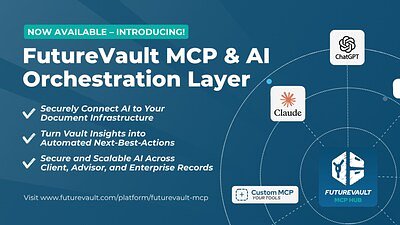
FutureVault Bridges AI and Finance With Secure Document Protocol
TORONTO and NEW YORK – April 21, 2026 – In a move that could significantly accelerate the adoption of artificial intelligence within the heavily regulated financial services sector, FutureVault today announced a new platform that allows enterprise firms to connect powerful AI models directly to their sensitive document infrastructures without compromising security or governance.
The wealth management technology firm launched its Model Context Protocol (MCP) and AI Orchestration Layer, a system designed to act as a secure, governed bridge between a firm's vast repository of client documents and popular large language models (LLMs) like Anthropic's Claude and OpenAI's ChatGPT. The launch addresses the central dilemma facing financial institutions: how to harness the immense analytical power of generative AI while ensuring that confidential client data remains private, secure, and compliant with stringent industry regulations.
For years, firms have been sitting on a goldmine of data locked away in millions of client forms, agreements, statements, and filings. While AI promises to unlock insights from this data, the risk of exposing it to public, third-party models has been a non-starter for compliance and security teams. FutureVault's announcement signals a potential path forward, leveraging a combination of emerging industry standards and a privacy-first architecture.
The 'New API' for Enterprise AI
At the heart of FutureVault's new offering is the Model Context Protocol (MCP), an open-source framework first introduced by the AI safety and research company Anthropic in late 2024. Gaining rapid traction across the tech industry, MCP is being heralded by developers as the “new API” or the “USB-C for AI.” Its purpose is to create a universal standard for how AI systems securely connect to and interact with external data sources and tools.
Before MCP, connecting an AI model to a new enterprise database or application often required building a complex, custom integration. This created a fragmented and inefficient ecosystem, slowing down AI adoption. The open standard provides a universal interface, enabling any MCP-compatible AI agent to search, read, and reason over data in a standardized way. This interoperability has led to swift support from major players, including Google, Microsoft, and OpenAI, positioning MCP as a foundational piece of the next generation of AI infrastructure.
By building its solution on this burgeoning standard, FutureVault is not creating another proprietary walled garden. Instead, it is aligning its specialized financial document vaults with the broader AI ecosystem, allowing firms to plug their secure data infrastructure directly into any MCP-compatible AI tool or orchestration platform they choose to deploy.
Unlocking Document Intelligence Without Compromising Trust
The most significant barrier to AI adoption in finance has always been governance. FutureVault aims to dismantle this barrier by ensuring its system operates entirely within a firm's existing security and compliance framework. A key element of this is the use of private LLMs, which means that while the system can leverage the reasoning capabilities of advanced AI, the actual document data is never passed to an external public model or leaves the firm's secure environment.
“Financial services firms sit on more than client documents – every form, filing, agreement, and record that moves through an organization holds information that advisors, operations, and compliance teams require but rarely have fast access to,” commented Daniel Kenny, FutureVault's CEO, in the company's announcement. “FutureVault MCP is a secure, private connection between that document infrastructure and the AI agents and orchestration tools firms are already deploying.”
This architecture is designed to appease the most stringent demands of regulators like the SEC and FINRA. Every query an advisor makes and every action the AI triggers is logged and runs through the firm's established permission structure. An advisor, for example, can only query documents they are already permitted to see. This maintains a complete audit trail and ensures that the principles of data privacy and access control are not bypassed in the pursuit of efficiency.
“Governance matters in financial services, and it is the part that gets overlooked in most AI announcements,” added Simon Tipler, FutureVault's Chief Product Officer. “Every query and every triggered action through FutureVault MCP runs inside the firm's existing permission structure, and private LLMs, meaning document data never leaves the firm's environment. Advisors get answers and efficiency. Compliance and operations teams keep the controls they need.”
This approach directly addresses fears of data leakage, regulatory penalties, and loss of client trust, providing a controlled environment for AI experimentation and deployment.
From Insights to Automated Action
Beyond simply providing secure access, the new platform is designed to turn AI-driven insights into tangible, automated workflows, a concept the company calls “Automated Next-Best-Actions.” This moves the technology from a passive analytical tool to an active participant in a firm's daily operations, aiming to generate what industry experts refer to as “business alpha” through enhanced productivity and client service.
The practical applications are extensive. For instance, an advisor could ask the system to review all tax documents for a specific client over the last five years, identify major changes, and flag potential planning opportunities—a task that would previously have required hours of manual file review. The system can also proactively scan an advisor's entire book of business to identify all clients who are missing signed advisory agreements or have outdated estate planning documents, turning a compliance headache into an automated alert.
Other powerful use cases include:
- Gap Analysis: Automatically analyzing insurance policies, retirement plans, and wills to find coverage shortfalls or timing mismatches based on the actual documents in a client's vault, not on assumptions.
- Client Deliverables: Drafting personalized client summary letters or meeting preparation memos by pulling key information directly from relevant financial records, saving advisors from relying on generic templates.
- Workflow Automation: Once an issue is identified, such as a missing document, the AI Orchestration Layer can automatically trigger a secure request to the client, create a follow-up task for the advisor, and schedule a review meeting, drastically reducing the administrative burden of chasing paperwork.
By automating these high-volume, low-complexity tasks, the platform promises to free up financial advisors to focus on high-value activities such as strategic financial planning and strengthening client relationships. Industry analyses on AI adoption in wealth management have suggested that such automation can lead to efficiency gains of up to 70% in certain back-office processes, representing a significant potential return on investment for firms that successfully integrate these tools.
As the financial services industry continues its cautious but determined march toward an AI-integrated future, solutions that prioritize security, compliance, and interoperability are poised to lead the way. By anchoring its platform to the open MCP standard while wrapping it in a private, governed architecture, FutureVault is making a compelling case that firms can finally unlock the intelligence within their documents without having to open the door to unacceptable risks.