
- 92,000 students worldwide participated in the 2026 Future City® Finals, a record-breaking season.
- 40% of the U.S. food supply goes uneaten, highlighting the competition's real-world relevance.
- 50/50 gender split achieved in the 2025-26 season, marking a milestone in STEM diversity.
Experts agree that the Future City Competition fosters innovative, system-wide solutions to food waste while promoting diversity and essential STEM skills for future leaders.
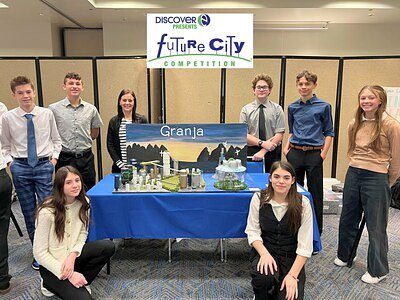
Future Engineers Tackle Food Waste in Record-Breaking STEM Competition
WASHINGTON, DC – February 05, 2026 – This month, the nation's capital will become a hub for the next generation of innovators as it hosts the 2026 Future City® Finals. From February 14-18, top middle and high school teams from around the globe will present their visions for a world without food waste. The event, organized by the nonprofit DiscoverE, is the culmination of a record-breaking season that engaged over 92,000 students worldwide, challenging them to engineer urban solutions to one of the planet's most pressing sustainability crises.
This year's theme, "Farm to Table," tasks students with designing a futuristic city that completely eliminates food waste. Finalist teams, having triumphed in regional competitions, will showcase their comprehensive projects through scale models, detailed essays, project plans, and live presentations to a panel of judges composed of engineers, educators, and industry leaders.
Innovating from Farm to Table
The competition's theme is not an abstract exercise; it targets a staggering real-world problem. According to data from the U.S. Department of Agriculture (USDA) and the Environmental Protection Agency (EPA), as much as 40% of the food supply in the United States goes uneaten. This waste represents a massive loss of resources, contributing to food insecurity, environmental degradation, and significant economic costs. The challenge pushes students to think systemically about how cities of the future can break this cycle.
"The 'Farm to Table' theme pushes students to think across systems — agriculture, infrastructure, technology, and community impact," said Kathy Renzetti, Executive Director of DiscoverE. "By the time they reach the Finals, these teams have refined ideas that are both imaginative and grounded in real-world problem-solving."
The Future City Competition has a long history of challenging students with complex, relevant themes. In previous years, participants have designed floating cities to combat rising sea levels ("Above the Current," 2025), created cities powered entirely by renewable energy ("Electrify Your City," 2024), and engineered urban centers based on a zero-waste circular economy ("A Waste-Free Future," 2022). These past challenges demonstrate the high level of ingenuity and technical application expected, with students consistently delivering sophisticated solutions that integrate principles from civil, environmental, and systems engineering.
Building a Diverse STEM Pipeline
Beyond the technical innovations, the 2025-26 season marks a significant milestone for diversity in STEM education. DiscoverE announced that this season's participants achieved a 50/50 gender split, a rare accomplishment in a field that has long struggled with gender imbalance. This achievement is not an anomaly but the result of a sustained effort; in the 2023-2024 season, girls already comprised a strong 48% of participants. Furthermore, historical data from the program shows significant engagement from underrepresented populations and students from Title I schools, underscoring a deep commitment to making STEM accessible to all.
This success in fostering an inclusive environment is a key reason why the program attracts support from major industry players. Visionary sponsors like the Bechtel Group Foundation and Leader-level sponsors such as the Northrop Grumman Foundation invest in DiscoverE and Future City to help cultivate the next generation of talent. For these companies, supporting STEM education is a critical long-term strategy to ensure a skilled, innovative, and diverse workforce capable of tackling future global challenges. Their involvement goes beyond funding, often including employee mentorship and providing scholarships for top-performing high school teams.
A Global Showcase with Local Roots
While the Future City Competition boasts a global reach with teams from the United States, Canada, China, and Nigeria participating in recent years, the 2026 Finals will have a distinctly local flavor. This season saw the highest-ever participation from teams in the Washington, D.C., Maryland, and Virginia (DMV) region. This strong local representation not only provides area students a chance to shine on a national stage in their own backyard but also highlights the region's growing ecosystem for STEM education and innovation.
The journey to the Finals is a rigorous one. Teams spend months developing their projects, first competing at the regional level. The winners of these regional events advance to the showcase in Washington, D.C., bringing with them a wealth of diverse ideas honed through local and community-focused research. The event serves as both a competition and a celebration, connecting bright young minds with professional engineers and peers who share their passion for building a better world.
More Than a Model: Forging Future Leaders
At the heart of the Future City Competition is a project-based learning model that develops skills extending far beyond technical knowledge. Students are not just building a physical model; they are managing a complex project from conception to completion. The process requires them to conduct in-depth research, write a technical essay, develop a comprehensive project plan, and ultimately, present and defend their ideas to experts.
This multifaceted challenge cultivates essential life skills, including teamwork, public speaking, critical thinking, and project management—competencies that are invaluable in any future career path, whether in STEM or otherwise. By simulating the entire engineering design process, the competition gives students a realistic and empowering glimpse into what it means to be a professional problem-solver. As these teams prepare to unveil their waste-free cities, they are not just presenting a school project; they are demonstrating a capacity for leadership and a commitment to creating a more sustainable and equitable future for all.