
- 7,500 kilometers: The grueling distance of the 2026 China Taklimakan Rally across Xinjiang's harsh terrain.
- 18 billion yuan: The brand value of Sinopec, the state-owned sponsor behind the rally and Aipao 103 fuel.
- RON 103+: The Research Octane Number of Aipao 103, China's first domestically developed racing fuel, designed for high-performance engines.
Experts would likely conclude that the China Taklimakan Rally serves as a strategic platform for showcasing China's technological advancements, economic statecraft, and geopolitical ambitions, particularly through the development of domestically engineered fuel and the promotion of the Belt and Road Initiative in Xinjiang.
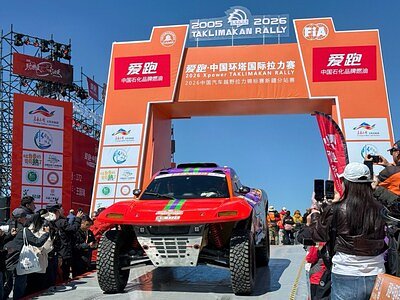
Fuel, Fury, and the State: China's Taklimakan Rally is More Than a Race
URUMQI, China – May 17, 2026
The air in Urumqi, the sprawling capital of China's Xinjiang Uygur Autonomous Region, crackled with manufactured energy this week. With a ceremonial flag drop, nearly 300 competitors in 152 custom-built vehicles roared to life, embarking on the 2026 China Taklimakan Rally. On the surface, it’s a spectacle of extreme motorsport: a grueling 17-day, 7,500-kilometer odyssey across some of the planet's most unforgiving terrain. But look closer, past the dust and the corporate banners of exclusive sponsor Sinopec, and you see something far more significant. This is not just a race. It is a carefully orchestrated display of technological prowess, economic statecraft, and geopolitical ambition, all running on a new, domestically engineered fuel.
The Engine of Ambition
At the heart of the rally is Aipao 103, China's first domestically developed and mass-produced racing fuel. For years, China's burgeoning motorsport scene relied on expensive imported fuels, a vulnerability that grated against a national policy of technological self-sufficiency. Teams often resorted to blending their own oils, a costly and inconsistent process. The arrival of Aipao 103, produced by the state-owned behemoth China Petroleum & Chemical Corporation (Sinopec), marks a quiet but profound declaration of independence.
With a Research Octane Number (RON) exceeding 103, the fuel is engineered to prevent engine knock in the ultra-high compression engines used in professional racing—a feat achieved without the metallic additives like lead or manganese common in older formulas. Sinopec touts its creation as having four core advantages: superior anti-knock performance, environmental friendliness through lower sulfur and olefin content, high combustion efficiency for better power, and enhanced safety via anti-static additives. Developed at the Sinopec Zhenhai Refinery, the fuel represents the pinnacle of China's refining capabilities, leveraging advanced techniques to create a product that can compete on the world stage.
For Sinopec, a company with a brand valued at over 18 billion yuan, this is more than just a new product. It is a strategic move up the value chain, shifting from a commodity supplier to an innovator in a high-margin, specialized market. The global high-octane racing fuel market is expanding, with China's own motorsport culture projected to drive a significant portion of that growth. By mastering the core technology behind Aipao 103, Sinopec has not only filled a gap in the domestic market but has also positioned itself as the default energy partner for the future of Chinese motorsport.
The New Silk Road's Proving Ground
The choice of Xinjiang as the rally's stage is no coincidence. The route, a record-breaking loop from Urumqi through Turpan, Hotan, and Kashi before concluding in Aksu, is a journey through the heart of what Beijing designates the “core area of the Silk Road Economic Belt.” This is the modern branding for the Belt and Road Initiative (BRI), China's ambitious global infrastructure and trade project. And this rally, fueled and sponsored by a state-owned champion, is its mobile billboard.
Chen Yanbin, a senior vice president at Sinopec, was explicit in this framing, stating a goal to "deepen the integration of energy, sports, and tourism to drive high-quality growth in Xinjiang and contribute to the Belt and Road Initiative." Every kilometer of the race, which carves a path through the vast Taklimakan Desert and the rugged canyons of the Tianshan Mountains, is designed to showcase a narrative of a dynamic, accessible, and economically vital region. The rally is a tool of soft power, transforming a remote and politically sensitive area into a backdrop for adventure and international competition.
This carefully curated image is critical. The rally brings international teams and media to a region often viewed through a more contentious lens, presenting them with a spectacle of speed, logistics, and development. The event itself becomes a fact on the ground, an argument for Xinjiang’s successful integration into a national and global economic vision. The roar of the engines is meant to drown out other, more difficult, conversations.
A Race Against More Than Time
The sheer logistics of the event are a testament to China's state-backed capacity. Keeping nearly 300 competitors fueled across 7,500 kilometers of desert and mountains is a monumental task. Sinopec’s solution is an innovative “fixed + mobile” strategy, deploying over 40 mobile refueling points to service vehicles in the most remote desert sections. It is a powerful demonstration of the ability to project infrastructure and support into hostile environments, a skill honed by state-owned enterprises across BRI projects worldwide.
Yet, there is an unavoidable tension at the core of the event. Sinopec's corporate motto is “Clean Energy, Better Life.” This slogan is emblazoned on the rally, an event that involves burning high-performance fossil fuels to power heavy vehicles across a fragile desert ecosystem. While Aipao 103 is undoubtedly “cleaner” than many racing fuels—its lack of metallic additives and low sulfur content are significant improvements—the term “environmental friendliness” feels dissonant in this context.
The rally exists in a gray area common to modern spectacle. It is an exercise in pushing human and mechanical limits, enabled by technological progress that makes the endeavor marginally less harmful. But the fundamental question remains: how does one reconcile a vision for a “Better Life” with an activity that, by its very nature, consumes vast resources and leaves a footprint on the landscape? The answer, it seems, is that when the goals are national pride, technological demonstration, and geopolitical messaging, such paradoxes are considered a small price to pay for the prize.