
- 75% higher heat transfer efficiency compared to conventional cooling solutions
- 8°C cooler components with LiquidJet Nexus
- 10% reduction in data center power consumption with optimized cooling
Experts agree that advanced liquid cooling solutions like LiquidJet Nexus are critical to overcoming thermal bottlenecks in AI hardware, enabling higher performance and efficiency in data centers.
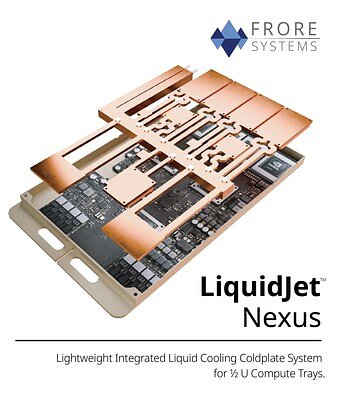
Frore Systems Tackles AI's Heat Crisis with LiquidJet Nexus Cooler
SAN JOSE, CA – March 13, 2026 – As the artificial intelligence industry races toward ever-more powerful models, it has slammed into a physical barrier: heat. To combat this escalating crisis, Frore Systems today introduced LiquidJet™ Nexus, an integrated liquid cooling system designed to manage the intense thermal output of next-generation AI servers like NVIDIA's high-density Kyber platform.
The announcement spotlights what industry experts are increasingly calling the "AI Thermal Stack"—the critical infrastructure responsible for dissipating the immense heat generated by AI hardware. With AI chips becoming exponentially more powerful and power-hungry, this thermal layer is no longer an afterthought but a fundamental factor determining the performance, density, and efficiency of the world's data centers.
The Emerging 'AI Thermal Stack'
The relentless scaling of AI has been built upon revolutions in software and silicon. However, the sheer energy consumption of modern processors is creating a thermal bottleneck that threatens to cap future progress. Next-generation GPUs, such as NVIDIA's upcoming Rubin Ultra, are projected to have thermal design power (TDP) exceeding 1.8 kilowatts per chip, a level of heat production that makes traditional air cooling completely unviable.
"The industry has revolutionized the AI software stack and scaled the AI compute stack," said Dr. Seshu Madhavapeddy, Founder and CEO of Frore Systems, in the company's announcement. "The AI Thermal Stack is now a fundamental layer of AI infrastructure, and innovation in that layer will determine how far AI performance can scale."
This thermal challenge is a system-level problem. It's not just about cooling the GPU; it's about managing heat across the entire compute tray, including CPUs, networking components (DPUs and NICs), and power conversion electronics. Inadequate cooling leads to thermal throttling, where chips automatically reduce performance to prevent overheating, negating the very power that data centers are paying for. At worst, it can cause hardware failures and costly downtime.
An Integrated Approach to Cooling
Frore Systems' LiquidJet Nexus directly addresses this system-level challenge with a novel integrated design. Instead of relying on a complex and failure-prone assembly of individual hoses, connectors, and manifolds for each component, LiquidJet Nexus combines multiple multi-stage 3D short-loop jetchannel coldplates into a single, unified system for ½ U compute trays.
This hoseless, connector-free architecture is designed to directly cool all major heat-generating components on a server blade. The company claims this streamlined approach delivers a 75% higher heat transfer efficiency compared to conventional solutions and keeps components a significant 8°C cooler. By eliminating numerous potential points of failure, the integrated design also promises higher reliability—a crucial factor in hyperscale data centers where a single rack can represent millions of dollars in hardware.
Furthermore, the design dramatically reduces the physical overhead of the cooling system itself. Frore Systems claims a 65% reduction in the thermal stack's weight, which simplifies server assembly, maintenance, and the structural requirements of data center racks.
The Economic Equation of AI Data Centers
Beyond raw performance, the new cooling solution targets the bottom line for data center operators. One of the most significant claims for LiquidJet Nexus is its ability to operate with a liquid inlet temperature of 53°C. This is a critical threshold because it can potentially eliminate the need for expensive and power-guzzling mechanical chillers, which are major energy consumers in traditional data center cooling loops.
By relying more on ambient air for heat rejection—a process known as free cooling—data centers can achieve substantial energy savings. Frore Systems projects this could reduce a data center's total power consumption by as much as 10%, a massive figure in an industry where electricity is a primary operational cost. This directly improves Power Usage Effectiveness (PUE), a key metric for data center efficiency.
This efficiency, combined with the system's ability to cool ½ U compute trays, allows for a doubling of compute density per rack. For data center operators, this means deploying twice the AI processing power in the same physical footprint, maximizing the return on investment for both real estate and expensive AI hardware. This combination of reduced operational expenditure (OpEx) through energy savings and improved capital expenditure (CapEx) efficiency through higher density directly lowers the Total Cost of Ownership (TCO) for AI infrastructure.
A High-Stakes Market Heats Up
Frore Systems is entering a fiercely competitive but rapidly expanding market. The urgent need for advanced cooling has attracted a host of specialized companies like CoolIT Systems, which focuses on direct liquid cooling, and Submer, a leader in immersion cooling technologies. Established data center infrastructure giants such as Vertiv and Schneider Electric are also heavily invested in the space.
Simultaneously, major server manufacturers are integrating liquid cooling directly into their flagship AI products. Dell Technologies and Hewlett Packard Enterprise (HPE) both offer high-performance servers with native liquid cooling options, underscoring the industry-wide consensus that managing heat is paramount. Frore's strategy appears to be to offer a uniquely simplified and integrated component that these system builders can adopt to accelerate their own designs.
As AI continues its explosive growth, the innovations happening within the thermal stack are becoming as important as the algorithms themselves. Frore Systems is also known for its AirJet solid-state cooling chips for edge devices, demonstrating a broad focus on thermal management from the largest data centers to the smallest consumer electronics. Technologies like LiquidJet Nexus are not just about cooling chips; they are about enabling the next leap forward in artificial intelligence by ensuring the hardware can run at its full, unthrottled potential.