
- 250-year-old historical link: Saddlehill Cellars' land is tied to Timothy Matlack Jr., the scribe of the Declaration of Independence.
- 70-acre property: The winery's land was once part of a 1,500-acre tract owned by Matlack's family since 1701.
- 15-minute AI documentary: The winery produced a cinematic documentary using generative AI to recreate Revolutionary-era scenes.
Experts would likely conclude that Saddlehill Cellars' innovative use of AI to tell a historically significant story sets a new standard for blending heritage with modern technology, offering a compelling model for other businesses and historical sites.
From Revolutionary Scribe to AI Storytelling: A Winery's Bet on History
VOORHEES, NJ – June 02, 2026 – In the competitive landscape of the modern experience economy, businesses are constantly searching for a unique narrative. For Saddlehill Cellars, a 70-acre winery in South Jersey, that narrative has been hiding in plain sight for 250 years. The winery has uncovered a direct historical link between its land and Timothy Matlack Jr., the man whose elegant script gave form to the Declaration of Independence.
But this isn't just another historical plaque dedication. In a move that bridges centuries, Saddlehill is leveraging cutting-edge artificial intelligence to resurrect this lost chapter of American history. The result is a cinematic documentary that not only repositions a local business but also offers a compelling case study in how innovation can unlock the economic value of heritage. As the nation gears up for its 250th anniversary, this South Jersey farm is transforming from a place that grows grapes into a destination that cultivates history.
Unearthing a Revolutionary Trifecta
When Bill Green purchased the 70-acre property in 2021, it was known locally as the old Stafford Farm, a once-proud landmark that had become blighted. The prevailing legend was that George Washington had gifted the land to a loyal soldier. "When I bought this property, the local legend was that George Washington gifted the land to one of his soldiers," Green, the owner of Saddlehill Cellars, explained. "It turns out that story was wrong — but what we actually found was bigger."
Driven by this local lore, Green commissioned historical research that peeled back layers of myth to reveal a far more intricate and compelling story, one validated by the Camden County Historical Society. The research documented a trifecta of Revolutionary figures connected to the single plot of land. The first is "The Scribe": Timothy Matlack Jr., the so-called "Fighting Quaker" from nearby Haddonfield who was disowned by his pacifist brethren for his revolutionary zeal. His family, research confirmed, owned a 1,500-acre tract beginning in 1701, which included the land Saddlehill now occupies. It was his nephew's family who held the deed.
Next is "The Sword": John Stafford, a member of Washington's elite personal Life Guard. The local legend was half-right; Stafford did settle the land, but he acquired it not through a gift from Washington, but through his marriage into the Wilkins family, who themselves were genealogically linked to the Matlacks. Stafford was a proven soldier, wounded at the Battle of Germantown, who settled the tract after his service.
Finally, there is "The Shield": the land itself. Known as "The Ridge" or "Sand Hills," the property’s 150-foot elevation made it the highest point in the vicinity, offering a clear strategic vantage point with a direct sightline to Philadelphia. During the British occupation of the city in 1777–1778, this high ground would have been an invaluable asset for colonial observation. "The real history connects three Revolutionary families on one piece of ground," Green noted, framing the narrative that now defines his business.
Scripting the Past with Silicon
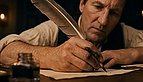
Discovering a compelling history is one thing; telling it is another. Rather than relying on static exhibits or traditional narration, Saddlehill Cellars invested in a 15-minute documentary, The Scribe, The Sword & The Shield. What makes the project a bellwether for local historical initiatives is its use of generative AI to create cinematic recreations of the Revolutionary era. The film promises to place viewers in the room as Matlack engrossed the Declaration and on the battlefield at Germantown.
This application of AI represents a significant shift in historical storytelling. For decades, high-quality historical reenactments have been the domain of big-budget film productions, far beyond the reach of a local winery or historical society. AI-powered generation democratizes this capability, allowing a small business to produce content with a visual richness previously unattainable. This isn't just about cost-cutting; it's about accessibility and impact. By feeding the AI historical data and artistic prompts, the Saddlehill team could generate scenes that bring a 250-year-old story to life with startling realism.
Of course, the use of AI in historical representation carries ethical weight. The potential for generating inaccuracies or deepfakes is real, but the project's foundation in research vetted by the Camden County Historical Society provides a crucial layer of academic integrity. Jack O'Byrne, the Society's Executive Director, endorsed the effort, stating, "The Camden County Historical Society proudly supports this kind of serious, community-driven work — because the land holds the story, and South Jersey's is one worth telling." This blend of rigorous historical method and innovative technological execution serves as a powerful model for other heritage sites looking to engage a modern audience.
A New Landmark on the Road to 250
The timing of the discovery and the documentary's release is no accident. With free public screenings scheduled for July 4th, 2026, Saddlehill Cellars is strategically positioning itself at the heart of the nation's 250th-anniversary celebrations. This savvy move transforms a business asset—its land—into a site of national historical significance, creating a powerful engine for tourism and economic activity.
Local and state officials have been quick to recognize the project's potential. "This discovery further enriches our history," said Voorhees Mayor Michael Mignogna. "The documented connection between this land, the Matlack family, and the writing of the Declaration of Independence is a story every resident of Voorhees — and every American — should know." His words point to the immense community pride and branding opportunity the discovery offers.
On a broader scale, it helps re-center a piece of the American Revolution's narrative back in New Jersey. "New Jersey played a pivotal role in the American Revolution and this discovery in Voorhees is a powerful reminder of that legacy," noted State Senator James Beach. For a state often overshadowed by historical sites in Philadelphia and Boston, the Saddlehill story is a welcome addition to its revolutionary bona fides.
For Saddlehill Cellars, this is more than a marketing campaign. It’s the fusion of product, place, and purpose. Visitors can now tour the vineyards, taste award-winning estate wines, and dine at the farm-to-table restaurant, all while standing on ground tied directly to the nation's founding. It's a multi-layered experience that caters to wine lovers, foodies, and history buffs alike, creating a durable competitive advantage that no competitor can replicate. By unearthing its past and using the tools of the future to tell it, Saddlehill Cellars has shown that sometimes the most powerful innovation is the rediscovery of a story worth telling.