
- 50,000+ hours of autonomous operation logged by Built Robotics in utility-scale solar projects.
- AI models tested against edge cases like odd worker poses, occlusions, and challenging light conditions.
- Partnership aims to create provably safe AI systems for construction sites.
Experts would likely conclude that this collaboration represents a significant step toward mathematically verified safety in construction automation, potentially setting a new industry standard for human-robot interaction.
From Lab to Jobsite: AI's New Blueprint for Construction Safety
SAN FRANCISCO and PHILADELPHIA – June 16, 2026 – On the sprawling, dynamic, and often hazardous expanse of a modern construction site, the line between progress and peril is a thin one. For decades, the industry has wrestled with a stubborn reality: it is one of the world's most dangerous professions. Today, a new partnership between a leader in construction robotics and a premier academic research lab aims to redraw that line, forging a future where physical AI doesn't just enhance productivity, but fundamentally redefines safety.
Built Robotics, the San Francisco firm behind the autonomous systems operating on massive solar farm projects, has announced a research collaboration with Penn Engineering's xLAB, the Safe Autonomous Systems Lab. This isn't just another corporate-academic handshake. It represents a targeted fusion of real-world operational data with rigorous, mathematically-proven safety architecture, tackling one of the biggest hurdles to widespread automation in high-risk environments: trust.
A New Foundation for Safety
The construction industry is plagued by what the Occupational Safety and Health Administration (OSHA) calls the "Fatal Four": falls, electrocutions, caught-in/between accidents, and struck-by incidents. The latter, where a worker is hit by equipment or falling objects, is a persistent danger wherever heavy machinery and human crews work in close proximity. Traditional safety measures—high-visibility vests, human spotters, and basic backup alarms—are essential but fallible, relying on human perception in chaotic environments.
This is the challenge the collaboration is designed to meet head-on. The partnership aims to build a new standard for safety by focusing on robust validation and advanced personnel detection. "xLAB is committed to building safety-critical autonomous systems for real-world deployment, and construction represents one of the most demanding frontiers for that work," said Rahul Mangharam, Professor in Electrical and Systems Engineering and principal investigator of xLAB. "The fundamental challenge is bridging the gap between validation in controlled environments and robust performance under operational conditions."
The goal is to move beyond systems that simply react, and toward systems that can be mathematically verified as safe. By leveraging xLAB’s expertise in developing "provably safe" software, the partnership seeks to create an AI that can operate with a high degree of certainty, ensuring it can reliably detect and protect people on a jobsite. This academic rigor is what Built Robotics believes is necessary for the next leap in physical AI. "What xLAB has built in safety architecture is precisely the kind of rigorous foundation that physical AI demands," said Noah Ready-Campbell, CEO of Built Robotics.
Bridging the Gap from Theory to Practice
The power of this collaboration lies in its symbiotic nature. While xLAB brings the theoretical framework of formal methods and safety-critical system design, Built Robotics provides the ultimate testing ground: active construction sites. The company has already logged over 50,000 hours of autonomous operation, primarily in the utility-scale solar industry where its RPD 35 Robotic Pile Driver has become a key tool.
This vast trove of real-world data is invaluable. "Our proprietary edge AI model for personnel detection has been refined across some of the most demanding operational environments in the industry — active construction sites with hundreds of employees stretching over thousands of acres," Ready-Campbell explained. Yet, to achieve the next level of reliability, the model needs to be tested against an even wider array of scenarios.
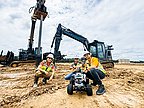
The initial phase of the research will deploy a fleet of construction survey robots to collect high-fidelity sensor data on active solar projects. This data will capture the "edge cases" that are notoriously difficult for AI to handle: workers in odd poses, partial occlusions from materials or other equipment, challenging light conditions at dawn or dusk, and the unpredictable nature of human movement. This rich dataset will be fed back to xLAB to validate and improve the AI models, creating a powerful feedback loop between the lab and the field. For Ready-Campbell, a Penn Engineering alumnus, the partnership is a natural fit. "Dean Vijay Kumar's pioneering work on quadcopters and multi-robot coordination at the GRASP Lab was formative for me when I started Built," he noted. "As our fleet of robots has scaled in the field, the mission alignment with xLAB has become crystal clear."
The Competitive Edge in a Transforming Industry
Built Robotics is not operating in a vacuum. Industry giants like Komatsu and Caterpillar are heavily invested in their own smart construction and semi-autonomous platforms, while a host of startups are automating specific tasks from drywall finishing to rebar tying. However, the San Francisco-based firm has carved out a distinct niche. Its strategic pivot to focus on the $300 billion utility-scale solar industry has allowed it to deeply optimize its technology for a specific, high-volume need.
Furthermore, its "Exosystem" approach—an aftermarket kit that retrofits existing heavy equipment—offers a more flexible and potentially cost-effective path to automation for contractors. Perhaps most tellingly, the company has proactively partnered with the International Union of Operating Engineers (IUOE) to train and certify union members as "Robotic Equipment Operators." This collaborative stance on workforce evolution, focusing on upskilling rather than pure replacement, addresses a major social and practical barrier to technology adoption.
The partnership with xLAB further sharpens this competitive edge. While competitors focus on productivity with safety as a feature, this collaboration places verifiable safety at the very core of its mission. "We are driven by the same core conviction as xLAB: that physical AI must first be safe, and that it is poised to set a new standard for safety in construction," commented Liam Osler, Engineering Director for AI at Built Robotics. This commitment could become a key differentiator in an industry where the cost of failure is measured in human lives.
Building the World of Tomorrow
The long-term vision extends far beyond driving piles for solar panels. The data collected and the models refined through this partnership are intended to form a "world foundation model" for how machines and people can safely coexist on complex job sites. Success in this initial phase will pave the way for expanding these advanced safety models to other vehicle platforms and a wider array of construction activities, from mass excavation to building foundations.
By systematically de-risking human-robot interaction, the collaboration could significantly accelerate the adoption of autonomy across the construction sector. This has profound implications for addressing persistent labor shortages, increasing project efficiency, and ultimately, building the next generation of infrastructure more quickly and cost-effectively. The work being done by Built Robotics and xLAB today is more than just an engineering exercise; it's about laying a trusted, verifiable groundwork for a future where technology elevates human potential by removing people from harm's way. This partnership is a tangible step toward proving that the smartest machines are not just the ones that work the hardest, but the ones that protect us the best.