
- 45% trust gap in digital insurance among consumers over 50 (2024 survey).
- 152,000 customers by August 2025, up from 90,000 in mid-2023.
- 94% customer retention rate and 98.3% VHIS claim approval rate.
Experts would likely conclude that Bowtie's strategic pivot to a hybrid digital-physical model is a calculated move to bridge the trust gap in digital insurance, leveraging tangible presence to reinforce brand credibility and customer loyalty.
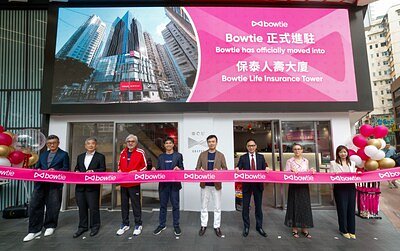
From Clicks to Bricks: A Virtual Insurer's Bet on a Physical Tower
HONG KONG – February 25, 2026 – In a move that sends a powerful message across Hong Kong's financial landscape, Bowtie, the city's first virtual insurer, today cut the ribbon on its new headquarters—a landmark building in Wan Chai now bearing its name: the "Bowtie Life Insurance Tower." For a seven-year-old digital-native company, securing naming rights and a seven-floor lease in a prime business district is a bold and counterintuitive play, signaling a strategic pivot from a purely virtual existence to a hybrid model that wagers heavily on the power of physical presence to build enduring trust.
This inauguration is more than a corporate expansion; it's a calculated answer to a fundamental question facing digital finance: How do you build lasting confidence when your entire operation exists in the cloud? Bowtie's answer is concrete, steel, and a cup of coffee.
Bridging the Virtual Gap with a Tangible Commitment
While Bowtie's operational model is built on digital efficiency, its leadership recognizes that in the world of insurance—an industry predicated on long-term promises—trust is often rooted in tangible, visible commitments. Research indicates a persistent trust deficit in digital insurance, with a 2024 survey from the Hong Kong Federation of Insurers noting that while many consumers are willing to buy online, a significant 45% trust gap remains, particularly among demographics over 50.
By planting a flag at 68 Johnston Road, Bowtie is directly confronting this "intangible distance." The move emulates a time-honored tradition where financial institutions use physical landmarks to project stability and permanence. It’s a strategic decision designed to reassure customers that Bowtie is more than just an app or a website.
"'Trust' is the absolute cornerstone of the financial services industry, and even more so in insurance," said Mr. Fred Ngan, Co-Founder of Bowtie, at the inauguration. "Our operational edge stems from digitalization, but building enduring, cross-generational trust requires a 'visible' commitment. Through the physical landmark, 'Bowtie Tower', we want to prove to the public that Bowtie is not merely a tech firm residing in the cloud, but a highly transparent insurance brand delivering genuine service and walking alongside the people of Hong Kong for the long haul."
This hybrid Online-to-Offline (O2O) model aims to offer the best of both worlds: the cost-efficiency and accessibility of digital channels combined with the reassurance and human connection of a physical location.
Challenging the Status Quo on the Insurance Battleground
Bowtie's move into a physical tower is not just about branding; it's a power play backed by formidable growth that is actively reshaping Hong Kong's competitive insurance market. The company has consistently ranked first in the direct sales channel for new policies for seven consecutive quarters and, more impressively, broke into the top ten across all distribution channels, reaching the 9th position by the end of 2024.
This ascent is fueled by rapid customer acquisition, growing from roughly 90,000 customers in mid-2023 to over 152,000 by August 2025. This momentum validates the appeal of its digital-first model, which has proven highly efficient. By harnessing its proprietary technology stack to automate complex processes, Bowtie has slashed the heavy operational and customer acquisition costs typical of traditional insurers.
"The scale and efficiency of the fully digital insurance model have now been validated by the market," stated Mr. Michael Chan, CEO and Co-Founder of Bowtie. "Precisely because technology cuts out the heavy costs of traditional operations and customer acquisition, we are in the unique position of being able to pour those resources directly back into 'services'."
This financial leverage, strengthened by over HK$1.0 billion in funding from backers like Sun Life Financial and Mitsui & Co., is what enables such a significant investment in physical infrastructure. The strategy appears to be working, as the company’s strong performance and high customer retention rate of over 94% demonstrate a public vote of confidence that is now being cemented in brick and mortar.
The 'Bow Coffee' Revolution: Insurance Service Without the Pressure
Perhaps the most innovative element of Bowtie's new headquarters is what occupies its most visible space. Instead of a traditional sales-focused branch, the ground and mezzanine floors house "Bow Coffee," a full-fledged café open to the public. This concept radically redefines how consumers interact with an insurance brand.
Here, customers and passersby can get a coffee, work on their laptops, and, if they choose, approach Bowtie's on-site customer service team for objective information and support in a relaxed, pressure-free environment. This move directly addresses a common pain point highlighted in consumer feedback on virtual services: the frustration of dealing with impersonal chatbots or a lack of accessible human support.
"Traditional insurance often feels distant or even high-pressure," commented Mr. John Tsang, Senior Advisor of Bowtie. "The inception of Bow Coffee is to integrate 'customer service' seamlessly into daily life. It is more than just a cafe; it is a community hub. We want everyone in Wan Chai to know they have a safe, pressure-free space where they can always find support for their insurance needs."
By transforming the customer service point into a welcoming community space, Bowtie is injecting a crucial element of human warmth into its virtual model. This O2O approach not only fills the face-to-face interaction void but also serves as a powerful marketing tool, embodying the brand's promise of being helpful, not pushy.
This strategic investment in a human-centric experience is underpinned by a robust track record of service delivery. The company boasts a VHIS claim approval rate of 98.3% and processes 95% of its more than 150,000 claims within just five working days. As Bowtie celebrates its new physical home with promotional offers, its core strategy is clear: leverage technology for efficiency, but invest the savings in building tangible, human-centric trust. This hybrid model may well set a new precedent, not just for virtual insurers, but for any digital-first business aiming to earn a permanent place in the lives of its customers.