
- Projected Job Creation: The Indian EV market is expected to generate millions of jobs, but a NASSCOM report highlights a severe shortage of professionals skilled in battery management systems and power electronics.
- Industry-Academia Collaboration: The CoE will offer joint research projects, hands-on workshops, and internships with LTTS's TECHgium® program.
- Global Expertise: LTTS, a subsidiary of Larsen & Toubro, serves global OEMs and Tier-1 suppliers, providing access to international best practices in EV technology.
Experts would likely conclude that this partnership is a critical step in bridging the skills gap in India's EV sector, ensuring a sustainable talent pipeline to meet the industry's ambitious growth targets.
Forging the Future: How a New E-Mobility Hub Will Power India's EV Goals
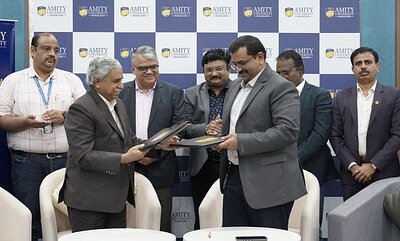
BENGALURU, India – June 19, 2026 – In a move that signals a deepening synthesis between Indian higher education and high-tech industry, Amity University Bengaluru and L&T Technology Services (LTTS) have formalized a partnership to establish a dedicated Centre of Excellence (CoE) for E-Mobility. While memoranda of understanding are common in the corporate and academic worlds, this collaboration represents something more fundamental: a calculated response to one of India's most pressing economic and environmental challenges.
As the nation accelerates its transition to electric vehicles, driven by ambitious government policies like the FAME II scheme, a significant gap has emerged—not in ambition, but in aptitude. The industry's rapid evolution has outpaced the development of a workforce skilled in the complex interplay of battery technology, power electronics, and data analytics. The new CoE, with the engineering giant LTTS serving as the official knowledge partner, is designed to directly address this chasm. It aims to transform the university's campus into a live ecosystem for creating the next generation of e-mobility engineers and innovators.
A Blueprint for the Future Workforce
The collaboration goes far beyond a simple plaque on a building. The signed MoU outlines a comprehensive framework for embedding industry-level expertise directly into the academic fabric. For students and faculty at Amity University Bengaluru, the CoE will serve as a hub for joint research projects, hands-on technical workshops, and direct access to industry thought leaders through guest lectures and mentorship.
Under the agreement, students will have the opportunity to secure coveted internships and participate in LTTS's flagship innovation program, TECHgium®, an initiative that challenges young engineers to solve real-world industrial problems. This is a critical distinction from traditional academic learning. Instead of theoretical problem sets, students will be grappling with the same challenges faced by engineers at a global leader in ER&D services. The curriculum will be infused with practical insights into electric mobility, industrial automation, advanced sensing systems, and data analytics—the core pillars of the modern EV landscape.
"This partnership is about creating a self-sustaining talent pipeline," one industry analyst noted, commenting on the trend of such collaborations. "The Indian EV market is projected to create millions of jobs, but a NASSCOM report recently highlighted a severe shortage of professionals with skills in battery management systems and power electronics. Initiatives like this are not just beneficial; they are essential for the industry to meet its growth targets."
The vision, as articulated by the university's leadership, is to produce graduates who are not just degree-holders, but industry-ready professionals. As Prof. (Dr.) D. Subhakar, Vice Chancellor of Amity University Bengaluru, noted at the signing ceremony, the goal is to build future-ready talent. This means moving from a model of passive learning to one of active creation and problem-solving, a shift that is critical for competing in the global technology arena.
The Power of a Knowledge Partner
The success of such an ambitious undertaking hinges on the quality of the industry partner. In this regard, L&T Technology Services brings a formidable arsenal of expertise. As a subsidiary of the Larsen & Toubro conglomerate, LTTS is a pure-play engineering services firm with deep roots in the automotive sector. Their work isn't confined to India; they serve global OEMs and Tier-1 suppliers, giving them a bird's-eye view of international best practices and emerging technological trends.
LTTS’s role as "knowledge partner" is therefore not a passive title. Their expertise spans the entire EV ecosystem, from designing sophisticated battery management systems (BMS) and motor control units to developing the complex software for connected car platforms and advanced driver-assistance systems (ADAS). This deep, practical knowledge is the asset being transferred to the CoE. Dr. Guruprasad A. S., Global Practice Head at LTTS, emphasized that the collaboration is designed to accelerate innovation and advance technology-driven solutions for society.
By providing access to their engineers, their project methodologies, and their understanding of market needs, LTTS ensures that the research and training conducted at the CoE are not purely academic exercises. They are grounded in the commercial and technical realities of the e-mobility industry. This direct line to the industry is what prevents the curriculum from becoming obsolete—a common pitfall for university programs in rapidly evolving tech sectors.
A New Model for Collaborative Innovation
Viewed from a wider angle, the Amity-LTTS partnership can be seen as part of a larger, systemic shift in how India approaches innovation. It represents a move away from siloed research toward an integrated model that mirrors successful ecosystems like Germany's Fraunhofer Institutes or the industry-centric research parks in the United States and parts of Asia. While India has other notable examples, such as the IIT Madras Research Park, this CoE's specific focus on e-mobility within the bustling tech hub of Bengaluru makes it particularly significant.
The structure of the collaboration—encompassing faculty exchanges, joint IP development, and shared research goals—addresses many of the typical challenges that can derail industry-academia partnerships. By defining clear roles and shared objectives from the outset, both institutions are creating a framework designed for long-term impact rather than short-term publicity. This model could serve as a precedent for other universities and corporations looking to bridge the gap between academic theory and industrial application in other critical sectors, from renewable energy to artificial intelligence.
The collaboration also solidifies Bengaluru's position as the nexus of India's technological ambitions. The city is already home to countless R&D centers, tech giants, and a vibrant startup scene. By establishing a dedicated hub for e-mobility talent and innovation, Amity and LTTS are adding another critical piece to this ecosystem. It sends a clear signal to investors, entrepreneurs, and policymakers that Bengaluru is not just participating in the EV revolution but is actively building the intellectual infrastructure to lead it. As the Indian automotive industry undergoes its most significant transformation in a century, it is these systemic investments in human capital that will ultimately determine the winners.