
- Up to 40% of the current maintenance workforce could retire within the next five years, taking decades of undocumented knowledge with them. - Fluke's AI-powered eMaint platform claims to reduce the time needed to create preventive maintenance plans by 50% or more. - Up to 70% of a technician's job-specific knowledge can be lost when they retire, creating costly inefficiencies.
Experts would likely conclude that Fluke's AI-powered eMaint platform represents a strategic and timely response to the industrial skills gap, offering practical tools to capture and standardize critical maintenance knowledge while augmenting the capabilities of existing technicians.
Fluke's New AI Platform Aims to Solve Maintenance Skills Gap
EVERETT, WA – March 16, 2026 – Fluke Corporation today announced a significant pivot for its eMaint platform, embedding a suite of purpose-built artificial intelligence features designed to transform how industrial maintenance is performed. The beta release, now available to existing eMaint CMMS/EAM customers, aims to put practical AI tools directly into the hands of technicians, addressing long-standing industry challenges of workforce shortages and knowledge loss.
"With this new version of eMaint, we’re bringing the power of artificial intelligence directly to maintenance professionals who keep operations running,” said Jay Hack, General Manager at Fluke Corporation, in the company's announcement. “This beta release isn’t about experimentation. It’s about transforming the way maintenance work gets done by turning complex data and manuals into actionable insights, while helping teams make smarter, faster decisions."
AI to the Rescue: Tackling the Industrial Skills Gap
Fluke's announcement arrives at a critical juncture for asset-intensive industries. Maintenance and reliability departments are grappling with a severe and worsening skills gap, a problem consistently ranked among their top challenges. A perfect storm of an aging workforce, mass retirements, and a shallow pool of new talent has left many organizations vulnerable. Some industry analyses, such as reports from the Hudson Institute, estimate that up to 40% of the current maintenance workforce could retire within the next five years, taking decades of invaluable, undocumented knowledge with them.
This "knowledge gap" is not a distant threat; it is a present-day reality that leads to longer equipment downtime, inconsistent repair quality, and increased safety risks. Projections from Deloitte and the Manufacturing Institute paint an even starker picture for the broader sector, forecasting that nearly 1.9 million manufacturing jobs could go unfilled by 2033. When an experienced technician leaves, studies suggest that up to 70% of their job-specific knowledge can be lost forever, creating a costly cycle of relearning and inefficiency for the teams left behind.
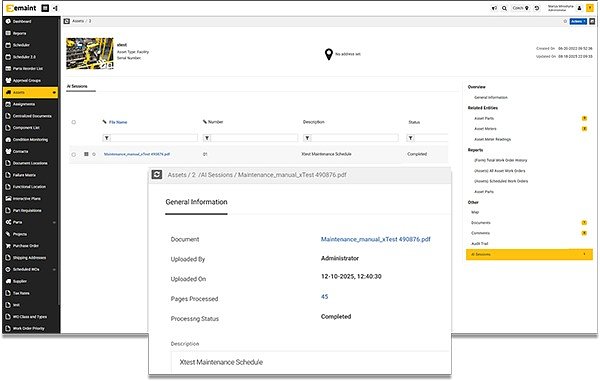
Fluke is positioning its new AI-powered eMaint as a direct countermeasure. The platform's SOP Builder, for example, automates the creation of standard operating procedures and preventive maintenance tasks directly from dense technical manuals and other documents. The company claims this can reduce the time needed to create these critical PM plans by 50% or more. For a plant manager struggling to onboard new hires, this tool acts as a force multiplier, capturing and standardizing best practices that might otherwise have been lost. The system then prompts technicians to follow these critical steps, ensuring consistency and safety regardless of an individual's experience level.
From Manuals to Mentors: A Day in the Life with AI
Beyond high-level strategy, the true test of this technology lies in its impact on the daily routine of a maintenance technician. Fluke's new features are designed to function less like a complex software suite and more like an ever-present digital mentor.
One of the most practical innovations is the ability for technicians to "talk to their data." Instead of spending precious time searching through digital folders or dusty binders for a specific OEM manual, a technician can now ask the eMaint mobile app a direct question, such as "What is the standard operating pressure for Pump-05?" or "Show me the last three work orders for this asset." The AI instantly surfaces summarized insights drawn from work orders, asset histories, and technical documents, providing clear, multilingual answers.
This capability extends to hands-free work. A technician who spots a potential issue while on the plant floor can now create a work order simply by recording a voice message. The AI automatically translates the recording into a structured work order request, capturing the problem in the flow of work without the need to stop, find a terminal, and type. This not only improves efficiency but also enhances data capture, ensuring that small issues are logged before they become major failures. For complex equipment, the AI transforms dense manuals into on-demand guidance, allowing technicians to ask questions and receive concise instructions, boosting confidence and competence across all skill levels.
A Strategic Play in a Crowded Field
Fluke is not the first company to bring AI to the CMMS/EAM market. The space is increasingly competitive, with major players like IBM and SAP, as well as agile competitors like UpKeep, heavily investing in intelligent solutions. IBM’s Maximo platform leverages the watsonx.ai framework for predictive maintenance and natural language assistance. SAP embeds AI to suggest maintenance templates and optimize technician scheduling. UpKeep's UpKeep Intelligence suite offers a range of tools from voice-activated work orders to AI-generated task summaries.
Against this backdrop, Fluke is differentiating itself with a "purpose-built" philosophy and a tightly integrated ecosystem. The company emphasizes that its AI was developed directly from customer feedback about what slows them down every day, focusing on immediate, practical value rather than complex, experimental algorithms.
Fluke's true strategic advantage, however, may lie in its broader hardware and software ecosystem. The new eMaint AI is designed to work seamlessly with other Fluke Reliability solutions. This includes Azima, an AI-driven vibration analytics platform trained on over 30 years of data, which can predict machine failures and automatically generate work orders in eMaint. It also integrates with Verusen for AI-powered inventory optimization, helping ensure critical spare parts are always on hand. By connecting its world-class test and measurement tools, condition monitoring sensors, and now an intelligent CMMS, Fluke is building a comprehensive, closed-loop reliability system that augments—rather than replaces—the expertise of human technicians.
The Road Ahead: Beta Testing and Future Vision
The new AI capabilities are currently in a beta phase, available to select eMaint customers in sectors like logistics and manufacturing. Fluke states the initial feedback highlights faster access to documentation and clearer insights from complex data. The company plans to use this feedback period for continued refinement before a broader rollout is announced.
This iterative approach aligns with Fluke's long-term vision of making maintenance "easier, leaner, and more efficient" by breaking down data silos and empowering teams. The introduction of AI into eMaint is not just a product update but a significant step in the evolution of industrial maintenance itself. By focusing on augmenting human skill and embedding intelligence directly into daily workflows, Fluke is betting that the most effective way to manage the future of the factory floor is to empower the people who know it best. The industry will be watching closely to see how this new era of AI-assisted maintenance redefines efficiency and reliability across the plant floor.
Topics & Related
Software & SaaS
AI & Machine Learning
Artificial Intelligence
Generative AI
Revenue
Related Company Pulse