
- 20 high-performance gaming PCs and dedicated console stations in the new arena.
- $3.5 billion projected global esports market value in 2026.
- 14 varsity esports teams competing in titles like Marvel Rivals, Overwatch, and Valorant.
Experts view Florida Poly's esports arena as a strategic investment in both competitive gaming and career-ready skills, aligning with the growing trend of universities leveraging esports to develop tech industry-relevant competencies.
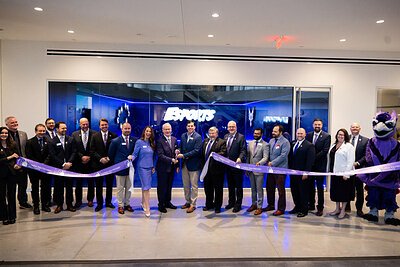
Florida Poly's New Esports Arena: A Bet on Tech Careers and Community
LAKELAND, FL – February 13, 2026 – Florida Polytechnic University, an institution built on the promise of technology and engineering, has made a bold new play in the future of higher education. The university officially cut the ribbon on a state-of-the-art esports arena Friday, a facility designed not just for competition, but as a high-tech crucible for career skills and community building.
Located within the Barnett Applied Research Center, the new arena is a testament to the university’s forward-thinking ethos. It boasts 20 high-performance gaming PCs, dedicated console gaming stations, and a striking 48-foot exterior video wall that can broadcast live tournament action to crowds across the campus. For Florida Poly’s more than 100 student-athletes competing across 14 varsity esports teams, it’s a game-changer. But for the university, the investment represents something far more significant: a strategic alignment with the demands of the modern student and the future of the tech industry.
A New Era for Collegiate Competition
The days of collegiate gaming being relegated to repurposed classrooms are long gone, a fact Florida Poly has embraced with conviction. The new arena provides a premier home for teams competing in the National Esports Collegiate Conference (NECC) in popular titles like Marvel Rivals, Overwatch, and Valorant.
"The goal was to not just have a row of gaming computers tucked into the back of a classroom somewhere like many places do when they address esports," said Cole Allen, the university's vice president and chief information officer. "We wanted something where we could compete at the highest levels."
This commitment to excellence is central to the university's vision. Dr. Devin Stephenson, Florida Poly's president, described the arena as an embodiment of the institution's innovative spirit. "I believe this arena exemplifies our very bold-thinking approach, creating a very modern university experience," he stated during the opening ceremony. "To our students, your interests and success matter to us. We want you to have environments where you can challenge yourself, build community and gain experience, and now the esports arena is one of those spaces."
This investment places Florida Poly firmly within a rapidly growing national trend. The National Association of Collegiate Esports (NACE) now counts over 280 member institutions, a dramatic increase in recent years, with universities collectively offering millions in scholarships. While some institutions like Full Sail University have built massive, spectator-focused venues, Florida Poly's approach appears deliberately focused on providing an elite training and competition space for its varsity athletes while also serving the broader student body.
More Than a Game: A Hub for Skill and Community
During daytime hours, the sleek, modern arena is open to all students, serving as a social hub for gaming, studying, or simply connecting with peers. In the evenings, it transforms into a dedicated training ground for the university's varsity teams as they prepare for national competition.
This dual-purpose design is key to its role on campus. It fosters a sense of inclusivity and provides a physical center for a digital-native generation to build social bonds.
"I'm in love with the new space," said Noah Vanscoyoc, a senior in business analytics and a student leader for the esports program. "I genuinely think it will help esports grow more as a whole because more students will see it and want to join."
While the arena is new, the culture of competitive gaming is deeply embedded at Florida Poly. The university has already celebrated significant victories, including a 2023 NECC conference title for its Valorant team and a 2019 national championship win by student Christian Lomenzo in the EA Madden NFL 19 Challenge, which came with a $35,000 prize. This new facility is set to amplify that success.
"Students will be in the arena every single night, often playing against universities from all across the nation," noted Derek Lower, director of athletics and recreation. "Esports is a huge industry, so it's really great to give our students the opportunity to get their feet wet and hop into it at an early, grassroots level."
The Proving Ground for Tomorrow's Tech Leaders
For a university dedicated to STEM, the most compelling argument for the new arena lies beyond the leaderboards. The facility is being framed as a practical training ground for the high-demand skills required in the tech industry. The global esports market, projected to exceed $3.5 billion in 2026, is not just creating professional players; it's fueling a massive ecosystem of careers in technology, management, data analysis, and media.
Jannice Rivera, a junior majoring in computer science and another student leader, sees the connection clearly. She called the new arena transformative, emphasizing how the skills honed in competition directly translate to her future career.
"In the field, we will have team-based projects, team-based coding, and you'll never be working alone," Rivera explained. "Esports gives you a chance to communicate with others and trust in them. One day you'll have a team and will have to say, 'I trust you with this, and in return, I'll help you.'"
Her perspective is backed by a growing body of research and industry sentiment. The intense, fast-paced environment of competitive gaming develops critical soft skills like strategic thinking, rapid problem-solving, resilience under pressure, and complex communication—all attributes highly sought after by tech recruiters. Students learn to analyze data to improve performance, manage complex team dynamics, and adapt to constantly changing scenarios, mirroring the agile environments of modern software development and engineering firms.
President Stephenson echoed this, noting that esports blends "technology, strategy, teamwork and high-level performance," and the arena provides a direct pathway for students to cultivate those skills. By investing in esports, Florida Poly is effectively creating a co-curricular experience that reinforces its core academic mission, preparing students for collaborative, high-stakes professional environments.
With the new arena now operational, the program's leaders and students are focused on the future. They aim to not only climb the competitive ranks but also to grow the community on campus, making it a welcoming space for gamers of all skill levels.
"Anybody can join us," Vanscoyoc said, extending an open invitation. "We want everyone to have an open mind and just have fun and play games with us. You don't have to do the competitive part."
Topics & Related
Related Company Pulse