
- 83% reduction in query complexity with Decode GA4's automated data transformation.
- 40% to 70% reduction in BigQuery costs for larger customers using the platform.
- GA4 BigQuery Export Problem: A pervasive industry pain point requiring complex SQL queries and custom workarounds.
Experts would likely conclude that Decode Data’s Decode GA4 platform addresses a critical industry pain point with a scalable, cost-effective solution, potentially reshaping the analytics ecosystem by democratizing access to high-quality GA4 data.
Fixing the Plumbing: Decode Data’s Cure for a Universal Analytics Headache
LONDON, UK – June 16, 2026 – In the world of corporate strategy, sometimes the most significant maneuvers aren’t found in boardroom takeovers but in the quiet release of a utility that solves a problem everyone has but no one can quite agree on how to fix. London-based Decode Data’s announcement of its Decode GA4 platform is one such move. On the surface, it’s a tool to simplify data exports. But reading the underlying signals, this is a confident play aimed at redrawing the economic and operational lines around one of the world's most ubiquitous analytics platforms.
The company’s pitch is deceptively simple, likening its solution to a “USB-C moment” for data. For years, professionals have fumbled in a digital junk drawer of complex code, custom connectors, and ad-hoc workarounds to make sense of Google Analytics 4 data. Decode Data is betting that the industry is ready for a single, clean interface. The confidence in this bet speaks volumes about the scale of the frustration it aims to eliminate.
The Anatomy of a Data Headache
To understand the significance of Decode Data’s move, one must first appreciate the problem it addresses—a pain point so pervasive it has been dubbed the “GA4 BigQuery Export Problem.” When Google transitioned its analytics platform to GA4, it gave millions of businesses access to raw, event-level data in its BigQuery data warehouse. This was a powerful gift, promising unprecedented depth of analysis. However, the gift came with punishingly complex wrapping paper.
The data is exported in a deeply nested format. While this structure is efficient for Google to store, it is profoundly difficult for humans to query. Accessing a simple piece of information, like the URL of a page a user visited, requires analysts to write convoluted SQL queries using repeated UNNEST commands. This process essentially unpacks nested data into a usable flat format, but it’s a brittle, complex, and error-prone operation that has become a dark art in the analytics community.
“It's genuinely one of the worst data experiences ever shipped,” said Jim Barlow, Co-Founder of Decode Data, in the company's press release. “An entire generation of analysts is learning the craft through this, and they're learning it wrong.”
Barlow’s assessment is not hyperbole. Independent research confirms a sprawling cottage industry has emerged solely to manage this complexity. Digital forums like Reddit and Stack Overflow are littered with desperate pleas for help. Analytics consultancies have built entire service lines around creating custom transformation pipelines. An ecosystem of open-source tools, training courses, and newsletters has flourished, all dedicated to navigating a data structure that many believe should have been simpler from the start. This isn’t just a technical inconvenience; it’s a multi-million dollar tax on the industry’s time and resources.
A BigQuery-Native Remedy
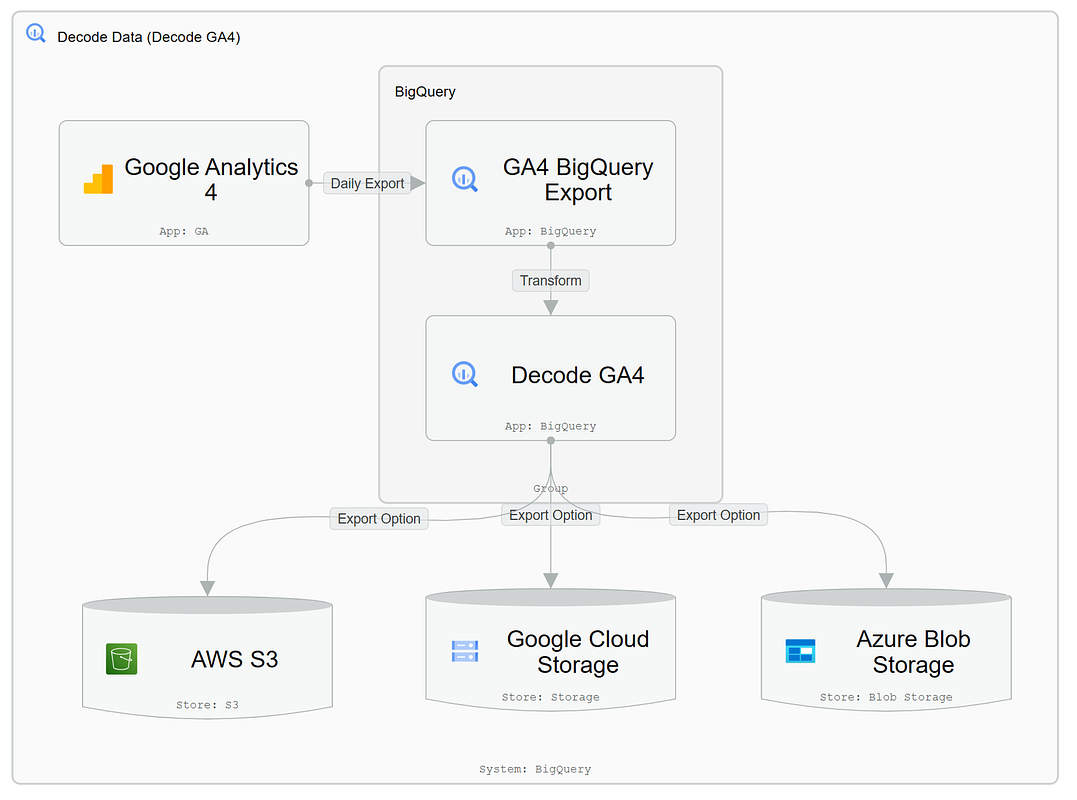
Decode Data’s solution, Decode GA4, enters this landscape not as another workaround, but as a definitive fix. Available on the Google Marketplace, the utility installs directly into a customer’s own Google Cloud environment. It acts as a refinery, automatically transforming the raw, nested GA4 exports into clean, flat, and date-partitioned tables. The UNNEST gymnastics that plagued analysts are handled behind the scenes.
Instead of writing labyrinthine code, an analyst can simply reference a field like page_location. The immediate impact, according to the company, is a staggering 83% reduction in query complexity. This isn't just about making an analyst's job easier; it's about fundamentally changing the speed and accessibility of insight.
This simplification directly translates into economic terms. Inefficient queries and bloated data structures have a real cost in a pay-for-what-you-process environment like BigQuery. By optimizing data partitioning and storage, Decode Data claims its larger customers have seen BigQuery costs fall by 40% to 70%. In an era of tightening tech budgets, a tool that pays for itself by reducing infrastructure spend is a powerful proposition.
“Before USB-C, you had a drawer full of adapters for every device. That's what GA4 integration has looked like for three years,” explained David R Lindahl, the company’s Co-Founder and Head of Growth. “Decode GA4 provides one clean interface.” The analogy is potent because it captures the shift from chaotic complexity to standardized simplicity—a shift that often marks a market’s maturation.
Reading the Economic and Strategic Signals
The launch of Decode GA4 is more than a product release; it's a strategic realignment of value. For years, value was captured by those who could master the complexity—the high-priced consultants, the specialized data engineers, the creators of bespoke pipelines. By automating that complexity, Decode Data is making a bold statement: the value shouldn't be in wrestling the data, but in using it.
This move effectively democratizes access to high-quality GA4 data. Organizations without large data engineering teams, which were previously locked out of deep analysis or forced to rely on the limited GA4 user interface, can now operate on a more level playing field. The tool lowers the barrier to entry for sophisticated business intelligence, potentially unlocking insights for a much broader swath of the market.
This also signals a challenge to the existing ecosystem. While Google’s partner-friendly approach encourages third-party solutions, a tool that so effectively solves a core problem could diminish the need for extensive custom-builds and ongoing consulting retainers focused on this specific issue. It’s a classic case of a product threatening a service-based industry by offering a scalable, one-time solution.
The Ambition Beyond the Fix
Perhaps the most telling signal from Decode Data is not what it has done, but what it plans to do next. The company's founders have been explicit that GA4 is just the first target. Their stated mission is to apply the same philosophy to other “high-friction data sources,” positioning themselves as plumbers for the modern data stack.
Barlow’s vision extends even further. “The future is one where humans don't write SQL at all. It gets generated from intent and semantic models,” he stated. “But that future requires a clean data layer underneath. Someone has to fix the plumbing.”
This is the core of the company’s long-term ambition. Decode GA4 is not the end goal; it is the proof of concept. It demonstrates a capacity to identify a point of extreme friction in a critical data workflow and engineer an elegant, automated solution. The intent is to build the clean, reliable, and standardized data foundations upon which the next generation of AI-driven analytics can be built.
By solving a problem that Google itself has, for whatever reason, chosen not to, Decode Data is carving out a crucial niche. It is a confident, assertive move that shows a deep understanding of where the real value in the data ecosystem lies—not in the data itself, but in the ability to access and use it effortlessly.