
- Gold Award Winner: FieldBee Vision secured the Digital Technology Innovation of the Year at the LAMMA Innovation Awards 2026.
- Centimeter-Level Precision: RTK-based autosteering provides centimeter-level accuracy, reducing overlaps and gaps in farming operations.
- AI-Driven Efficiency: Real-time crop sensing using Enhanced Vegetation Index (EVI) enables Variable Rate Application (VRA) of fertilizers and pesticides, optimizing resource use.
Experts view FieldBee Vision as a transformative leap in precision farming, combining AI, vision technology, and modular retrofitting to enhance efficiency, sustainability, and accessibility for farmers of all scales.
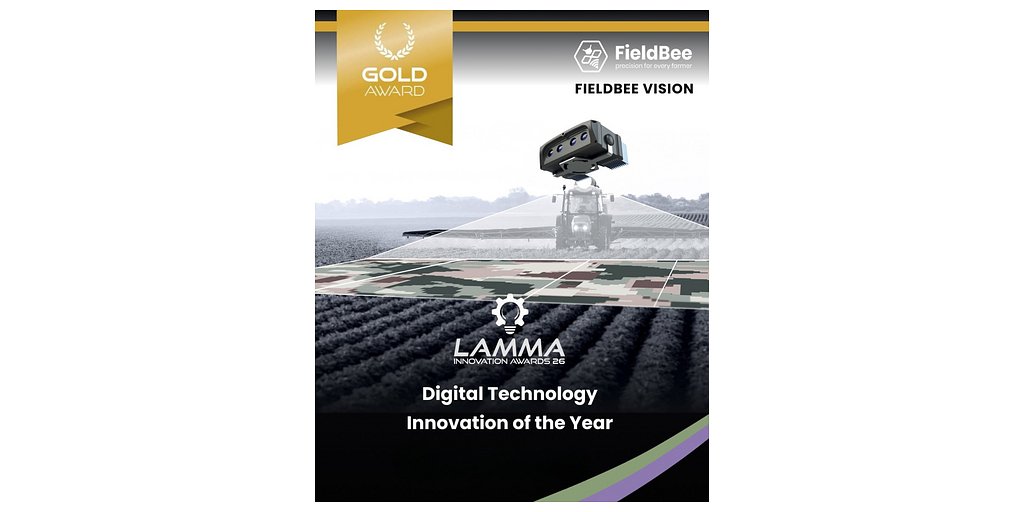
FieldBee’s AI Vision System Redefines Precision Farming
AMSTELVEEN, Netherlands – January 09, 2026 – In a move signaling a significant leap forward for intelligent agriculture, Dutch technology firm FieldBee has secured a prestigious Gold award at the LAMMA Innovation Awards 2026. The winning product, FieldBee Vision, was recognized as the Digital Technology Innovation of the Year, validating its sophisticated approach to unifying camera-based vision, artificial intelligence, and high-precision navigation into a single, accessible system.
The LAMMA Show, the UK’s premier agricultural technology event, awards innovations that demonstrate tangible benefits for farmers and the industry. FieldBee’s victory places its new system at the forefront of a movement aimed at making farming smarter, more efficient, and more sustainable.
FieldBee Vision is a modular retrofit system designed to be installed on existing tractors and farm machinery. It promises to deliver next-generation autonomous steering and real-time, data-driven decision-making directly in the field. By integrating multiple technologies, it aims to solve critical challenges that have long hampered the accuracy of precision farming, particularly in complex environments where traditional GPS signals fall short.
“Precision alone is no longer enough — modern farming demands intelligent autonomy,” a FieldBee spokesperson stated in the announcement. “FieldBee Vision goes beyond accuracy. It unifies sensing, decision-making, field planning, and AI-driven support into one ecosystem.”
Beyond GPS: The Technology Behind Intelligent Autonomy
The core innovation of FieldBee Vision lies in its ability to see and interpret the environment in real-time, creating a level of operational intelligence that surpasses reliance on satellite positioning alone. The system is built on a multi-layered architecture that combines several cutting-edge technologies.
At its foundation is RTK-based autosteering. Real-Time Kinematic (RTK) technology provides centimeter-level positioning accuracy, a dramatic improvement over standard GPS. This precision is essential for minimizing overlaps and gaps during planting, spraying, and harvesting, which directly translates to savings on fuel, seeds, and chemicals.
However, the system's true power is unlocked through visual odometry, powered by a combination of RGB (visible spectrum) and NIR (Near-Infrared) cameras. While RTK tells the tractor where it is on a map, the vision system tells it where it is relative to its immediate surroundings—the crops, the tramlines, or the vineyard rows. This is crucial in conditions where GPS signals can be unreliable, such as under dense tree canopies, within narrow or irregular layouts, or on uneven terrain. The cameras provide a constant stream of data that the system uses to maintain a perfect path, ensuring stability and accuracy where GPS-only systems might falter.
This visual data is processed by an advanced AI engine that performs real-time crop sensing using the Enhanced Vegetation Index (EVI). Unlike the more common NDVI, EVI is more sensitive in areas of high biomass (dense crops) and corrects for atmospheric distortions, providing a more accurate measure of plant health and vigor. The NIR camera is key to this analysis, as healthy vegetation reflects near-infrared light strongly. By analyzing EVI data on the fly, the system can instantly generate application maps, enabling automatic Variable Rate Application (VRA) of fertilizers and pesticides. This means resources are applied precisely where they are needed most, optimizing growth and minimizing waste.
Smarter Fields, Greener Yields
The practical implications of this technology are profound for both farm profitability and environmental stewardship. By virtually eliminating overlaps and ensuring inputs are used with surgical precision, FieldBee Vision promises significant economic benefits. Reduced consumption of fuel, fertilizer, and pesticides directly lowers operational costs, which is a critical concern for farmers facing volatile input prices.
The system's ability to create instant application maps and perform variable-rate application is a game-changer for sustainability. Instead of applying a uniform amount of fertilizer across an entire field, the ISOBUS-compatible system can instruct an attached sprayer or spreader to increase application in nutrient-deficient zones and decrease it in healthy ones, all based on the AI's real-time crop analysis. This not only boosts yield potential but also dramatically reduces the risk of chemical runoff into waterways, a major environmental concern in modern agriculture.
Furthermore, the increased automation significantly reduces operator fatigue. Long hours spent manually steering a tractor to maintain perfect lines are a major source of physical and mental strain. By automating this task with a high degree of reliability, FieldBee Vision frees up the operator to focus on higher-level tasks, such as monitoring implement performance and overall field conditions. This not only improves the quality of work but also addresses the persistent issue of labor shortages in the agricultural sector.
Democratizing Precision: A Retrofit Revolution
Perhaps the most significant aspect of FieldBee Vision is its potential to democratize access to high-end precision agriculture. While industry giants like John Deere and CNH Industrial have developed their own impressive autonomous tractors, these often come with a prohibitive price tag, putting them out of reach for small and medium-sized farms.
FieldBee’s focus on a modular retrofit solution directly challenges this barrier to entry. The system is designed to be installed on a wide range of existing tractors and implements, allowing farmers to upgrade their current fleet rather than investing in entirely new machinery. This approach drastically lowers the initial capital investment required to adopt advanced autonomous capabilities.
This strategy places FieldBee in a competitive but burgeoning market for retrofit solutions alongside companies like Trimble and Precision Planting. While Trimble offers robust, mixed-fleet solutions and John Deere provides entry-level retrofit kits, FieldBee Vision aims to differentiate itself by offering a deeply integrated, vision-first system that is both powerful and easy to use. The entire package is managed through the new myFieldBee ecosystem, a unified platform that connects navigation, autosteering, and implement control for seamless planning, execution, and reporting.
By positioning advanced AI and vision technology as an affordable and accessible upgrade, FieldBee is targeting the vast majority of farmers who have yet to adopt high-level precision tools due to cost and complexity. This focus on usability and an extensive partner network, combined with direct sales, could accelerate the adoption of smart farming practices across the agricultural landscape, from large open fields to specialized orchards and vineyards.
FieldBee Vision will be showcased at LAMMA 2026 and is slated for an official launch in the third quarter of 2026, with preorders opening at the event. Its success will ultimately be measured by its adoption in fields around the world, but its award-winning debut suggests that the future of intelligent, accessible farming is looking clearer than ever.