
- $258.6 billion: U.S. digital ad revenue in 2024, up nearly 15% year-over-year.
- 20-25% lift in conversions and 35-50% reduction in customer acquisition costs for clients using Fibr AI's Ads-to-Web Personalization.
- 28x increase in AI-driven visits in the banking sector and 13x increase in tech, with conversion rates as high as 15.9% from AI-referred traffic.
Experts would likely conclude that Fibr AI's new tools address critical inefficiencies in digital marketing by bridging the 'intent gap' between ad clicks and landing pages, particularly for high-value industries like finance and healthcare, where AI-referred traffic is growing rapidly and converting at significantly higher rates.
Fibr AI Tackles Ad Waste with New Web Personalization Tools
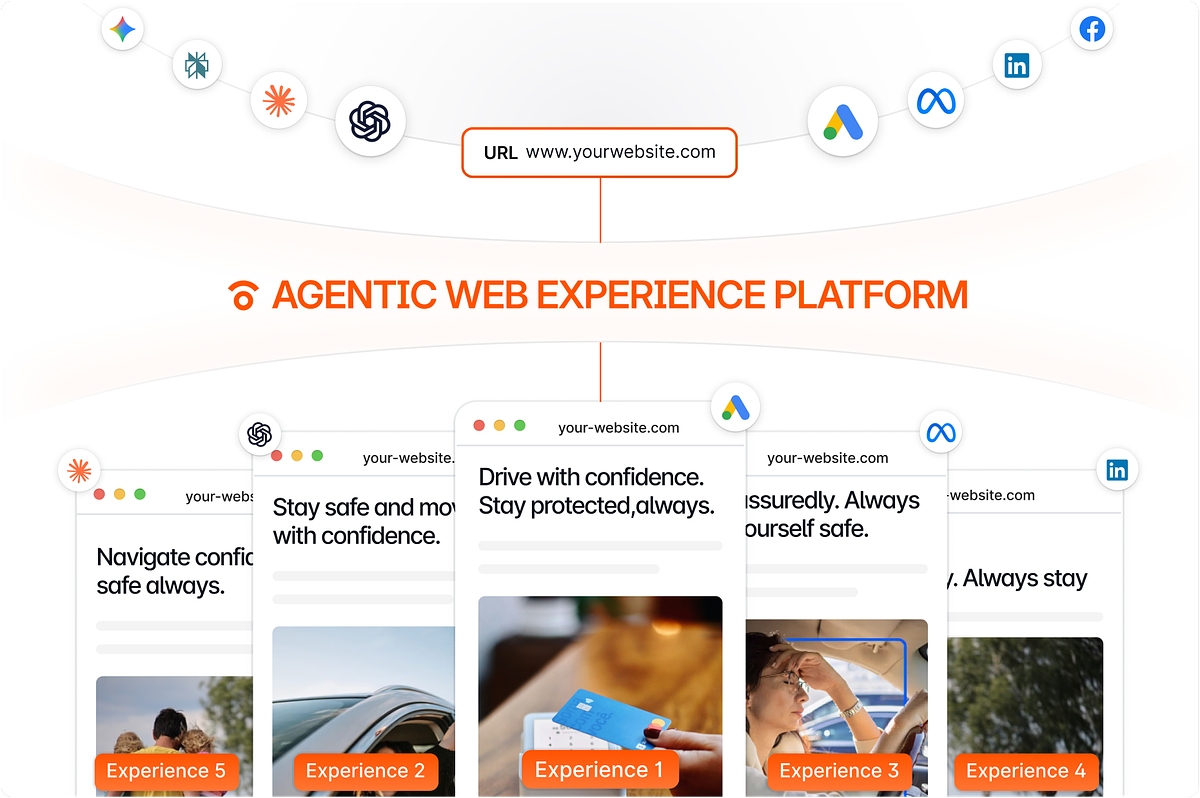
SAN FRANCISCO, CA – April 15, 2026 – As businesses grapple with the dual pressures of soaring digital advertising costs and the rise of a new, enigmatic stream of AI-referred web traffic, San Francisco-based Fibr AI today announced a suite of tools designed to tackle both. The company has launched Ads-to-Web Personalization and LLM-to-Web Personalization, two new capabilities aimed at closing the costly “intent gap” between why a user clicks a link and what they see on the resulting landing page.
These new features are part of Fibr AI's broader vision for an 'Agentic Web Experience Layer,' a system designed to transform static websites into adaptive, intelligent platforms. The launch comes at a critical juncture for digital marketers, who are navigating an increasingly expensive and complex online ecosystem.
“Marketing breaks in two places today. You generate highly specific intent in ads and then lose it the moment someone lands. And with AI traffic, you don't just lose intent, you never receive it,” said Ankur (AJ) Goyal, CEO and Co-Founder of Fibr AI, in a statement. “We built Fibr to solve both: carry intent through the click, and reconstruct it when it's missing.”
The Widening Chasm in Digital Marketing
The problem Fibr AI aims to solve is not academic; it’s a multi-billion-dollar inefficiency at the heart of the digital economy. In 2024, U.S. digital ad revenue surged to $258.6 billion, a nearly 15% increase year-over-year. Yet, for many advertisers, pouring more money into the funnel hasn't yielded proportional results. Research shows that while ad spend is climbing, the cost of acquiring customers is rising even faster.
Recent industry data highlights this growing disconnect. The average Cost Per Click (CPC) in Google Search Ads has seen double-digit percentage increases, with some reports indicating a nearly 40% rise over the past three years. During the same period, conversion rates have struggled to keep pace, improving by only a fraction of that amount. The result is a diminishing return on investment that forces marketers to continuously spend more just to maintain their position.
This challenge is particularly acute in high-consideration industries like financial services, healthcare, and telecommunications, where customer journeys are complex and the value of a successful conversion is high. For these sectors, the generic landing page is a significant point of failure, failing to capitalize on the specific intent a user expressed by clicking a targeted advertisement.
Bridging the Gap with AI
Fibr AI’s new capabilities address this market-wide pain point with a two-pronged approach.
First, Ads-to-Web Personalization directly targets the leakage between ad-click and landing page. The system is designed to automatically carry the specific intent expressed in an ad—whether it’s for a specific mortgage rate, a particular insurance feature, or a unique product benefit—through to the website experience. Instead of a one-size-fits-all page, the platform can generate up to 1,500 personalized page variants in under two weeks, ensuring the user’s first impression on-site is a direct continuation of the ad that brought them there. Fibr AI reports that clients using this approach have seen a 20-25% lift in conversions and a 35-50% reduction in customer acquisition costs.
Second, and perhaps more innovatively, LLM-to-Web Personalization tackles a new and rapidly growing source of web traffic: referrals from Large Language Model (LLM) platforms like ChatGPT, Perplexity, and Claude. This traffic is often described as 'dark' because it typically arrives without the standard tracking parameters that inform marketers about user intent. However, this traffic is immensely valuable. Adobe Analytics data reveals that AI-driven visits are exploding, with the banking sector seeing a 28x increase and tech seeing a 13x increase in just under a year. Crucially, traffic from platforms like ChatGPT can convert at rates as high as 15.9%, nearly nine times higher than standard Google organic traffic (1.76%).
Fibr AI’s technology works to “reconstruct” the missing intent from these valuable visitors. By modeling the likely prompt pathways and conversational contexts that lead a user from an AI chat to a specific webpage, the platform can infer intent and generate context-specific page variants. It then uses a Multi-Armed Bandit framework—a type of reinforcement learning—to continuously test and optimize these variants, automatically reallocating traffic to the best-performing experiences.
The Agentic Web and the Future of Engagement
These new tools are foundational elements of Fibr AI's larger ambition: to build the 'Agentic Web.' This vision moves beyond simple personalization toward a future where websites act as intelligent agents, capable of autonomously adapting to the needs of both human visitors and the growing number of AI agents and crawlers that now navigate the internet.
In this paradigm, every URL becomes an intelligent endpoint, capable of understanding the context of a visit and dynamically reconfiguring itself to provide the most relevant experience. This represents a significant shift from the current model, where personalization is often a layer retrofitted onto a static web structure, requiring extensive manual setup and rule-based logic.
The competitive landscape for web personalization is crowded, with established giants like Adobe, Optimizely, and Sitecore offering powerful digital experience platforms. However, Fibr AI's sharp focus on closing the specific intent gaps from paid ads and, most notably, from LLM referrals, carves out a distinct and timely niche. As AI assistants become a primary interface for information discovery, the ability to understand and cater to this traffic will likely become a critical differentiator for online businesses.
For industries like finance and healthcare, which are already seeing massive surges in AI-referred traffic, the implications are profound. In banking, where AI-referred users are reportedly 23% more likely to start an application, personalizing the subsequent journey could significantly boost the acquisition of high-value customers. Similarly, in healthcare, guiding a user from a complex health query on an AI platform to a clear, relevant, and trustworthy resource on a provider's website can build patient trust and improve outcomes. Fibr AI's focus on these regulated, high-stakes industries suggests confidence in its platform's ability to handle complex compliance and security requirements while delivering tangible business results.