
- Price-to-Performance Disruption: Q8 at under $1,000 with 2000W peak motor (1500W in reviews) and 32 mph top speed. Q8 Plus at under $1,500 with 6000W peak motor (3000W in reviews) and 50 mph top speed (40 mph in reviews).
- Weight and Range: Q8 Plus weighs over 80 pounds with a 90–120 mile range and 9-10 hour charge time.
- Legal Restrictions: Motors exceed 750W, barring use on most public trails and bike lanes.
Experts agree that FENGQS's Q8 and Q8 Plus e-bikes offer exceptional value for their price, but note that real-world performance falls short of advertised specs and legal restrictions limit their off-road usability.
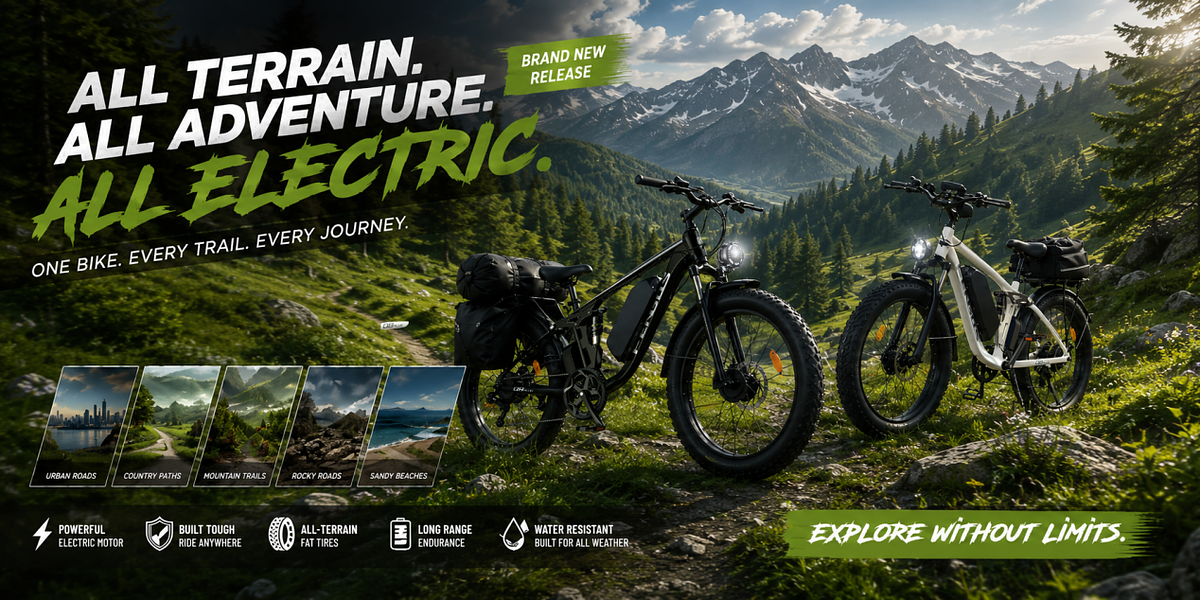
FENGQS Launches High-Power E-Bikes at Disruptive Prices
NEW YORK, NY – May 28, 2026 – By Daniel Howard
FENGQS has entered the competitive electric bike arena with a bold proposition, launching two new electric mountain bikes, the Q8 and Q8 Plus, that aim to redefine the price-to-performance standard. The company announced the release with claims of eliminating the long-standing trade-off between a daily commuter and a capable trail machine, offering specifications typically found in much pricier models for under $1,000 and $1,500, respectively.
According to the company's press release, the launch is built around a simple premise: a single bike should be able to handle both weekday commutes and weekend adventures. The Q8 is presented as the versatile workhorse, while the Q8 Plus is billed as a high-performance machine for demanding off-road terrain. Both models arrive with the increasingly critical UL2849 safety certification, a significant selling point in a market growing more conscious of electrical system safety.
"We built the Q8 lineup for the rider who lives between categories," a FENGQS spokesperson stated in the release. "Someone who commutes Monday through Friday and wants to hit a trail on Saturday. They shouldn't have to own two bikes, or compromise on either."
Unpacking the Power-to-Price Ratio
The specifications announced by FENGQS are designed to turn heads. The Q8 is listed with a 2000W peak motor, a 32 mph top speed, and a 60–85 mile range for under $1,000. The Q8 Plus boasts even more startling numbers: a dual-motor system with 6000W of peak power, a 50 mph top speed, and a 90–120 mile range, all for under $1,500. In a market where 750W motors are standard and full-suspension bikes often start well above $2,000, these figures represent a significant disruption.
However, initial independent reviews suggest the press release figures may be ambitious. Multiple reviews of the Q8 Plus point to a powerful dual-motor system with a combined peak output of 3000W—half the advertised wattage, but still formidable—delivering a top speed closer to 40 mph. Even at this revised specification, the bike's performance is consistently praised as exceptional for its price point, often seen on sale for around $1,200. Reviewers describe its acceleration as "motorcycle-like," backed by a large 1196Wh battery and a full-suspension setup that provides a smooth ride over rough terrain.
Similarly, some reviews of the standard Q8 mention a 1500W motor rather than 2000W, yet still find it delivers "punchy, immediate power" that easily handles hills. The consensus is that while the official marketing numbers might be inflated, the real-world performance of both bikes still offers a value proposition that few competitors can currently match.
Safety Certification and a Heavy-Duty Build
A standout feature for both the Q8 and Q8 Plus is their UL2849 certification. This standard goes beyond just the battery, ensuring the entire electrical system—including the motor, controller, and charger—has been rigorously tested for fire and electrical safety. As cities like New York begin to mandate this certification for all e-bikes sold, its inclusion is a crucial mark of quality and consumer assurance, particularly for high-powered models from emerging brands.
This robust engineering contributes to a significant downside: weight. Independent reviews place the Q8 Plus at over 80 pounds, making it challenging to lift onto a bike rack or carry up a flight of stairs. While its fat tires and full suspension provide excellent stability and comfort on gravel, sand, and cracked pavement, the bike's sheer mass makes it less of an agile trail dancer and more of a powerful all-terrain cruiser. The large battery, while providing impressive range, also requires a lengthy 9-10 hour charge time with the standard charger.
The All-Terrain Dream Meets a Legal Hurdle
While FENGQS markets the Q8 lineup for "trail and forest riding" and exploring "protected recreation areas," the bikes' immense power creates a significant legal paradox for potential buyers. Federal and state regulations for trail access, including those for U.S. National Parks, typically define an electric bicycle as having a motor of 750 watts or less. Bikes exceeding this limit are often classified as motorized vehicles, akin to mopeds or dirt bikes.
With motors rated at 1500W and 3000W, both the Q8 and Q8 Plus fall well outside this definition. This means they are legally prohibited from most multi-use paths, bike lanes, and non-motorized trails on public lands where traditional bicycles and Class 1-3 e-bikes are permitted. Their use would be restricted to private land and roads or trails explicitly open to motorized vehicles. This reality stands in stark contrast to the marketing promise of a single bike for every environment, as its off-road capabilities are legally constrained in many of the exact places a rider would want to use them.
Environmental advocacy groups like the Sierra Club have argued that high-wattage e-bikes should be managed as motorized vehicles to protect wildlife and preserve the quiet nature of non-motorized trails. For a rider dreaming of silent, emission-free exploration of national forests or state parks, the FENGQS bikes may not be the key to access they appear to be. Instead, they are better understood as powerful urban commuters and capable machines for use on private property or designated off-highway vehicle (OHV) areas, rather than as go-anywhere mountain bikes.