
- 70% of nonprofit budgets are consumed by salaries, creating complex allocation challenges.
- 88% of nonprofits secure grants, but managing them remains a significant administrative burden.
- Single Audits cost upwards of $15,000, with failure risking fund clawbacks and reputational damage.
Experts would likely conclude that Budgyt's database-driven approach offers a critical solution to nonprofit grant management challenges, balancing enterprise-level capabilities with affordability.
Enterprise Power, Nonprofit Price: Budgyt Tackles Grant Budgeting Chaos
NEW YORK, NY – June 22, 2026 – For nonprofit finance leaders, the annual budget is a relic. In its place is a continuous, high-stakes discipline of managing a complex web of grants, each with its own rules, timelines, and reporting demands. At the heart of this complexity lies a single, overwhelming challenge: payroll. With salaries often consuming 70% of an operating budget, the task of accurately allocating staff time across multiple funding sources has pushed the humble spreadsheet—the sector's long-standing financial workhorse—to a breaking point.
Now, a new generation of specialized software is emerging to address this critical pain point, promising to restore order and audit-readiness to nonprofit finance. Budgyt, a financial planning platform, recently highlighted this shift, framing grant allocation and audit readiness as the core operational challenge for modern nonprofits. The company's database-driven approach aims to provide the capabilities of enterprise-level systems at a price point that doesn't require a grant of its own to afford.
The Allocation Breaking Point
The financial reality for many nonprofits is a patchwork of funding from private foundations, government agencies, and corporate donors. This diversification, while a sign of a healthy funding strategy, creates a significant administrative burden. Independent research confirms that while 88% of nonprofits successfully secure at least one grant, managing them is another story.
“Grant-funded teams don’t struggle with the budget so much as with the allocation behind it,” said James McCoy, Founder and CEO of Budgyt, in a recent statement.
This struggle becomes acute when dealing with payroll. A single employee's salary may be split across a federal grant, a foundation award, and the organization's unrestricted funds. Each source has different rules and reporting periods. A spreadsheet designed to track this becomes a labyrinth of interconnected formulas. When a grant ends mid-year or a new one begins, finance staff must manually rebuild the logic, a process fraught with risk. One broken formula can cascade through an entire budget, leading to misallocations that may not be discovered until an audit.
And the audits will come. Organizations spending over $750,000 in federal funds are subject to a Single Audit, a rigorous review that can cost upwards of $15,000. Even without federal funding, many states and private foundations mandate independent audits. Failure to provide a clear, traceable path from a summary report down to an individual timesheet can result in funders clawing back funds, damaging an organization's reputation and jeopardizing future support.
“You live in constant fear of the audit,” one nonprofit finance director shared in a recent forum. “Our spreadsheets were a house of cards. We spent more time checking formulas and reconciling versions than actually analyzing what the numbers meant for our programs.”
This sentiment is common. The reliance on disconnected files and manual processes means the audit trail funders expect is often buried in hidden worksheets or email chains, turning a routine request for documentation into a frantic, time-consuming scramble.
A Database-Driven Approach to Compliance
The fundamental problem with using spreadsheets for complex allocations is that they are not databases. Budgyt and similar platforms are built on this distinction. Instead of relying on fragile cell references, they use a database structure where allocation logic is set once and applied consistently.
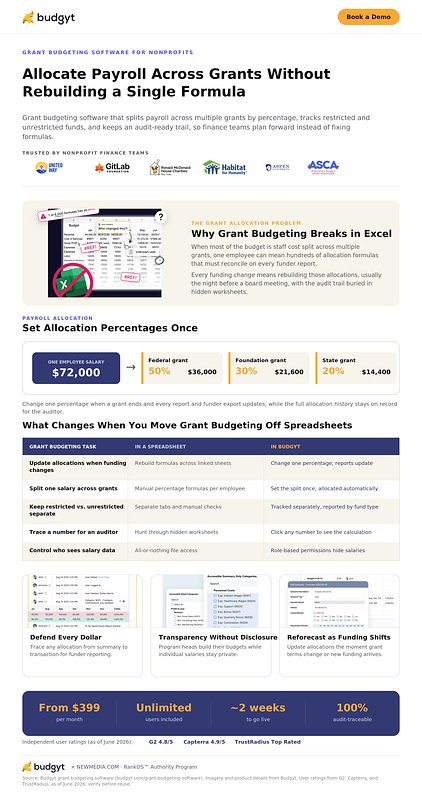
In practice, this means a finance manager can define that an employee's $72,000 salary is split 50% to a federal grant, 30% to a foundation grant, and 20% to a state program. The system automatically calculates the dollar amounts ($36,000, $21,600, and $14,400) and applies them across all relevant reports. If the foundation grant ends in June, the manager adjusts the percentage for the remainder of the year, and the system instantly updates every forecast and report without manual intervention. The full history of the allocation remains on record, providing a clean, unassailable audit trail.
This database-centric model also solves other chronic nonprofit challenges. It allows for the strict separation of restricted and unrestricted funds, preventing the accidental use of designated money for general operating costs. It can manage grants operating on different fiscal calendars, reporting each against its own timeline. Furthermore, role-based permissions allow program directors to participate directly in the budgeting process—entering their own assumptions and seeing their total allocations—while keeping sensitive data like individual salaries confidential.
“When you can set the split once, trace every dollar back to a transaction, and bring program leads into the process without exposing salaries, the audit stops being something you dread and the board conversation gets a lot simpler,” McCoy explained.
Validated by Users, Defined by Price
While the technical solution is compelling, its real-world value is best measured by user adoption and feedback. Across independent software review platforms, Budgyt has garnered consistently high marks, particularly from its target nonprofit audience. As of June 2026, it holds a 4.8 out of 5-star rating on G2 across more than 100 reviews, a 4.9 on Capterra, and is designated a "Top Rated" solution on TrustRadius.
Reviewers frequently praise the platform's ease of use, a critical factor for teams that include non-financial staff. Many describe a significant reduction in time spent on manual budget consolidation, freeing them to focus on strategic analysis. "It has taken us out of the Excel nightmare," one user wrote, echoing a common theme. The inclusion of unlimited users in its pricing is another frequently cited benefit, as it encourages the collaborative workflow the platform is designed to support.
This market validation is crucial, but it is the relationship between capability and cost that defines Budgyt's disruption. The platform has carved out a distinct niche between two less-than-ideal alternatives for most small to mid-sized nonprofits.
On one end, there is accounting software like QuickBooks paired with spreadsheets. This is the default for many, but as discussed, it lacks the robust allocation, forecasting, and collaborative features needed for grant compliance. On the other end are enterprise-grade Financial Planning & Analysis (FP&A) platforms like Vena, Planful, or Workday Adaptive Planning. These systems are immensely powerful but come with annual price tags starting around $25,000 and implementation timelines stretching from three to six months, placing them far out of reach for most nonprofits.
Budgyt enters the market with a starting price of $399 per month and a two-week implementation timeline, connecting to existing accounting systems through a read-only API. This combination delivers the core functionality of the enterprise players—payroll allocation, audit-ready detail, rolling forecasts, and board reporting—at a price point below most nonprofit procurement thresholds. For finance teams that need the power of a dedicated FP&A tool without the enterprise cost or implementation burden, this represents a significant shift in what’s possible.