
- 4-6 hours: Time previously required for creative performance data analysis, now reduced to seconds with ChatEDO
- Trillions of impressions: EDO's proprietary dataset used to train ChatEDO's AI
- 2028: Year when Gartner projects agentic AI will be in a third of enterprise applications
Experts view ChatEDO as a significant advancement in TV ad measurement, democratizing access to sophisticated analytics and enabling real-time decision-making for advertisers.
EDO's AI Agent Aims to Revolutionize TV Ad Measurement
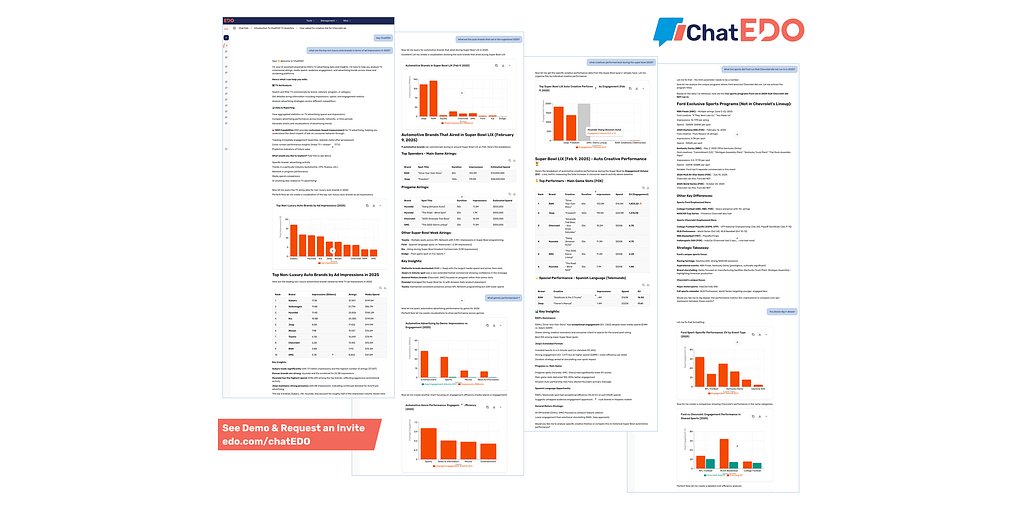
NEW YORK, NY – February 04, 2026 – EDO, the TV outcomes company, today launched ChatEDO, a conversational AI agent designed to fundamentally change how advertisers measure the effectiveness of their television campaigns. The new application allows users to ask complex questions in plain language and receive immediate insights from EDO's vast database of TV advertising performance, a process that traditionally required hours of manual data analysis.
This launch marks a significant step in the application of artificial intelligence to ad-tech, moving beyond simple dashboards and spreadsheets to a dynamic, interactive model of data analysis. ChatEDO aims to democratize access to sophisticated analytics, empowering a wider range of advertising professionals to optimize campaign performance in real-time.
“ChatEDO is about meeting our customers where they are,” said Kevin Krim, President and CEO of EDO, in the official announcement. “Research & Insights teams are under more pressure than ever and EDO’s industry-leading scale and granularity of data across Convergent TV breaks old dashboard and spreadsheet-based workflows. With ChatEDO, we’re making TV outcomes intelligence even more accessible, immediate, and useful.”
Beyond Dashboards: A New Workflow for Overworked Agencies
The introduction of ChatEDO directly addresses a critical pain point within the advertising industry: marketing teams, particularly at agencies, are often overextended and under-resourced. The rise of fragmented, cross-platform TV has increased the complexity of measurement, while expectations for speed and accuracy have skyrocketed. Previously, answering a client's question about a competitor's media strategy or the impact of a specific creative could involve a data analyst spending hours filtering multiple dashboards, downloading data into spreadsheets, and manually compiling a report. This workflow could delay crucial decisions by days.
ChatEDO promises to collapse that timeline from hours to seconds. According to EDO, internal tests have shown the AI agent can instantly answer common but time-consuming queries about creative impact, competitive intelligence, and media weights. For an agency on a call with a client, this means they can explore a competitor's media plan and performance in real-time, providing immediate strategic value rather than promising a follow-up meeting. By eliminating the need for specialized skills like SQL to query the database, the tool extends powerful analytical capabilities beyond a small group of data specialists to the broader organization, including media planners, brand managers, and account executives.
This shift represents a democratization of data intelligence. Team members who might have previously waited 4-6 hours for creative performance data can now receive instant analysis, fostering a more agile and responsive environment. The goal is to help teams move faster, respond to stakeholder needs more quickly, and ultimately improve efficiency and ROI at a time when doing more with less has become an industry mandate.
Under the Hood: The Power of Vertical and Agentic AI
What distinguishes ChatEDO from a generic chatbot is its sophisticated technical foundation, built on what EDO calls its "Vertical AI" heritage. Rather than relying on a general-purpose AI trained on the public internet, ChatEDO is grounded in EDO's decade of proprietary, structured data on Convergent TV outcomes. This specialized dataset includes trillions of impressions and hundreds of millions of individual ad airings, all linked to real, predictive consumer behaviors like online searches. This vertical focus provides the necessary context and guardrails for the AI to deliver reliable, industry-specific insights.
Furthermore, EDO describes the tool as an "agentic AI" application—a significant evolution from reactive AI. While a chatbot responds to prompts, an agentic system is designed to be a more proactive partner. It can understand broader goals, utilize multiple tools, and handle complex, multi-step tasks without explicit human instruction. This aligns with a major trend in enterprise software, with industry analysts at Gartner projecting that agentic AI will be incorporated into a third of enterprise applications by 2028, handling a significant percentage of daily business decisions autonomously.
“Our focus wasn’t just on building a chat interface — it was building the right intelligence behind it,” said Joshua Lee, EDO’s Chief Technical Officer and Head of Product. “We’ve spent years structuring Convergent TV outcomes data so it can be reliably consumed by AI agents. ChatEDO brings that powerful technical foundation to life, reducing friction and dramatically accelerating time-to-insight for agency teams.”
To ensure the platform remains at the cutting edge, ChatEDO is built as a model-agnostic orchestrator on Amazon Web Services (AWS) Bedrock. This architecture allows it to leverage the best available foundation models—including Anthropic’s Claude Opus and, reportedly, future access to OpenAI's GPT-5—and seamlessly switch between them as the technology evolves, future-proofing the platform without disrupting the user experience.
Reshaping the Competitive Ad Measurement Landscape
The launch of ChatEDO arrives as the advertising industry is undergoing a fundamental shift in how it defines success. The long-standing model of measuring campaigns based on reach and impressions is increasingly being challenged by a demand for tangible business results. Advertisers want to know not just how many people saw an ad, but what actions they took as a result. EDO has positioned itself within this outcomes-focused paradigm, and ChatEDO is a direct extension of that strategy, making outcome measurement more immediate and actionable.
This places EDO in a dynamic competitive landscape dominated by audience-counting giants like Nielsen but also populated by other outcomes-focused players such as iSpot.tv and Samba TV. While many ad-tech firms are integrating AI, EDO is claiming a first-mover advantage with an agentic AI application specifically for TV outcome measurement. This move could set a new standard for data interaction and force competitors to accelerate their own development of conversational and agentic intelligence tools.
The broader market context supports this push. Recent analysis from McKinsey identified agentic AI as a major emerging trend for marketing organizations, with the potential to accelerate business processes by 30-50%. As advertisers demand more granular proof of ROI from their massive TV ad spends, tools that can instantly connect an ad airing to consumer engagement and predictive sales metrics will hold a distinct advantage.
ChatEDO is initially being rolled out exclusively to agency teams through an invite-only early access program. The company stated this controlled launch is intended to carefully manage capacity and ensure the performance, accuracy, and overall quality of the user experience. Interested agencies can request an invite on the company's website. As these advanced tools become more integrated into daily workflows, the ability to simply ask complex business questions and receive immediate, data-backed answers may soon become the new industry standard for strategic media planning.
Topics & Related
Agentic AI
Artificial Intelligence
Generative AI
Software & SaaS
AI & Machine Learning
Related Company Pulse