
- 65 acres per hour: The EAVISION J150 drone can cover up to 65 acres per hour, significantly enhancing efficiency in large-scale farming operations.
- 20-gallon (75.7-liter) spray tank: The drone's capacity allows for extensive spraying operations without frequent refills.
- 9-minute recharge time: The drone's smart battery system can be recharged in under nine minutes, minimizing downtime.
Experts would likely conclude that the EAVISION J150 drone represents a significant advancement in precision agriculture, particularly for Brazil's challenging terrains, offering economic and environmental benefits through reduced chemical waste and enhanced operational efficiency.
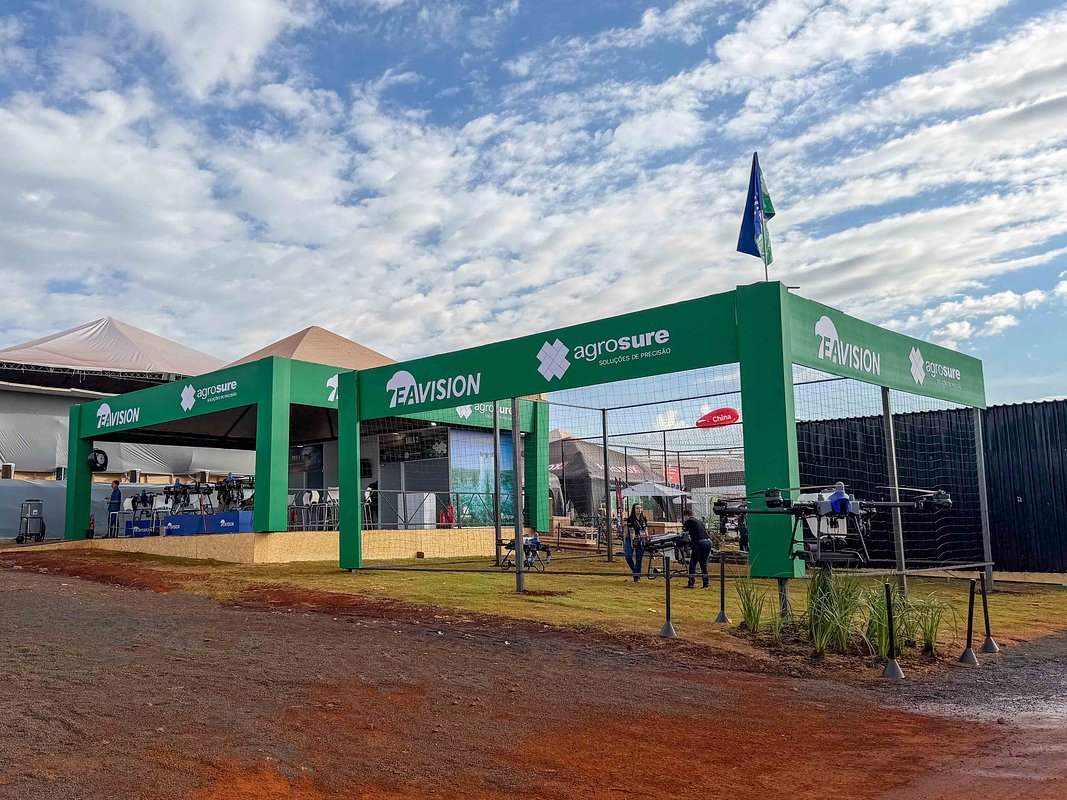
EAVISION Drone Aims to Conquer Brazil's Toughest Farming Terrains
RIBEIRÃO PRETO, Brazil – April 28, 2026 – The roar of engines at Agrishow, Latin America's largest agricultural trade show, is being joined by a different sound this year: the high-efficiency hum of autonomous drones. EAVISION is a central part of this shift, using the massive event to showcase its J150 autonomous spraying drone, a machine engineered specifically to meet the complex demands of Brazilian agriculture. Through live demonstrations, the company is moving beyond theoretical promises to present a field-vetted solution for the nation's vast and varied farming landscapes.
For years, the promise of drone technology in agriculture has been tantalizing but often fell short when faced with the reality of Brazil's topographically diverse farms—from rolling hills to densely packed crop canopies. EAVISION’s showcase at Agrishow 2026 signals a potential turning point, presenting a drone that doesn’t just fly, but intelligently navigates.
A Technological Leap for Challenging Fields
The core of the EAVISION J150's appeal lies in its sophisticated sensory and control systems, designed to treat steep inclines and uneven ground not as obstacles, but as part of the operational landscape. Independent analysis of the drone's capabilities highlights its advanced “Fusion Perception System,” which integrates automobile-grade LiDAR with a trio of active radar arrays. This creates a 360-degree sensory bubble, allowing the drone to detect and navigate around obstacles as small as a one-centimeter wire, day or night.
This technology enables what the company calls “ultra-low terrain-following.” While many drones struggle on anything but flat land, the J150 is designed to maintain a consistent altitude relative to the crops below, ensuring a uniform spray application even on hillsides and in terraced fields. This represents a significant upgrade over its predecessor, the J100, by adding comprehensive spherical obstacle detection that eliminates previous blind spots.
Performance metrics further underscore its capabilities. The J150 boasts a 20-gallon (75.7-liter) spray tank and can cover up to 65 acres per hour. Its fourth-generation rotary atomizer system allows for precise control over droplet size, from a fine mist to larger droplets, minimizing pesticide drift—a major environmental and financial concern. Field tests have shown a highly efficient swath consistency, ensuring that costly chemicals are applied exactly where needed, reducing waste and environmental impact.
“We want to provide real access to a precision agriculture drone,” says an EAVISION spokesperson. “For years, we’ve watched as Brazilian farmers struggle with different terrain and canopy coverage. Our J150 directly addresses these issues so more people can ensure the national food supply both for residents and the growing export market.”
Sowing Seeds of Economic Growth and Sustainability
The introduction of such advanced technology is not merely a technical curiosity; it has profound implications for Brazil's economy. With agribusiness accounting for roughly a quarter of the nation's GDP and nearly 45% of its exports, any gains in efficiency and productivity reverberate throughout the economy.
The J150’s precision directly translates to economic benefits for farmers. By reducing chemical overlap and missed spots, the drone lowers overall input costs for pesticides and fertilizers. This waste reduction also aligns with growing global pressure for more sustainable farming practices and stricter regulations on chemical use. The drone's versatility is another key economic driver. Equipped with a spreader, it can distribute seeds and fertilizers with a capacity of 180 pounds (80kg), making it a multi-purpose tool that optimizes resource use throughout the growing season.
For an industry grappling with rising operational costs, this level of efficiency is critical. The J150 is designed for continuous operation, with a smart battery system that can be recharged in under nine minutes, minimizing downtime. This allows large-scale operations to cover vast areas quickly and small-scale farms to manage their land with unprecedented precision.
Reshaping Labor and Livelihoods on the Farm
Beyond the technological and economic benefits, the adoption of autonomous drones like the J150 is set to reshape the human side of farming in Brazil. The technology directly addresses chronic labor shortages and the inherent risks of manual crop spraying. Traditional methods often require teams of workers to navigate difficult and sometimes dangerous terrain, where loose footing or hidden wildlife can pose a threat. Automating this process significantly enhances worker safety.
However, the story is more complex than simple labor replacement. The introduction of advanced agricultural technology necessitates a shift in the workforce, creating demand for new skills. Farmers and farm workers will increasingly need expertise in drone operation, data interpretation, and equipment maintenance. This transition represents an evolution of the agricultural profession, moving from manual labor to technology management.
EAVISION's strategy appears to acknowledge this, emphasizing local partnerships and training programs. By working with local distributors and offering after-sales support, the company is laying the groundwork for a skilled ecosystem capable of supporting this new wave of technology. This approach helps ensure that the benefits of automation are accessible across the spectrum of Brazilian agriculture, from large corporate farms to smaller family-run operations.
A Strategic Commitment to the Brazilian Market
EAVISION’s prominent presence at Agrishow is more than a product launch; it is a strategic investment in the Brazilian market. The company has explicitly stated that its participation is part of a broader plan to expand its footprint in Brazil, focusing on field validation and product adaptation to meet local needs. Successfully navigating Brazil's regulatory landscape, overseen by agencies like the National Civil Aviation Agency (ANAC), will be crucial for widespread adoption, and EAVISION's emphasis on localization and partnerships is a key step in that process.
“EAVISION is firmly committed to being a part of Brazil’s farming future,” the company spokesperson continues. “We encourage field validation and localization efforts, always listening to our partners and clients to overcome agricultural challenges through our crop spraying drone technology.”
As attendees watch the J150 perform its intricate maneuvers over the demonstration field, they are seeing a potential future for Brazilian agriculture—one that is more efficient, sustainable, and resilient. By providing a practical tool to solve long-standing problems, EAVISION is not just selling a drone; it is offering a new way to manage the complex and vital business of feeding a nation and the world. The real test will be its adoption and performance in the diverse fields across the country, but the demonstration at Agrishow 2026 makes a compelling case.