
- AED 3.5 billion: Contracts awarded for 544 luxury villas on Palm Jebel Ali
- Q4 2028: Target completion date for the villa construction
- 35-45%: Projected capital appreciation for the villas by completion
Experts view the AED 3.5 billion villa contracts as a pivotal step in Palm Jebel Ali's revival, signaling strong market demand and long-term investment potential, while highlighting Dubai's commitment to sustainable urban development.
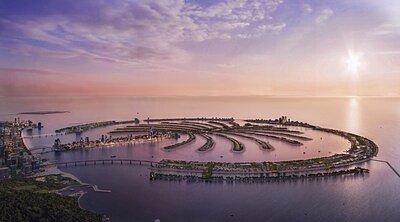
Dubai's Palm Jebel Ali Roars Back with AED 3.5 Billion Villa Contracts
DUBAI, UAE – April 27, 2026 – In the most definitive sign yet of Palm Jebel Ali's full-scale revival, developer Nakheel has awarded contracts worth over AED 3.5 billion for the construction of 544 luxury villas on the man-made island. The move injects massive momentum into one of Dubai's most iconic and long-awaited mega-projects.
The contracts have been secured by two prominent UAE-based firms: Ginco General Contracting L.L.C, which will build 354 villas across the island's Fronds A to D, and United Engineering Construction (UNEC), tasked with delivering 190 villas on Fronds E and F. According to Nakheel, a member of Dubai Holding Real Estate, construction is set to commence this quarter, with a target completion date of Q4 2028.
This monumental investment marks a pivotal moment in the storied history of Palm Jebel Ali, transforming years of speculation into tangible development and signaling a new era for the ambitious waterfront destination.
A Phoenix Rises from the Sands
First launched in 2002 as a larger, more elaborate successor to the world-famous Palm Jumeirah, Palm Jebel Ali was a symbol of Dubai's soaring ambition. However, the project was put on hold in 2008 following the global financial crisis, leaving the massive reclaimed landmass dormant for over a decade. Its future remained uncertain until May 2023, when Sheikh Mohammed bin Rashid Al Maktoum, Vice President and Ruler of Dubai, officially approved a new, futuristic master plan.
This relaunch reimagined Palm Jebel Ali not just as a revival, but as a cornerstone of Dubai's future. The new vision emphasizes sustainable urban planning, family-centric communities, and extensive green spaces. The awarding of these construction contracts is the first major capital deployment since the project's revival, confirming that the vision is now firmly transitioning into reality.
"The awarding of these contracts signals tangible progress in the delivery of Palm Jebel Ali, with construction now progressing across multiple fronds," said Khalid Al Malik, Chief Executive Officer of Dubai Holding Real Estate. "As momentum continues to build, Palm Jebel Ali represents one of the most significant expansions of Dubai's urban coastline in a generation and will play a key role in supporting the emirate's long-term growth."
Redefining Waterfront Investment and Luxury
The renewed confidence in the project is mirrored by intense market demand. The initial release of villas on Palm Jebel Ali reportedly sold out almost immediately, driven by both local and international investors eager to secure a foothold in Dubai's next frontier of luxury real estate.
Analysts point to a compelling investment thesis. With entry prices currently lower than the more mature Palm Jumeirah, Palm Jebel Ali offers significant potential for capital appreciation, with some projections estimating growth between 35-45% by its 2028 completion date. Expected rental yields are also strong, forecast to be in the 7.5-10% range upon handover.
The 544 new villas are part of the recently unveiled Beach and Coral Collections, which were developed in collaboration with leading international architects to offer a new standard in opulent living. Spanning an enormous 13.4 square kilometres across seven interconnected islands, the development will ultimately feature 16 fronds and add over 90 kilometres of pristine beachfront to the city. Beyond the private residences, the master plan includes extensive community infrastructure, such as a 9,000-square-metre retail centre and a landmark Friday Mosque designed by the renowned firm Skidmore, Owings & Merrill, capable of accommodating 1,000 worshippers.
Building a Sustainable Future
While the scale of Palm Jebel Ali is immense, its new master plan reflects a significant shift towards environmental consciousness, addressing historical concerns associated with the construction of artificial islands. The revived project places a strong emphasis on sustainability and green building practices.
The development aims for near self-sufficiency in power generation for public areas, with plans for 30% of the energy consumed by its public facilities to come from renewable sources. The villas themselves are being designed to be "net-zero-ready," incorporating energy-efficient systems and the infrastructure for future solar panel integration. This focus extends to water recycling systems, the use of low-impact construction materials, and the promotion of sustainable mobility through extensive pedestrian walkways and cycling paths.
Critically, the project includes measures to protect and enhance the surrounding marine ecosystem. These initiatives reportedly involve coral relocation programs and the creation of new artificial reefs to foster biodiversity, representing a more balanced approach that seeks to integrate development with environmental stewardship.
A Cornerstone of Dubai's 2040 Vision
The revitalization of Palm Jebel Ali is a strategic move, deeply woven into the fabric of Dubai's future ambitions as outlined in the Dubai 2040 Urban Master Plan and the Dubai Economic Agenda D33. The project is set to become a major new growth corridor for the emirate.
It directly supports the 2040 plan's goal of expanding public beaches and green spaces, while providing housing for an estimated 35,000 families to accommodate Dubai's growing population. Economically, its planned 80-plus hotels and resorts will provide a substantial boost to the tourism sector, a key pillar of the D33 agenda which aims to double the size of Dubai's economy over the next decade.
By creating a world-class destination that is larger and designed with a greater emphasis on tranquility and green living than its famous predecessor, Palm Jumeirah, the project reinforces Dubai's global appeal as a premier location to live, invest, and visit. The construction cranes now set to rise over the fronds of Palm Jebel Ali are not just building villas; they are constructing a key piece of Dubai's forward-looking narrative for decades to come.