
- Net Loss in 2025: $31.6 million (including a $105.3 million impairment charge)
- Debt Reduction: $420 million decrease in Reserve Based Lending (RBL) debt, ending 2025 with net debt of $155.3 million
- 2026 Production Guidance: Mid-teens decline in working interest production (23.0 to 28.0 kboepd)
Experts view Meren Energy's Q1 2026 results as a critical test of its ability to balance high oil prices with production declines, while maintaining financial discipline and long-term growth potential in the Orange Basin.
Meren Energy Q1 Results Awaited Amid Volatile Oil Market
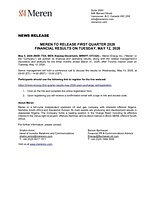
VANCOUVER, BC – May 05, 2026 – Meren Energy Inc. has announced it will release its first-quarter 2026 financial results on Tuesday, May 12, setting the stage for a critical update on the company's performance and strategic direction. The announcement, which includes a conference call with senior management on May 13, comes as investors and analysts keenly watch how the independent oil and gas producer is navigating a period of extreme volatility in the global energy market.
The upcoming report will provide the first detailed look into Meren's financial health in 2026, a year that has already seen dramatic swings in commodity prices. Stakeholders will be parsing the results for insights into the company's operational efficiency in its core Nigerian deepwater assets and progress on its long-term growth projects in the emerging Orange Basin off the coasts of Namibia and South Africa.
A Transformative but Challenging 2025
To understand the significance of the upcoming Q1 report, it is essential to look at the landscape Meren navigated in 2025. The company, which rebranded from Africa Oil Corp. in May 2025, underwent a significant strategic overhaul. The year was highlighted by a "transformational Prime consolidation" in March, a move that effectively doubled Meren's reserves and production from its high-netback Nigerian assets.
Despite this strategic expansion, the company's full-year 2025 financials painted a complex picture. Meren reported a net loss of $31.6 million for the year, heavily influenced by a non-cash impairment charge of $105.3 million related to its Agbami field. This charge reflected a more conservative outlook on future oil prices and costs. The fourth quarter was particularly challenging, with a net loss of $90.8 million, as production was hampered by scheduled maintenance and temporary facility disruptions.
However, the year also saw major strides in financial discipline. The company aggressively deleveraged its balance sheet, reducing its Reserve Based Lending (RBL) debt by $420 million to end the year with a net debt of just $155.3 million. This brought its Net Debt/EBITDAX ratio to a very healthy 0.4x. Furthermore, Meren demonstrated a strong commitment to shareholder returns, distributing approximately $100 million through dividends and share repurchases. This performance stands in contrast to a more profitable first quarter of 2025, which saw a net income of $50.9 million, highlighting the fluctuating nature of the company's earnings.
Riding the Wave of Soaring Oil Prices
The first quarter of 2026 was anything but ordinary for the energy sector. Geopolitical turmoil in the Middle East caused Brent crude oil prices to surge dramatically, starting the year at $61 per barrel and rocketing to a peak of nearly $128 before closing the quarter at $118 per barrel. The average price for March stood at $103 per barrel, a level not seen in years. This high-price environment has been a boon for oil and gas producers, with the sector as a whole seeing extraordinary gains.
Investors will be eager to see how Meren capitalized on these high prices. While the company's average realized price in 2025 was a respectable $72.2 per barrel, the Q1 2026 market offered a significantly more lucrative environment. However, any revenue boost from higher prices may be tempered by the company's production guidance for 2026, which projects a mid-teens decline in working interest production to a range of 23.0 to 28.0 thousand barrels of oil equivalent per day (kboepd). The Q1 report will be the first test of this guidance and will reveal the balance between higher price realizations and lower production volumes.
Deepwater Ambitions: Nigeria and the Orange Basin
Meren's strategy hinges on a dual focus: maximizing value from its established deepwater assets in Nigeria and pioneering new frontiers in Africa's Orange Basin. The Q1 results will offer clues on the execution of both.
In Nigeria, which is expected to generate all of the company's 2026 production, sustained drilling campaigns for the Akpo, Egina, and Agbami fields are slated to begin late in 2026. A pause in drilling during 2025 allowed the company to interpret 4D seismic data to optimize future well placements. Investors will look for any updates on the contracting of a deepwater rig and the timeline for these crucial infill drilling programs, which are vital for offsetting natural production declines.
The company's long-term growth story lies in the Orange Basin. Meren holds a significant interest in the Venus light oil project offshore Namibia, a massive discovery that has de-risked a new petroleum province. While this project offers enormous upside, partner TotalEnergies recently postponed its final investment decision (FID) to late 2026, pushing back the timeline for development. Meren also has a direct interest in Block 3B/4B offshore South Africa, further cementing its leading position in this exciting new basin. The upcoming report may provide commentary on the progress of development studies and exploration plans in this region.
Wall Street's Watchful Eye and Competitive Landscape
Analysts are approaching Meren's Q1 report with cautious optimism. The consensus rating among the few analysts covering the stock is a "Hold," with an average price target suggesting potential upside. Forecasts for Q1 2026 earnings per share (EPS) are modest, with one analyst predicting $0.06 on revenue of $167.66 million. The market will be watching to see if Meren can beat these expectations and signal a path toward sustained profitability, which analysts forecast the company will achieve within the next three years.
When viewed against its peers, Meren's position is distinct. Competitor Kosmos Energy reported a 25% increase in production for Q1 2026 but also a significant net loss, partly due to derivatives. Tullow Oil showed a production increase and benefited from record pricing for its West African barrels. Meanwhile, major player Eni reported a 9% production increase, driven by West African project ramp-ups. Meren's anticipated production decline in 2026 contrasts with the growth of some competitors, placing more emphasis on its financial discipline, strong balance sheet, and the long-term potential of its Orange Basin assets as key differentiators for investors.
The forthcoming financial results on May 12 will therefore be a pivotal moment, providing a clear snapshot of Meren Energy's ability to manage its mature assets effectively in a high-price environment while laying the groundwork for future growth.