
- 25% of all transportation trips in Dubai to be autonomous by 2030
- Apollo Go has logged over 240 million autonomous kilometers
- RT6 robotaxis priced at approximately $28,600 USD
Experts view this collaboration as a significant milestone in advancing autonomous transportation, aligning with Dubai's 2030 vision and setting a global benchmark for urban mobility innovation.
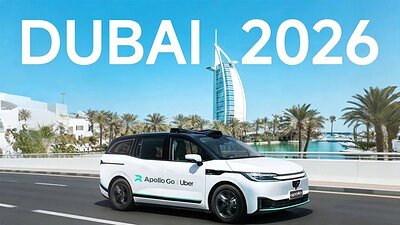
Dubai's Driverless Future Arrives: Baidu and Uber Launch Apollo Go Service
DUBAI, UAE – February 10, 2026 – The vision of a driverless city is rapidly becoming a reality on the streets of Dubai. In a landmark collaboration, Chinese tech giant Baidu and global ride-hailing leader Uber, in partnership with Dubai's Roads and Transport Authority (RTA), have announced the imminent launch of the Apollo Go autonomous ride-hailing service on the Uber platform.
Beginning next month, fully autonomous vehicles will become available for booking through the Uber app, initially serving select locations within the vibrant Jumeirah area. This deployment represents a significant step in a strategic global partnership, merging Baidu's advanced autonomous driving technology with Uber's massive user network to bring futuristic transport to the public.
Accelerating Dubai's 2030 Vision
This launch is not just a technological showcase; it is a critical component of Dubai's ambitious Autonomous Transportation Strategy. The emirate has set a bold target to make 25% of all transportation trips autonomous by 2030, and this partnership is a powerful catalyst toward achieving that goal. The government's strategy aims to generate Dhs22 billion in economic revenue by enhancing efficiency, while also increasing productivity by 13% and reducing traffic accidents, of which over 90% are attributed to human error.
The RTA has been instrumental in creating a fertile ground for such innovation. By actively fostering a competitive ecosystem and granting Baidu's Apollo Go Dubai's first driverless vehicle trial permit in January 2026, the authority has paved the way for fully autonomous commercial services. The initiative is also designed to enhance the city's public transport network, aligning with the RTA's 'First and Last-Mile Strategy' by providing seamless connections to and from metro and bus stations. This service aims to improve mobility for all residents, including senior citizens and people of determination.
Dubai's residents are uniquely positioned to embrace this change. With a long-standing trust in automation, exemplified by the world's longest driverless metro system, coupled with the city's advanced 5G networks and smart traffic infrastructure, the city provides an ideal environment for autonomous vehicles to thrive.
A Global Platform for Autonomous Tech
The Dubai launch highlights a pivotal shift in the global autonomous vehicle (AV) race. It showcases Uber's strategy to become the world's premier distribution platform for AV technology, rather than developing it in-house. Uber now partners with over 20 AV companies, leveraging its platform to introduce autonomous travel to millions.
"We're excited to partner with Baidu as we continue to grow our autonomous footprint across Dubai," said Sarfraz Maredia, Global Head of Autonomous at Uber. "Just as we helped millions of people try out EVs for the first time, we will expand consumer access to autonomous technology in major cities around the world."
For Baidu, this is a major step in its international expansion. The company has been aggressively scaling its Apollo Go service, which already operates in 22 cities. The Dubai launch follows the inauguration of the 'Apollo Go Park' in January—a 2,000-square-meter operations and management hub poised to support a future fleet of 1,000 vehicles. This move comes on the heels of announced plans to enter the challenging right-hand-drive market of London and the launch of commercial operations in Abu Dhabi.
"Bringing Apollo Go to Dubai via the Uber platform marks a pivotal step in our mission to provide safe, efficient, and accessible autonomous mobility worldwide," stated Nan Yang, Vice President of Baidu. "This deployment officially brings our autonomous ride-hailing service to Dubai, utilizing Uber's vast network to turn our shared vision into reality."
Dubai is quickly becoming a competitive hotbed for AVs. The RTA has also expanded its partnership to include WeRide for AV rides on the Uber platform, and Pony.ai has announced plans to launch robotaxi services in the Middle East, signaling a dynamic and open market for innovation.
Under the Hood of Apollo Go
The vehicles arriving in Dubai are Baidu's sixth-generation RT6 robotaxis, purpose-built for large-scale, fully driverless commercial deployment. Each vehicle is a rolling powerhouse of technology, equipped with over 40 advanced sensors, including high-precision LiDAR, multi-band radars, and high-resolution cameras. This suite of hardware, combined with sophisticated software and high-definition maps, allows the vehicle to navigate complex urban environments with precision.
Baidu's Apollo Go boasts one of the most extensive operational track records in the industry. The platform has logged over 240 million autonomous kilometers, with more than 140 million of those in fully driverless mode. As of late 2025, the service had completed over 17 million cumulative rides, with weekly ride counts recently surpassing 250,000. Baidu also reports an impressive safety metric, averaging 10.14 million kilometers of operation before a single airbag deployment, a figure it claims surpasses the performance of an average human driver. This focus on safety and efficiency is complemented by a significant reduction in manufacturing costs, with the RT6 vehicle priced at approximately $28,600 USD, making large-scale deployment economically viable.
What to Expect: The Rider Experience
For residents and tourists in Dubai, hailing a driverless car will soon be as simple as ordering a standard Uber. Within the designated service area in Jumeirah, users can either directly select the 'Autonomous' option in the Uber app or be automatically matched with an Apollo Go vehicle when booking a regular UberX or Uber Comfort ride. This seamless integration is designed to normalize autonomous travel and drive widespread adoption.
The initial deployment will serve as a crucial learning period, with data gathered on operational efficiency and public interaction informing future expansion across the city, pending regulatory approvals. The day-to-day fleet management, including vehicle maintenance and charging, will be handled by a third-party operator, New Horizon, demonstrating a collaborative operational model.
By introducing autonomous vehicles through a familiar and trusted platform, Baidu and Uber are not just launching a new service; they are shaping the future of urban mobility and positioning Dubai at the absolute forefront of the global transportation revolution.
Topics & Related
Partnership
Joint Venture
Revenue
AI & Machine Learning
Software & SaaS
Fintech
Logistics & Supply Chain
Artificial Intelligence
Generative AI
Automation
Related Company Pulse