
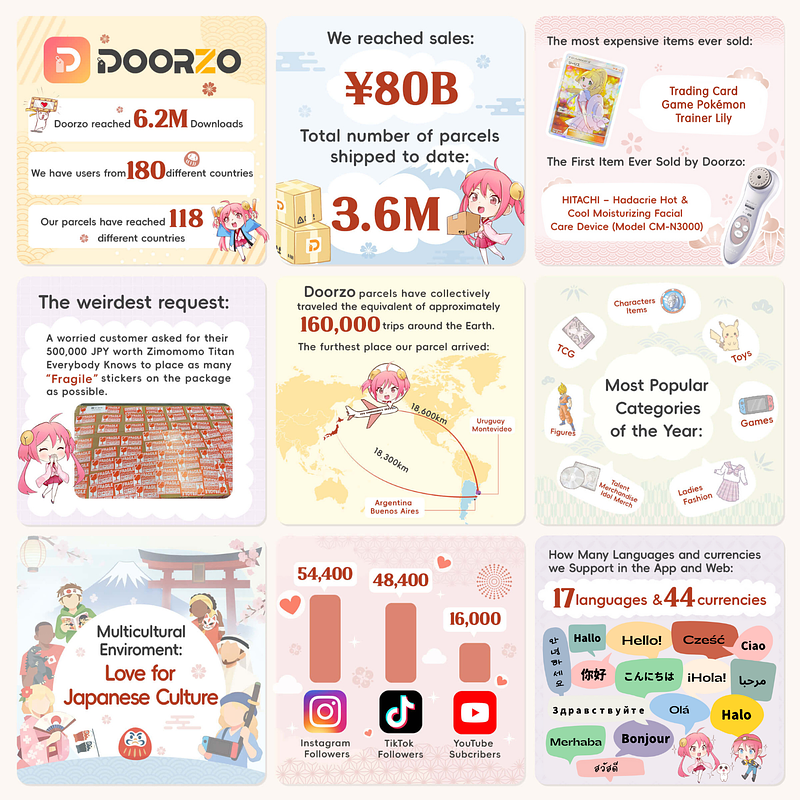
- ¥80 billion in cumulative sales for Doorzo in 2025
- 3.6 million parcels shipped to 118 countries in 2025
- Japan cross-border e-commerce market projected to grow at a CAGR of nearly 7% through 2030
Experts view Doorzo's success as a testament to the global demand for 'Cool Japan' goods and the platform's strategic focus on localization, trust, and logistical excellence in driving cross-border e-commerce growth.
Doorzo's ¥80B Milestone Signals Global Boom for 'Cool Japan' Goods
TOKYO, JAPAN – February 06, 2026 – Japanese cross-border e-commerce platform Doorzo has announced a record-breaking 2025, capping a decade of growth by surpassing a cumulative ¥80 billion in total sales. The achievement, detailed in a recent report by its operator SIG Service INC., highlights the platform's pivotal role in an increasingly globalized market and underscores a powerful trend: the world's insatiable appetite for Japanese products.
By shipping over 3.6 million parcels to 118 countries last year alone, Doorzo has cemented its position not just as a shopping service, but as a primary conduit for Japan's soft power. The platform's success provides a compelling case study in how technology, logistics, and a deep understanding of cultural demand can unlock a nation's marketplace for a global audience.
The Engine Behind the 'Cool Japan' Economy
Doorzo's performance is a powerful indicator of the strength of the cross-border e-commerce market, particularly for goods exported from Japan. Industry analysts project the Japan cross-border e-commerce market, valued at over $3 billion in 2022, to grow at a compound annual growth rate (CAGR) of nearly 7% through 2030. Some forecasts are even more bullish, predicting the market could exceed $10 billion by 2035.
This growth is largely fueled by the international appeal of 'Cool Japan'—a term encompassing everything from anime and manga to video games, fashion, and unique consumer goods. Doorzo's 2025 report validates this trend, with its most popular categories being Trading Cards (TCG), Figures, Games, and Toys. The market for these hobby-related items is expected to be the fastest-growing segment in Japan's cross-border sector, and Doorzo is riding the crest of that wave.
The platform acts as a digital gateway, giving consumers in 180 countries access to items that are often difficult or impossible to find outside of Japan. This direct access has transformed how international fans engage with Japanese culture, moving from passive consumption to active participation in collecting and trading, thereby driving significant economic activity.
A Blueprint for Cross-Border Success
In a competitive landscape populated by proxy services like Buyee and ZenMarket, Doorzo's remarkable growth can be attributed to a multi-faceted strategy focused on localization, user trust, and logistical excellence. The company's vision of being 'your gateway to Japan' is more than a slogan; it's an operational blueprint.
A key differentiator is the platform's deep commitment to accessibility. By supporting 17 languages and 44 different currencies, Doorzo significantly lowers the barrier to entry for a diverse global customer base. This localization effort moves beyond simple translation, creating a seamless and intuitive shopping experience that builds user confidence.
This confidence is reflected in the company's stellar reputation. Doorzo boasts a 4.7-star rating on Trustpilot from nearly 1,000 reviews, a figure that suggests a high degree of customer satisfaction with its service reliability and communication. In an industry where trust is paramount—especially when purchasing high-value items from overseas—this positive feedback serves as a powerful engine for organic growth and user retention.
The scale of its operation is staggering. The 3.6 million parcels shipped in 2025 collectively traveled a distance equivalent to 160,000 trips around the Earth. Managing this volume requires a sophisticated logistics network capable of navigating complex international shipping regulations and customs procedures. While facing industry-wide challenges like delivery times, Doorzo's stated commitment to 'logistics excellence' appears to be a core pillar of its success, enabling it to deliver to a vast network of countries including the United States, China, the United Kingdom, and Mexico.
Niche Markets, Major Impact
While the platform serves a broad audience, its most striking successes are found in niche, high-passion markets. The report reveals that the single most expensive item sold on the platform was a rare Pokémon Trainer 'Lillie' trading card, which can command market prices around ¥6 million (approximately $43,000 USD). This single transaction highlights the immense value locked within the collectibles market.
This isn't an isolated phenomenon. The top-performing categories—TCGs, figures, and toys—are driven by dedicated communities of collectors willing to spend significant sums on rare and sought-after items. One anecdote shared by the company involved a customer purchasing a Zimomomo Titan toy valued at ¥500,000 and requesting an excessive number of 'Fragile' labels, illustrating the deep personal and financial investment users place in their purchases.
These niche markets are no longer on the fringe; they are a formidable economic force. Doorzo has effectively tapped into this by providing a reliable platform for discovering, purchasing, and safely receiving these cultural artifacts. From limited-edition anime figures to exclusive Japanese fashion items, the platform's success demonstrates that catering to specialized interests can be a highly lucrative business model.
As Doorzo looks toward 2026, its journey from a startup in 2013 to a global e-commerce powerhouse offers valuable lessons. By blending technological innovation with a profound respect for the cultural products it handles, the company has not only achieved impressive financial milestones but has also become an indispensable part of the global cultural exchange. Its continued growth will likely depend on its ability to maintain this delicate balance, further refining the bridge it has built between Japan's vibrant marketplaces and an eager world.