
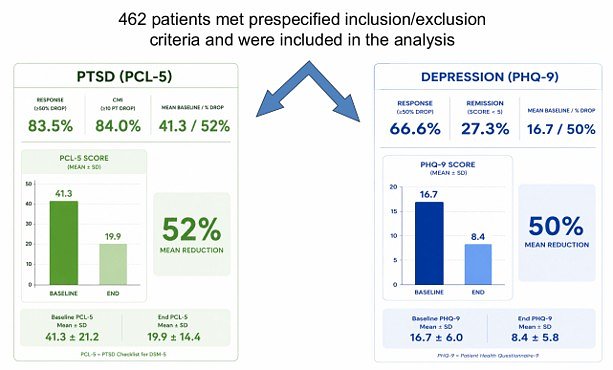
- 83.5% response rate for PTSD symptoms in patients with comorbid PTSD and MDD.
- 66.6% response rate for depression symptoms, with a 27.3% remission rate.
- Study included 462 patients across 11 clinical sites.
Experts would likely conclude that Deep TMS shows promising potential as a non-invasive treatment option for comorbid PTSD and MDD, though further peer-reviewed research and FDA clearance are needed to confirm its efficacy.
Deep TMS Shows Unprecedented Response in Complex PTSD and Depression
BURLINGTON, Mass. – June 29, 2026 – For the millions grappling with the dual diagnosis of Post-Traumatic Stress Disorder (PTSD) and Major Depressive Disorder (MDD), the treatment path is often a frustrating cycle of therapies that fail to address the intertwined nature of their conditions. Now, new data from a landmark study presents a significant beacon of hope, suggesting a noninvasive brain stimulation technology could fundamentally alter this landscape.
BrainsWay (NASDAQ & TASE: BWAY), a prominent player in neurostimulation, has released compelling results from the largest real-world study of its Deep Transcranial Magnetic Stimulation (Deep TMS™) technology in patients with comorbid PTSD and MDD. The findings, presented at a recent industry conference, are striking: nearly 84% of patients saw their PTSD symptoms reduced by half or more. This isn't just an incremental improvement; for a patient population where depression often proves resistant to standard treatments due to underlying trauma, these figures represent a potential breakthrough.
A New Hope for a Challenging Diagnosis
The clinical challenge of comorbid PTSD and MDD cannot be overstated. Nearly half of all individuals diagnosed with PTSD also meet the criteria for major depression, creating a complex clinical picture where each disorder exacerbates the other. Research from institutions like the U.S. Department of Veterans Affairs has repeatedly shown that these patients experience more severe symptoms and have poorer outcomes with standard treatments compared to those with depression alone.
This is the context that makes BrainsWay's data so significant. The retrospective study analyzed outcomes for 462 patients across 11 different clinical sites. These individuals, all diagnosed with both conditions, underwent at least 20 sessions of Deep TMS. The results demonstrated an 83.5% response rate for PTSD symptoms, with patients seeing an average 52% reduction in their scores on the PCL-5, a standard clinical measure for PTSD. The impact on depression was equally profound, with a 66.6% response rate and a 27.3% remission rate, meaning over a quarter of patients' depression symptoms were virtually eliminated.
“Patients living with both PTSD and depression often experience more severe symptoms and fewer effective treatment options,” said Dr. Toby Marton, Chief Medical Officer at Mindful Health and a key contributor to the study. “The promising outcomes observed across multiple clinical sites highlight the potential of Deep TMS to deliver meaningful benefits and support its role as potential treatment option for this challenging patient population.”
The “real-world” nature of this data is a critical success factor. Unlike a tightly controlled clinical trial with a narrow set of participants, this study reflects the technology's performance in a diverse patient population undergoing routine care, suggesting the results are not just achievable in a lab but also in everyday clinical practice.
The Science and Strategy Behind the H-Coil
At the core of these results is BrainsWay's proprietary H-coil technology. While Transcranial Magnetic Stimulation (TMS) has been used for years to treat depression, most systems use a figure-8 coil that stimulates relatively shallow areas of the brain. Deep TMS, as its name implies, uses a unique helmet-like coil design to generate electromagnetic fields that penetrate deeper and stimulate broader neural networks. This ability to directly modulate activity in deeper brain structures, particularly in the prefrontal cortex which is heavily implicated in both mood and trauma regulation, is believed to be key to its efficacy in complex cases.
“This study represents the largest real-world analysis of Deep TMS in patients with comorbid PTSD and major depressive disorder to date,” stated Colleen Hanlon, Ph.D., Vice President of Medical Affairs at BrainsWay and a recognized expert in neuromodulation. “Given the significant burden associated with these co-occurring conditions, it is encouraging to see meaningful improvements in both PTSD and depression symptoms across a large and diverse patient population.”
For BrainsWay, these findings are a major strategic step. The company is not a newcomer to regulatory success; it already holds FDA clearances for Deep TMS in treating major depression, Obsessive-Compulsive Disorder (OCD), and smoking addiction. Just last year, it became the first and only company to secure FDA clearance for treating depression in adolescents. This track record demonstrates a clear capability to navigate the rigorous path from clinical data to market-approved therapy. This PTSD/MDD study appears to be the next major pillar in its expansion strategy, targeting a large and underserved market.
Navigating the Path from Data to Clinical Reality
Despite the excitement, it is crucial to inject a note of regulatory reality. BrainsWay was clear in its announcement that Deep TMS is not currently cleared by the FDA for treating PTSD or the comorbid condition. The findings are preliminary and have not yet undergone the formal peer-review process, a critical step for scientific validation. Investors and clinicians will be watching closely for the study's publication in a reputable journal.
The path to a new FDA indication will likely require more than this single retrospective study. While the FDA is increasingly open to using Real-World Evidence (RWE) to support regulatory decisions, a prospective, randomized controlled trial is often the gold standard. However, this robust real-world data provides a powerful rationale for undertaking such a trial and could potentially expedite the process.
Furthermore, accessibility remains a key variable. A revolutionary treatment is only effective if patients can access it. Here, BrainsWay has been proactive, recently announcing expanded insurance coverage for its accelerated depression protocol to over 57 million people. This groundwork in establishing reimbursement pathways will be vital if and when a PTSD/MDD indication is secured.
A Shifting Landscape in Mental Healthcare
This development is part of a broader evolution in psychiatry. For decades, the primary tools for treatment-resistant conditions were medication adjustments and psychotherapy. The rise of neurostimulation technologies like TMS represents a fundamental shift, offering a new modality that directly targets the brain's electrical circuitry.
BrainsWay's results are corroborated by independent research. A recent multi-site study within the VA system compared different TMS protocols for veterans with comorbid PTSD and MDD. It found that Deep TMS (dTMS) yielded a 78% PTSD response rate, a figure remarkably close to the 83.5% reported by BrainsWay. This external validation strengthens the case that Deep TMS is a highly effective tool for this specific comorbidity.
Perhaps the most significant implication is the technology's ability to treat two intertwined conditions simultaneously. Instead of separate, and sometimes conflicting, protocols for PTSD and MDD, Deep TMS may offer a unified approach that addresses the common underlying neural dysregulation. By calming the networks associated with trauma while uplifting those tied to mood, it has the potential to break a vicious cycle that has trapped patients for years, offering a more holistic and effective path to recovery.