
- 8.15 MW Cooling Capacity: The new DCX FDU V2AT2 delivers a record-breaking 8.15 megawatts of cooling capacity, designed for next-gen AI supercomputers.
- 45°C Warm-Water Cooling: Enables chillerless operation, potentially reducing data center energy consumption by 30% or more.
- 550 m³/h Flow Rate: Industry-leading flow rate to maintain stable warm-water operation for high-density AI workloads.
Experts agree that DCX’s FDU V2AT2 represents a critical advancement in liquid cooling technology, addressing the thermal challenges of next-generation AI supercomputers while improving energy efficiency and sustainability in data centers.
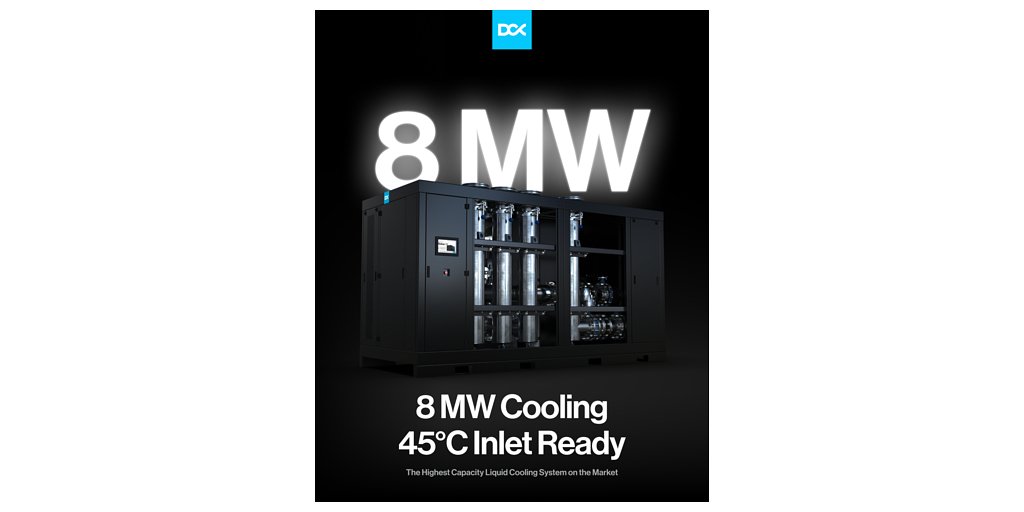
DCX Unveils 8MW Cooler to Tame Next-Gen NVIDIA AI Supercomputers
WARSAW, Poland – January 23, 2026 – As the artificial intelligence arms race accelerates, the immense heat generated by next-generation processors has become a primary barrier to progress. In a significant move to address this thermal challenge, DCX Liquid Cooling Systems today announced a powerful new cooling solution, the Facility Distribution Unit FDU V2AT2, engineered to support the massive power and cooling demands of future AI factories.
This second-generation unit delivers a record-breaking 8.15 megawatts (MW) of cooling capacity, a scale designed to match the infrastructure shift driven by NVIDIA’s upcoming Vera Rubin and current Blackwell AI platforms. By enabling 45°C warm-water cooling, the system promises to revolutionize data center economics and sustainability, potentially eliminating the need for energy-hungry water chillers in many deployments.
Taming the AI Heat Wave
The relentless advance of AI is creating a power paradox: the very chips that enable unprecedented computational power are generating thermal loads that traditional air cooling can no longer handle. Modern AI accelerators are pushing rack power densities from a manageable 10-15 kW to well over 100 kW, transforming data halls into furnaces that threaten performance and reliability. Cooling has shifted from an operational line item to a fundamental architectural constraint.
Liquid cooling, which is up to 3,000 times more effective at heat transfer than air, has emerged as the consensus solution. DCX’s FDU V2AT2 represents a major leap forward in this domain. Unlike previous Coolant Distribution Units (CDUs) designed for a single row of racks, the FDU V2AT2 is a facility-scale system. A single unit can replace a multitude of legacy 1.3MW CDUs, simplifying the entire cooling loop topology for a data hall and supporting large-scale, high-density AI server deployments.
“As the datacenter industry transitions to AI factories, operators need cooling system that won’t be obsolete in one platform cycle,” said Maciek Szadkowski, CTO at DCX, in the company's announcement. “The FDU V2AT2... enables 45°C supply water operation. This new category of CDUs has minimum thermal loss with AT2 approach temperature, and provides multi-megawatt cooling at the hall level. That opens a clear path to NVIDIA Vera Rubin architecture and beyond while simplifying cooling loop topology and significantly reducing both CAPEX and OPEX of datacenter liquid cooling system.”
To achieve this, the system boasts an industry-leading flow rate of 550 cubic meters per hour, essential for maintaining stable warm-water operation. It also features N+1 pump redundancy and integrated water quality control, ensuring the high availability required by mission-critical AI workloads.
The Chillerless Revolution: A Greener, Leaner Data Center
The most disruptive feature of the new system is its optimization for 45°C warm-water cooling. This specific temperature is not arbitrary; it directly aligns with NVIDIA’s public guidance for its Vera Rubin architecture, explicitly enabling data centers to operate without traditional chillers. Chillers, which use refrigeration cycles to cool water, are one of the largest power consumers in a data center, often accounting for 30% or more of total electricity usage.
Eliminating them offers a cascade of benefits. The operational expenditure (OPEX) plummets due to drastically lower energy bills. According to industry analyses, this efficiency gain can free up enough grid capacity to power more AI systems, potentially increasing a facility's compute output by over 30% for the same power connection. The capital expenditure (CAPEX) also decreases by simplifying the mechanical plant and removing expensive chiller hardware.
This approach also tackles another looming crisis for the data center industry: water consumption. While liquid cooling uses water, chillerless designs can significantly reduce a facility's overall water footprint by avoiding the massive evaporative losses associated with cooling towers. With U.S. data centers already consuming billions of gallons annually—a figure projected to nearly double by 2028—water-conscious designs are becoming a license to operate in many regions.
From Waste Heat to Community Asset
For decades, the vast amounts of heat produced by data centers have been treated as a waste product to be vented into the atmosphere. The shift to warm-water cooling, however, reframes this waste as a valuable resource. The 45°C water exiting the FDU V2AT2 is far more useful for heat reuse applications than the cooler water from traditional systems.
This isn't a theoretical benefit; it's already happening. In Finland, a Google data center provides the majority of the annual heat for its local district heating network. In Ireland, waste heat from an Amazon data center is warming thousands of homes and businesses, saving over 1,000 tonnes of CO2 in its first year. The DCX unit's highly capable heat exchanger, which features a tight 2°C approach temperature, is specifically designed to maximize the efficiency of this heat transfer, making such reuse schemes more economically viable.
As governments begin to mandate sustainability, this capability is becoming critical. Germany, for instance, will soon require new data centers to reuse a significant portion of their waste heat. Technologies that facilitate efficient heat capture are no longer just a bonus but a key to future-proofing infrastructure against evolving regulations.
A New Front in the AI Infrastructure Race
DCX's announcement lands in a fiercely competitive market. The global data center liquid cooling market is projected to grow at a compound annual rate of over 50% in the coming years, with major players like Vertiv and Schneider Electric also racing to provide solutions for the AI boom. Vertiv, for example, has introduced its own multi-megawatt modular systems to support high-density workloads.
The strategic alignment with NVIDIA’s roadmap is what sets the FDU V2AT2 apart. By designing a system expressly for the requirements of Vera Rubin and Blackwell, DCX is positioning itself as a critical enabler for hyperscalers and enterprises planning to deploy these next-generation AI platforms. The AI race is no longer just about who has the fastest chips, but who has the infrastructure to cool them effectively and sustainably.
This technology represents a foundational shift in how AI factories are designed and built. By providing a clear path to scalable, efficient, and chillerless cooling, solutions like the FDU V2AT2 are becoming as crucial as the silicon itself, laying the groundwork for the next wave of artificial intelligence while simultaneously addressing the profound energy and environmental challenges it creates.