
- $2,209,100: Expected financial loss increase for every 10 days a data breach goes undetected
- 67%: Customers reported cutting Mean Time to Respond (MTTR) by more than half
- 1,000,000+: Public data sources analyzed in real-time
Experts view Dataminr's AI suite as a significant advancement in proactive cyber defense, aligning with industry frameworks like CTEM and UCRI, but caution that human oversight remains essential for robust security.
Dataminr Unveils AI Suite to Automate Proactive Cyber Defense
NEW YORK, NY – March 23, 2026 – Dataminr, a leader in AI-powered real-time intelligence, today launched Dataminr for Cyber Defense, a new suite of solutions designed to shift enterprise security from a reactive to a proactive, automated posture. The launch marks the first major product integration following the company's 2025 acquisition of ThreatConnect, fusing its vast external threat detection capabilities with an organization's internal security data to provide tailored, prioritized, and actionable intelligence.
Built around a core of agentic and predictive artificial intelligence, the platform aims to cut through the noise of endless security alerts by contextualizing threats specific to each client's environment. It automates the entire threat management lifecycle, from the first signal of a potential threat to a risk-prioritized, decisive response.
"We acquired ThreatConnect with a clear vision: to unite our unrivaled breadth and depth of external threat signals with internal telemetry and provide organizations with clarity on what threats are impacting their business so they can act with speed and precision," said Ted Bailey, CEO and Founder of Dataminr. "The old model of static feeds is obsolete. If you aren't linking the real-time threat directly to your specific posture and real-time financial impact, you are operating blindly."
Redefining Defense with Agentic AI
At the heart of the new suite is the application of agentic AI, a class of artificial intelligence that goes beyond simple analysis to perform complex, multi-step tasks autonomously. Unlike AI models that merely summarize data after an event, Dataminr's agents are designed to handle the labor-intensive work of threat intelligence operations—assembling fragmented signals, enriching data, scoring risks, and routing finished intelligence to the appropriate security workflows.
The suite is comprised of three core solutions:
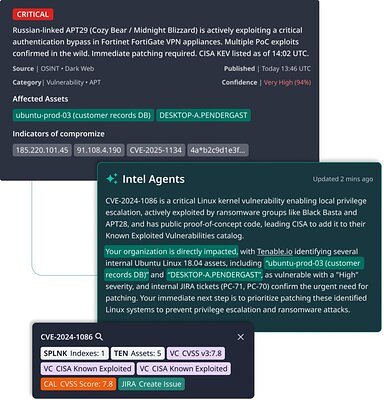
- Dataminr Client-Tailored Threat Intelligence (CTTI): This solution leverages AI to correlate external threats, detected in real-time from over one million public data sources, with an organization's specific internal posture. This fusion is delivered as an overlay within an analyst's existing tools, reportedly cutting investigation times from hours to seconds.
- Dataminr Agentic TI Ops: Acting as a unified intelligence operations platform, this solution combines CTTI with other commercial and internal intelligence sources. It uses "Intel Agents" to automate investigation, enrichment, and prioritization, allowing human analysts to focus on judgment rather than manual data correlation.
- Dataminr Predictive Threat Exposure Management (PTEM): This component quantifies cyber risk in financial terms. It continuously monitors security controls and correlates asset exposure with real-time threat intelligence to provide business-centric prioritization, moving away from purely technical metrics like CVSS scores.
"Using Dataminr to fuse external foresight with internal telemetry, organizations can finally cut through the noise and neutralize threats before they cause material impact," stated Jen Easterly, Chair of Dataminr's Corporate Advisory Board.
Operationalizing a New Industry Vision
With this launch, Dataminr is making a strategic push to be the first to fully operationalize two influential cybersecurity frameworks promoted by industry analyst firm Gartner: Continuous Threat Exposure Management (CTEM) and Unified Cyber Risk Intelligence (UCRI).
The CTEM framework represents a move away from reactive vulnerability patching. It advocates for a continuous, five-stage process of scoping, discovering, prioritizing, validating, and mobilizing defenses based on a realistic understanding of an organization's actual threat exposure. By prioritizing threats based on business impact and exploitability, organizations can focus resources where they are most needed.
UCRI, as outlined in a 2025 Gartner report, is the next evolution of threat intelligence. It calls for the convergence of multisignal data collection—fusing diverse internal and external signals—with advanced AI to enable faster, more accurate, and preemptive threat detection. "Looking ahead, the future of threat intelligence is Unified Cyber Risk Intelligence (UCRI) and will be defined by the convergence of multisignal collection and advanced analytical capabilities," Gartner noted in its report.
By integrating external signals, internal telemetry, and business context, Dataminr for Cyber Defense aims to embody the principles of both frameworks, modernizing security operations from a model based on alerts and incidents to one centered on continuous, preemptive risk control.
From Abstract Threats to Quantified Business Risk
The most significant business implication of the new suite may be its ability to translate cyber threats into financial terms. The PTEM solution is designed to provide security leaders with evidence-backed justification for prioritizing actions, enabling more effective communication from the Security Operations Center (SOC) to the boardroom.
This approach addresses a long-standing challenge in cybersecurity: demonstrating return on investment and aligning security initiatives with business objectives. By quantifying risk based on potential financial impact, organizations can make more informed decisions about resource allocation and risk tolerance.
Dataminr supports this focus with its own analysis, claiming that based on its "Proprietary Dataminr Cyberloss Data," the total expected financial loss increases by $2,209,100 for every 10 days a data breach goes undetected. The company asserts that the speed enabled by its agentic AI is critical to mitigating these escalating costs. According to Dataminr, customer deployments have already shown that reducing investigation cycles from hours to minutes can cut Mean Time to Respond (MTTR) by more than half for 67% of users.
The Competitive Future of AI in Security
Dataminr enters a competitive field where major players like CrowdStrike and Palo Alto Networks are also heavily investing in AI-driven security. CrowdStrike, for instance, has promoted its own "Agentic Threat Intelligence," while Palo Alto Networks integrates AI and machine learning across its Cortex platform. However, Dataminr's differentiation appears to rest on the sheer scale of its public data ingestion—built on a 12-year archive and 55+ proprietary language models—and its explicit productization of the integrated CTEM and UCRI frameworks.
The broader adoption of agentic AI is seen by many experts as the next frontier in cybersecurity, promising to augment human analysts who are often overwhelmed by the volume and speed of modern attacks. These autonomous systems can hunt for threats, manage complex response workflows, and model attack scenarios proactively. However, experts also caution that human oversight remains critical. The power and autonomy of agentic AI introduce new risks, including the need for robust identity management for AI agents and the challenge of maintaining explainability when an AI makes a critical security decision.
As the cyber battlefield continues to evolve, the race is on to develop intelligent, automated systems that can not only defend against machine-speed attacks but also anticipate and neutralize them before they can inflict damage. Dataminr will be showcasing its vision for this future at the upcoming RSA Conference 2026 in San Francisco.