
- 86% of institutional investors either hold digital assets or plan to invest in 2025 (Coinbase & EY-Parthenon survey).
- 55% of traditional hedge funds now have exposure to digital assets (7th Annual Global Crypto Hedge Fund Report).
- GENIUS Act passed in 2025, establishing a federal framework for payment stablecoins.
Experts agree that clear, comprehensive U.S. regulatory frameworks for digital assets are essential to unlock institutional capital and integrate crypto markets into mainstream finance.
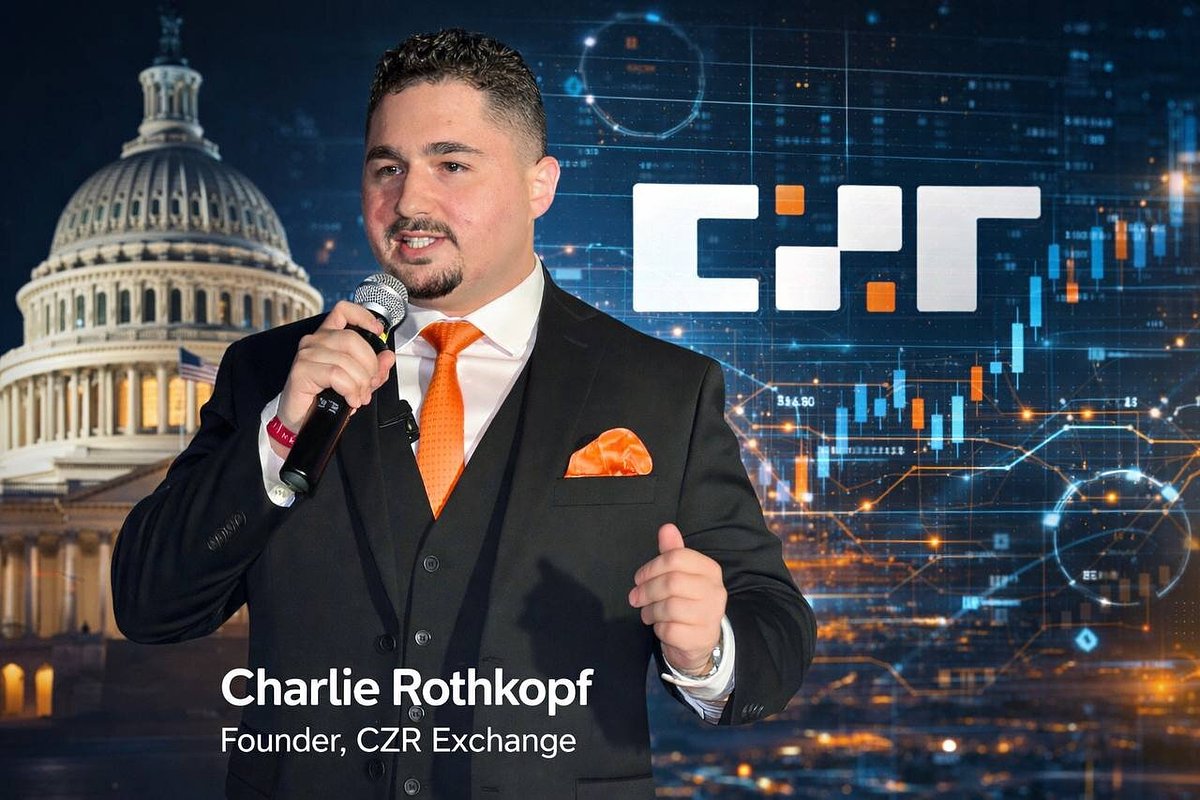
CZR Exchange's Davos Plea: U.S. Crypto Rules Key to Unlocking Capital
DAVOS, SWITZERLAND – January 27, 2026 – By Sharon Kelly
Speaking from the World Economic Forum, a hub for global economic discourse, the founder of digital asset exchange CZR has issued a pointed call for the United States to finalize a clear and comprehensive regulatory framework for digital assets. Charlie Rothkopf, founder of the institutional-focused CZR Exchange, argued that such legislation is the single most critical factor for unlocking long-term institutional capital and ensuring the maturation of digital asset markets within the global financial system.
Rothkopf’s remarks position the current debate not as a reaction to volatile price swings, but as a foundational exercise in market architecture. “This is not a discussion about short-term price movements,” Rothkopf stated. “It is about defining market structure: clear asset classifications, regulatory jurisdiction, and the operational standards governing exchanges and intermediaries; so markets can function efficiently and capital can engage with confidence.”
This appeal from a global stage highlights a pivotal moment for the cryptocurrency industry, which is actively seeking to shed its “Wild West” image and integrate into mainstream finance. The core of the issue, as framed by CZR Exchange and echoed across the industry, is the move away from a patchwork of enforcement actions toward a deliberate, predictable legal structure.
The Legislative Labyrinth
Rothkopf's call for clarity lands amidst a flurry of legislative activity in Washington, where lawmakers are grappling with the complex task of regulating a novel technology. The central conflict remains the jurisdictional tug-of-war between the U.S. Securities and Exchange Commission (SEC) and the Commodity Futures Trading Commission (CFTC). For years, the industry has operated in a gray area, uncertain whether specific digital assets should be treated as securities under the SEC's purview or commodities under the CFTC.
Recent progress, however, suggests a path forward. The Digital Asset Market Clarity (CLARITY) Act of 2025, which passed the House with significant bipartisan support, aims to grant the CFTC authority over “digital commodity” spot markets. This, along with earlier proposals like the Financial Innovation and Technology for the 21st Century Act (FIT21), signals a congressional consensus that a new approach is needed. These bills attempt to draw the very lines Rothkopf called for, defining how assets are classified and which regulator holds the whistle.
“When legislation begins to address spot markets, stablecoins, custody standards, yield mechanisms, and exchange operations, lawmakers are establishing the architecture of a financial marketplace, not simply regulating a new technology,” Rothkopf elaborated, drawing parallels to the development of traditional capital markets where clear rules enabled institutional trust and deep liquidity.
The recent passage of the GENIUS Act, which established a federal framework for payment stablecoins, represents a concrete step in this direction. However, disagreements persist on key details, such as whether stablecoins should be permitted to offer yield, underscoring the complexity that remains. Rothkopf cautioned that without statutory clarity, an “enforcement-driven” approach creates the exact uncertainty that deters long-term investors.
An Institutional Dam Ready to Break
The urgency behind this regulatory push is underscored by overwhelming evidence of institutional demand. Major financial players are no longer just crypto-curious; they are poised for significant allocation, with regulatory ambiguity being the primary floodgate holding them back.
A January 2025 survey by Coinbase and EY-Parthenon found that a staggering 86% of institutional investors globally either hold digital assets or plan to invest in 2025, with regulatory clarity cited as the number one catalyst for growth. Similarly, the 7th Annual Global Crypto Hedge Fund Report from late 2025 revealed that 55% of traditional hedge funds now have exposure to digital assets, with nearly half of all institutional investors surveyed stating that the evolving U.S. regulatory landscape is encouraging them to increase their allocations.
This sentiment validates Rothkopf’s assertion that for these investors, the stakes are too high for ambiguity. “For long-term investors, uncertainty around jurisdiction, asset treatment, and operational standards directly impacts capital allocation decisions,” he said. The market has matured structurally since past downturns, with recent analysis from Coinbase Institutional and Glassnode suggesting lower leverage and more disciplined risk management. Still, the final green light for many remains in the hands of policymakers.
Building a Bridge from Offshore
CZR Exchange is making its case for U.S. regulatory clarity while being headquartered in the Cayman Islands, a common strategy in the digital asset space. This offshore positioning allows firms to innovate and build their platforms within a more defined, if different, regulatory environment while the U.S. finalizes its own rules. The move is often seen as a response to the very regulatory delays that industry leaders are now urging Congress to resolve.
CZR Exchange aims to differentiate itself by building an “all-in-one” ecosystem that includes spot and futures trading, custody, and payments, all underpinned by what it describes as a “compliance-driven approach.” The company is positioning itself to compete with established U.S.-based institutional giants like Coinbase Institutional and specialized platforms such as EDX Markets and Anchorage Digital, the latter of which operates the first federally chartered crypto bank.
By emphasizing governance, transparency, and risk controls aligned with traditional finance, CZR is betting that it can build a trusted venue that can seamlessly integrate into a future, globally regulated financial system. The strategy appears to be one of preparing for the destination while building the vehicle in a jurisdiction that offers a clearer road map for construction. This approach reflects a broader industry trend where innovation has been forced offshore, and companies are now advocating for the rules that would allow them to operate more directly in the world’s largest capital market.
The Architect Behind the Vision
Driving CZR's strategy is Charlie Rothkopf, an entrepreneur with a background that spans cloud-based software, web3, and venture capital. His experience leading tech startups and his tenure as CEO of NFT marketplace company MetaResorts inform his approach to building what he terms the essential “infrastructure” for the next phase of digital finance. His vision, rooted in principles of transparency and ownership, is to bridge the gap between the legacy financial world and decentralized technology.
His advocacy in Davos is not just a call for rules, but a declaration that the digital asset industry is ready to build on a foundation of trust and predictability. “Liquidity and market confidence are functions of trust,” Rothkopf noted. “Trust is built when regulatory authority is clearly defined, compliance expectations are practical, and rules are applied consistently.” As lawmakers in Washington continue their deliberations, the global financial community and a new generation of digital asset firms are watching, ready to deploy capital once the architecture is finally in place.
Topics & Related
Generative AI
Machine Learning
Artificial Intelligence
Blockchain & Web3
Trade Wars & Tariffs
Revenue
Fintech
AI & Machine Learning
Cybersecurity
Cryptocurrency & Digital Assets
Related Company Pulse