
- 10 trillion yuan ($1.4 trillion): Projected size of China's AI-related sector by 2030
- 15.5 trillion yuan: Forecasted output of China's future industries in 2026 (15% annual growth rate)
- 70%: China's share of global bio-fermentation product output
Experts view China's industrial transformation as a deliberate, whole-of-government effort to achieve technological self-reliance and global leadership in key future industries, though European partners remain cautious about potential risks and dependencies.
China's High-Stakes Gambit on 'Future Industries'
BEIJING – March 09, 2026 – China is embarking on one of the most ambitious industrial transformations in modern history, strategically pivoting its vast economy toward a suite of “future industries” designed to secure technological leadership for decades to come. A recent dispatch from state-affiliated media outlet China Today framed this national push as a market reality and extended an invitation for European partnership, but behind the diplomatic language lies a determined strategy to redefine global innovation and economic power.
The initiative, a cornerstone of the nation's forthcoming 15th Five-Year Plan (2026-2030), seeks to cultivate a new generation of growth engines, from artificial intelligence and humanoid robots to 6G networks and biomanufacturing. This isn't merely an upgrade; it's a fundamental rewiring of the world's second-largest economy, moving away from quantitative expansion toward what officials term “new quality productive forces.”
The Blueprint for a Trillion-Dollar Transformation
At the heart of this strategy is a massive mobilization of state and private capital. Government bodies, including the powerful National Development and Reform Commission (NDRC) and the Ministry of Industry and Information Technology (MIIT), are orchestrating the shift. Projections indicate the AI-related sector alone is expected to swell into a 10 trillion yuan (approx. $1.4 trillion) industry by 2030. The output of these nascent future industries already reached an estimated 11.7 trillion yuan in 2024 and is forecast to hit 15.5 trillion yuan this year, marking a blistering 15 percent annual growth rate.
This vision centers on achieving technological self-reliance and insulating the economy from external pressures while creating high-value exports. The goal is to build new industrial clusters in aerospace, new materials, and quantum technology, among others. To catalyze this, Beijing has allocated significant funding, including 200 billion yuan in special treasury bonds to support equipment upgrades and advanced manufacturing, ensuring that the transition from blueprint to factory floor happens at speed.
“This is a deliberate, whole-of-government effort to leapfrog to the next stage of industrial development,” noted one independent analyst specializing in Chinese industrial policy. “It’s about moving from being the world’s factory to becoming the world’s laboratory and design center.”
The Six Pillars of a New Tech Superpower
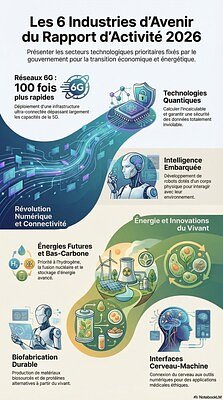
The strategy is built upon six key pillars of innovation, where China is already demonstrating significant progress:
Biomanufacturing: China has rapidly become a dominant force, accounting for over 70 percent of global bio-fermentation product output. The industry, valued at over 1.1 trillion yuan, is no longer just a low-cost producer but a research powerhouse, with a dedicated 15th Five-Year Plan in the works to solidify its leadership.
6G Networks: While the world finalizes 5G adoption, China is deep into the next frontier. It has completed the first phase of 6G technology trials, holds over 40% of global 6G patents, and is actively collaborating with international bodies, including Europe's 6G-IA, with an eye toward a commercial rollout around 2030.
Brain-Machine Interfaces (BMI): Elevated to a core strategic industry, China has launched invasive BMI human trials—only the second country to do so. Researchers have demonstrated mind-controlled wheelchairs, with experts predicting potential public applications within three to five years. The rapid progress is coupled with a new set of national ethical guidelines aimed at managing the profound societal implications.
Embedded Intelligence: The “AI Plus Initiative” aims to integrate artificial intelligence into every facet of the economy. A particular focus is on Embodied AI—giving artificial intelligence a physical form through advanced robotics and smart devices capable of interacting with the real world.
Quantum Technologies: From quantum computing to unbreachable cryptography, this sector is consistently prioritized in policy documents. The goal is to solve problems currently intractable for classical computers, a potential game-changer for science, finance, and national security.
Future Energy: To power this high-tech economy, China is investing heavily in next-generation energy solutions, including hydrogen fuel, advanced energy storage, and the long-term ambition of nuclear fusion.
A European Dilemma: Partnership or Peril?
The official messaging from Beijing emphasizes collaboration, positioning its industrial transformation as an opportunity for Europe to jointly tackle global challenges like climate change and public health. The alignment on green technologies and the need for global standards in AI and 6G are presented as fertile ground for cooperation.
However, for policymakers in Brussels and other European capitals, the invitation is fraught with complexity. It arrives amidst a broader European strategy of “de-risking” from China to reduce critical dependencies. The prospect of deeper collaboration in sensitive, dual-use technologies raises immediate concerns about intellectual property protection, data security, and long-term strategic competition.
“There is a fundamental tension,” a European trade official commented anonymously. “We want to collaborate on climate change, but we are also wary of creating new dependencies or seeing our own industries hollowed out by state-backed competition.”
The memory of China’s rapid dominance in sectors like solar panels and electric vehicles—often accompanied by concerns of overcapacity and unfair subsidies—looms large. While joint R&D in areas like biomanufacturing and green hydrogen holds promise, any partnership will be approached with significant caution and a demand for robust frameworks ensuring a level playing field.
Despite the geopolitical friction, some channels remain open. The ongoing dialogue between Chinese entities and Europe's 6G-IA demonstrates that collaboration is not impossible, but it is likely to be selective and transactional rather than a grand, all-encompassing partnership. As China builds a more resilient and technologically advanced domestic market, the nature of its engagement with the world is set to change, forcing nations everywhere to adapt to a new and formidable competitor that is also, at times, a willing partner.