
- 20% of study resources: Mapping clinical trial data to SDTM/ADaM standards consumes up to 20% of statistical programming resources.
- 8+ hours per domain: Manually mapping a single data domain can take over eight hours.
- July 2026 launch: Data Mapper is scheduled for general production availability.
Experts agree that AI-driven automation like Data Mapper can significantly streamline clinical data standardization, reducing errors and accelerating drug development timelines while augmenting—not replacing—the role of statistical programmers.
Clymb Clinical Unveils AI Platform to Automate Clinical Data Maze
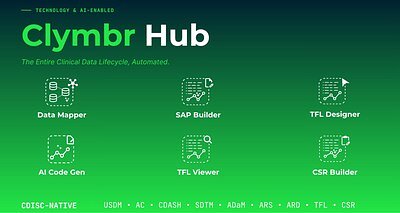
BURLINGTON, Mass. – May 28, 2026 – Clymb Clinical today announced the launch of Data Mapper™, an artificial intelligence-driven platform designed to automate one of the most complex and time-consuming processes in clinical trials. The new tool, part of the company's expanding Clymbr Hub™ ecosystem, aims to streamline the conversion of raw clinical study data into standardized formats required for regulatory submission, potentially shaving months off drug development timelines.
The platform ingests a range of clinical study documents—including protocols, Case Report Forms (CRFs), and Statistical Analysis Plans (SAPs)—to automatically generate mapping specifications for the Study Data Tabulation Model (SDTM) and derivation frameworks for the Analysis Data Model (ADaM). These CDISC standards are critical for ensuring that data submitted to regulatory bodies like the FDA is consistent, interpretable, and ready for review.
Tackling a Critical Bottleneck in Drug Development
For decades, the process of mapping trial data to SDTM and ADaM standards has been a significant bottleneck. It is a meticulous, manual task that falls on the shoulders of highly skilled statistical programmers. Industry analyses show this process can consume upwards of 20% of a study's statistical programming resources, with experts noting that mapping a single data domain can take more than eight hours. This manual effort is not only costly but also fraught with the risk of human error, where simple copy-paste mistakes can lead to data inconsistencies that jeopardize a study's integrity and require extensive rework.
Data comes from an increasingly diverse array of sources—electronic data capture (EDC) systems, labs, and patient wearables—each with its own format. Harmonizing this disparate data into a coherent, standardized structure is a monumental task. Clymb Clinical's Data Mapper confronts this challenge head-on by using AI to interpret study metadata and produce draft specifications in real time. Programmers and other stakeholders can then use the platform's collaborative web-based workspace to review, refine, and finalize the AI-generated mappings.
Once the specifications are approved, the platform's AI-powered code generator produces production-ready programs in either SAS or R, the two most common languages in biostatistics. This dramatically reduces the manual coding burden, improves consistency across studies, and accelerates a crucial step in the journey from data collection to clinical study report.
The AI Revolution Reshaping Clinical Trials
The launch of Data Mapper places Clymb Clinical in a rapidly growing and competitive field where AI is being leveraged to overhaul legacy processes in pharmaceutical research. Companies like Saama, Narrativa, and IQVIA are also deploying AI-driven solutions to tackle data standardization challenges. This industry-wide shift signals a move away from manual data wrangling and toward intelligent, automated systems that promise to enhance efficiency and data quality.
What distinguishes Clymb's approach is its integration into the Clymbr Hub™, an ecosystem designed to provide end-to-end automation for biostatistics workflows. Data Mapper is built on the same metadata-driven foundation as the company's flagship TFL Designer™ platform, which automates the creation of tables, figures, and listings. This shared architecture promotes the reuse of standards and ensures scalability across a company's entire portfolio of studies.
"Our customers have been asking for SDTM and ADaM automation for over a year, so we're excited to bring Data Mapper into production," said Colin Izzo, Co-Founder of Clymb Clinical, in the company's announcement. "Since launching the Clymbr Hub, we've seen strong interest from both existing and prospective customers - Data Mapper will be a game-changer."
The platform's technical underpinnings likely involve a combination of Natural Language Processing (NLP) to parse unstructured documents and Generative AI to create the executable SAS or R code. This human-in-the-loop model—where AI provides the initial draft for human experts to validate—is becoming a best practice for applying AI in regulated environments, balancing speed with the need for rigorous quality control.
Advancing Interoperability with CDISC 360i
Beyond immediate efficiency gains, Data Mapper's architecture represents a strategic alignment with the future of clinical data management. The platform features a direct integration with the CDISC Library API, allowing it to dynamically consume the latest metadata and terminology standards directly from the source. This is a crucial step toward realizing the vision of the CDISC 360i initiative.
CDISC 360i is a forward-looking project aimed at transforming static, document-based data standards into a machine-readable, interoperable, and fully automated data lifecycle. The goal is to create a seamless flow of information from the initial study protocol all the way through to the final analysis, eliminating redundant manual steps and ensuring data traceability. By connecting directly to the CDISC Library, Data Mapper ensures its automated processes are always based on the most current, authoritative standards, which is vital as standards like SDTM and ADaM continue to evolve.
"We believe the future of statistical programming and clinical reporting is metadata-driven, standards-connected, and AI-assisted," stated Bhavin Busa, Co-Founder of Clymb Clinical. "By integrating with CDISC Library and aligning with the principles of the CDISC 360i vision, Data Mapper helps move the industry toward a more automated and interoperable future."
This standards-connected architecture is what enables the platform to not just accelerate a single task, but to contribute to a more cohesive and automated ecosystem, paving the way for more sophisticated uses of AI and machine learning in clinical analysis.
The Evolving Role of the Statistical Programmer
The introduction of powerful AI assistants like Data Mapper inevitably raises questions about the future role of the statistical programmer. However, the consensus within the industry is that these tools are not designed to replace human experts, but to augment their capabilities. By automating the repetitive and error-prone tasks of mapping and code generation, the platform frees up programmers to focus on more complex and valuable work.
Instead of spending weeks manually mapping variables and writing boilerplate code, programmers can now act as strategic reviewers and problem-solvers. Their expertise becomes critical in validating the AI's output, handling complex or novel data scenarios that automation cannot, and dedicating more time to the nuanced aspects of statistical analysis and interpretation. This shift elevates the role from a technical coder to a data scientist and strategist, whose deep understanding of both the clinical context and the data standards is more valuable than ever.
The platform's collaborative nature supports this new paradigm, creating a central hub where programmers, data managers, and biostatisticians can work together to ensure the data is structured correctly for analysis. This human-AI partnership promises to not only make the process faster but also more robust, leveraging the strengths of both machine-scale automation and human critical thinking.
Data Mapper is currently being used by early adopters and is scheduled for general production availability in July 2026. As it rolls out, the industry will be watching closely to see how this new wave of AI-driven automation reshapes the landscape of clinical development.