
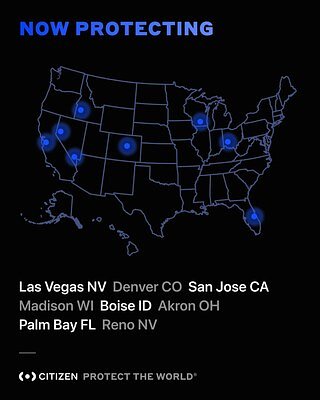
- 15 new metropolitan areas: Citizen app expands to major hubs like Denver, Las Vegas, and San Jose.
- $19.99/month: Premium tier offers 24/7 access to safety agents.
- 2021 incident: CEO offered $30,000 bounty for wrongly identified arsonist.
Experts caution that while Citizen provides real-time safety alerts, its expansion raises concerns about privacy risks, potential for racial profiling, and the reliability of unverified information.
Citizen App Expands: A New Era of Safety or a Gateway to Surveillance?
DENVER, CO – March 18, 2026 – The real-time safety alert application Citizen has arrived in 15 new metropolitan areas across the United States, bringing its blend of crowdsourced incident reporting and 911-monitoring technology to millions of new potential users. The expansion, announced today, includes major hubs like Denver, Las Vegas, and San Jose, marking a significant step in the company's quest for a nationwide footprint.
Citizen's premise is simple and powerful: to provide immediate, hyperlocal alerts for everything from active fires and traffic collisions to crimes in progress, often faster than traditional news or official municipal channels. By monitoring public emergency radio and allowing users to livestream video from incident scenes, the app aims to create an unparalleled level of on-the-ground situational awareness.
“This expansion is another step forward in our mission to Protect the World,” said Mara Aguinis, Citizen’s Head of Marketing, in a press release. “Millions of people now have the tools to stay informed and ahead of what's happening around them, not just react to it.” For residents in new markets like Boise, Idaho, and Savannah, Georgia, this means instant access to a map dotted with real-time incident icons, promising a new layer of transparency into the safety of their communities.
The Shadow of 'Vigilante'
Despite its polished mission statement, Citizen operates under a shadow cast by its own history. The app first launched in 2016 under the name “Vigilante,” with marketing that appeared to encourage users to directly intervene in crimes. It was pulled from Apple’s App Store within 48 hours amid widespread criticism that it promoted vigilantism. Though it rebranded and relaunched in 2017 with a focus on awareness rather than intervention, the core concerns have persisted.
Critics, including privacy advocates and technology ethicists, argue the platform can function as a “digital superhighway for racial profiling.” By empowering users to report “suspicious” activity, the app risks amplifying biases and turning mundane situations into perceived threats. This risk was starkly illustrated in May 2021 when Citizen's own CEO, Andrew Frame, broadcast a live offer of a $30,000 bounty for a man the app had wrongly identified as an arsonist in a Los Angeles wildfire, sparking a public manhunt for an innocent individual.
Furthermore, the speed of its alerts—its key selling point—has often come at the cost of accuracy. Former employees have reported a high-pressure environment where moderators are pushed to generate engaging, often sensationalized, alerts. More recently, a shift toward AI-generated alerts without human review has led to glaring errors, such as mistranslating police scanner traffic for a car accident into a “murder vehicle accident,” fueling panic rather than providing clarity.
A Double-Edged Sword for Privacy
For the app to function, users must grant it significant access to their personal data. Citizen requires continuous location tracking, even when the app isn't open, as well as access to the device’s camera and microphone for its livestreaming features. While the company’s privacy policy states it “has never sold data,” it also allows for the sharing of user information, including precise location data, with third-party service providers and affiliated companies.
This extensive data collection has led to tangible privacy breaches. In 2021, the company’s COVID-19 contact tracing feature, “SafePass,” was found to have exposed users’ self-reported health statuses, despite promises of encryption and privacy. For residents in the 15 new markets, downloading Citizen is an implicit agreement to a significant privacy trade-off, where personal data becomes the currency for situational awareness. The app’s terms grant it a broad, perpetual license to use and distribute any content users upload, meaning a livestreamed video from a fire could become company property used for any purpose.
The Business of Staying Safe
Citizen's aggressive expansion is fueled by a robust business strategy and significant venture capital. Backed by prominent firms like Sequoia Capital and Founders Fund, the company has raised hundreds of millions of dollars to scale its operations. The core product is free, a classic Silicon Valley tactic to quickly build a massive user base and create a network effect—the more users, the more potential on-the-scene reporters, and the more valuable the app becomes.
Monetization comes from a freemium model. While basic alerts are free, users are consistently prompted to upgrade. Citizen Plus, at $5.99 a month, offers access to live police and fire scanner audio clips and detailed incident archives. The premium tier, Citizen Protect, costs $19.99 per month and provides 24/7 access to a team of “safety agents” who can be contacted via video, text, or voice for assistance in emergencies. This model raises ethical questions about creating a two-tiered system of safety, where those who can afford to pay receive a higher level of protection.
This strategy places Citizen in a competitive landscape with family-focused apps like Life360 and neighborhood social networks like Nextdoor, but it differentiates itself with its real-time, incident-based focus. The push for profitability is clear, as the company seeks to turn its millions of users into a sustainable revenue stream.
Reshaping the Urban Safety Landscape
As Citizen rolls into cities like Madison, Wisconsin, and Akron, Ohio, it enters complex ecosystems that already have established public safety infrastructures. Police departments, fire services, and official emergency management agencies have their own protocols and alert systems, such as Everbridge and Wireless Emergency Alerts (WEA), which are built on rigorous verification.
Citizen’s arrival presents a potential disruption. On one hand, it can complement official channels by providing early, crowdsourced intelligence. On the other, its unverified or inaccurate alerts risk sowing public confusion, instilling a disproportionate sense of fear, and potentially straining 911 dispatch centers with calls based on incomplete app-based information.
The app is fundamentally changing the public’s expectation for real-time information, conditioning users to demand instant knowledge of any incident in their vicinity. For local governments and first responders in these new markets, the challenge will be to adapt to a landscape where official, authoritative communication must now compete for attention with the immediate, and sometimes chaotic, flow of information from a private, for-profit platform.